

Did you know that the benchmark interest rate (Selic) in Brazil reached 45% per year during the Real Plan? This shows why the fixed income It's a great investment.
It offers financial security and predictability.
In this article, we'll discuss the reasons for invest in fixed-income securities. Let's take a look starting with low-risk investments until government bonds of Treasury Direct.
This could be very beneficial for you.
What Is Fixed Income and How Does It Work?
Fixed-income investments are when you lend money to the government, banks, or companies. You get your money back with interest. This happens after the security matures.
Basic Concepts of Fixed Income
The main issuers are the government, banks, and companies. Each offers securities with different characteristics. These characteristics include maturities, rates, and specific terms.
How Fixed-Income Securities Work
Investing in fixed-income securities means lending money for a period of time. In return, you receive interest. This interest can be fixed, variable, or a combination of the two.
The Role of Issuers in the Market
Issuers use the proceeds from securities to finance their activities. In this way, you help the country grow economically and socially.
For example Daycoval Bank has CDBs with a 110% CDI rate and daily liquidity. They also offer securities with a 13% annual rate and a 3-year maturity.
The Treasury Direct The government issues bonds with fixed, variable, or inflation-indexed interest rates.
So, fixed-income investments are a way to invest with a predictable return. They help the country grow and develop.
Why Invest in Fixed Income
Investing in fixed-income securities offers predictability of return e safe investments. This makes it a good choice for many investors.
You know exactly what you'll earn and when, which helps a lot with financial planning.
A big advantage is the wide range of options that exist. This allows everyone, regardless of their risk tolerance, to find what they're looking for.
In addition, it is very accessible. So even those who are just starting out or prefer a more conservative approach can invest.
Anyone looking for security e capital protection She usually chooses fixed-income investments. They are more stable than the variable income.
This makes it ideal in times of economic uncertainty, when everyone wants safe investments.
| Advantages of Fixed Income | Details |
|---|---|
| Predictability of Returns | Investment terms, such as the term and rate of return, are known in advance |
| Safe Investments | Options with lower risk and volatility, which are especially important in times of uncertainty |
| A Variety of Options | A variety of investment options are available, tailored to different investor profiles |
| Accessibility | Beginner and conservative investors can easily access this type of investment |
Therefore, fixed-income investments are a great choice for anyone who wants to predictability of return e safe investments. It also offers many options and is easy to access in the financial market.
Key Features of Fixed Income Investments
Fixed-income investments are known for being predictable, safe, and offering a steady return. These characteristics make them a good choice for anyone who wants to low risk and stability.
Predictability and Security
With fixed-income investments, you know how much you'll earn and when. This is a big help when it comes to planning your finances.
In addition, many products offer the FGC guarantee, which further protects your investment.
Capital Protection
A major advantage of fixed-income investments is that they protect your money. They guarantee that you’ll receive at least what you invested, even when the market fluctuates.
Consistent Returns
The return on fixed-income investments comes from interest rates or indices. The higher the rate, the higher the return. And the longer you invest, the more you’ll earn—especially with compound interest.
“Fixed-income investments are ideal for investors seeking security, predictability, and consistent returns on their investments.”
Types of Returns on Fixed-Income Securities
There are several types of returns on fixed-income investments. Each has its own characteristics and advantages. The main ones are fixed-rate, floating-rate, and hybrid.
Investments fixed in advance They have fixed interest rates from the start. You know the return on your investment, even if market conditions change. This can be a good thing when interest rates are high.
Investments post-fixed They are based on indices such as the Selic or the CDI. The final return is not known until the investment is redeemed. This makes the investment somewhat uncertain.
The Titles Hybrids They combine features of both types. For example, they may offer a fixed rate plus the change in inflation (IPCA).
This could be a good compromise between predictability and protection against inflation.
There are several fixed-income investments that offer these types of returns. For example, the Fixed-Rate Treasury Bond, the Selic Treasury Bond, and the IPCA+ Treasury Bond. There are also CDBs, LCIs e LCAs.
It is essential to understand the differences between these types. That way, you can choose the best investment for yourself.
Ideal Investor Profiles for Fixed Income
Fixed-income investments are ideal for a variety of investors. They may be suitable for those who are more conservative or for those who are more risk-tolerant. It’s important to understand your own investment style in order to choose the right investments.
Conservative Investor
Conservative people want security and predictability. They’d rather earn a little less than lose money.
For them, investing in CDBs e Treasury Direct It's great. They provide stability and protect your money.
Moderate Investor
The moderate investor seeks a middle ground. He or she combines fixed-income and equity investments. Thus, fixed-income investments provide security, while equity investments offer the potential for higher returns.
Aggressive Investor
The bold investor is willing to take on more risk to earn more. Fixed-income investments help diversify the portfolio. This reduces the risk of losing a lot of money.
Fixed-income investments are important for everyone. They help you build a diversified portfolio and generate consistent returns. When choosing investments, you should consider your goals and your risk tolerance.
Key Fixed-Income Products
In Brazil, there are many products made from fixed income for investors. Among the best known are the Treasury Direct, the CDBs, the LCIs, the LCAs and the debentures. Each one has its own characteristics, such as term and return.
O Treasury Direct It's safe and offers a variety of interest rate options. The CDBs have interest rates linked to the CDI, ranging from 100% to 150%.
The LCIs e LCAs are a good option for individual investors. They offer tax-free interest. On the other hand, the debentures They are issued by companies and can offer a good return, but you need to assess the risks.
The fixed income They are also an option. They combine various securities and offer different levels of risk and return, depending on the investor.
| Product | Features | Profitability | Risks |
|---|---|---|---|
| Treasury Direct | Government bonds with different forms of compensation (fixed, fixed-rate and mixed) | Varies, depending on the type of security | Low risk, since they are securities issued by the federal government |
| CDB | Bank Certificates of Deposit, with varying terms and liquidity | From 100% to 150% of the CDI | Credit risk from the issuing financial institution |
| LCI e LCA | Real Estate and Agribusiness Bills of Exchange, Exempt from Income Tax | Varies, depending on the issuing institution | Credit risk from the issuing financial institution |
| Debentures | Debt securities issued by private companies | Potential returns above the CDI | Credit risk from the issuing company requires careful analysis |
Choose a product from fixed income requires considering profitability, risk, and liquidity. It is essential to align these aspects with your goals and investor profile.

Taxation and Costs in Fixed-Income Securities
Investing in fixed-income securities requires an understanding of taxation and costs. The Income Tax (IR) It varies depending on the investment term.
This is due to a regressive scale.
For those who invest on their own, the income tax rates are:
- 22.51 TP3T for investments of up to 180 days
- 20% for investments ranging from 181 to 360 days
- 17.51 TP3T for investments ranging from 361 to 720 days
- 15% for investments with a term of more than 720 days
Products such as Real Estate Letters of Credit (LCI) and Agribusiness Letters of Credit (LCA) are exempt from income tax.
Companies under the Simples Nacional They also have a simplified tax system for financial income.
In addition to income tax, there is administrative fees such as the custody fee for Tesouro Direto. The Tax on Financial Operations (IOF) is charged on redemptions made within 30 days.
It is crucial to consider these factors when planning fixed-income investments. This helps maximize net returns, taking taxes and fees into account.
Understanding the Income Tax Rates and tax exemption For certain products, this is essential. It helps optimize investments in fixed-income securities.
Risks and Guarantees in Fixed Income Investments
Fixed-income securities are viewed as a safe investment. However, they are not without risks. The main challenges are the credit risk and market risk.
O credit risk It occurs when the issuer of the security fails to make payment at maturity. This can happen if the company is experiencing financial difficulties.
O market risk refers to changes in interest rates, which can affect the value of the investment.
To reduce these risks, many fixed-income products are protected by the Credit Guarantee Fund (FGC). This guarantee covers up to R$ 250,000 per CPF and financial institution.
This gives investors peace of mind.
| Risk Type | Description | Mitigation Measures |
|---|---|---|
| Credit risk | The possibility that the issuer of the security will not honor the payment when it becomes due | Diversification portfolio, analysis of the issuer's financial health, protection of the FGC |
| Market Risk | Fluctuations in interest rates that may affect the value of the investment | Diversification, monitoring the economic outlook, selecting securities with different benchmarks |
Investing in fixed-income securities requires careful consideration of the risks. It is important to diversify your portfolio and choose products that offer the protection of the FGC.
This way, you can enjoy the benefits of fixed-income investments, such as predictability and security. This gives you peace of mind and protects your assets.
Investing in fixed-income securities requires careful risk assessment. However, it can be an excellent option for those seeking security and predictable returns.
Differences Between Fixed Income and Variable Income
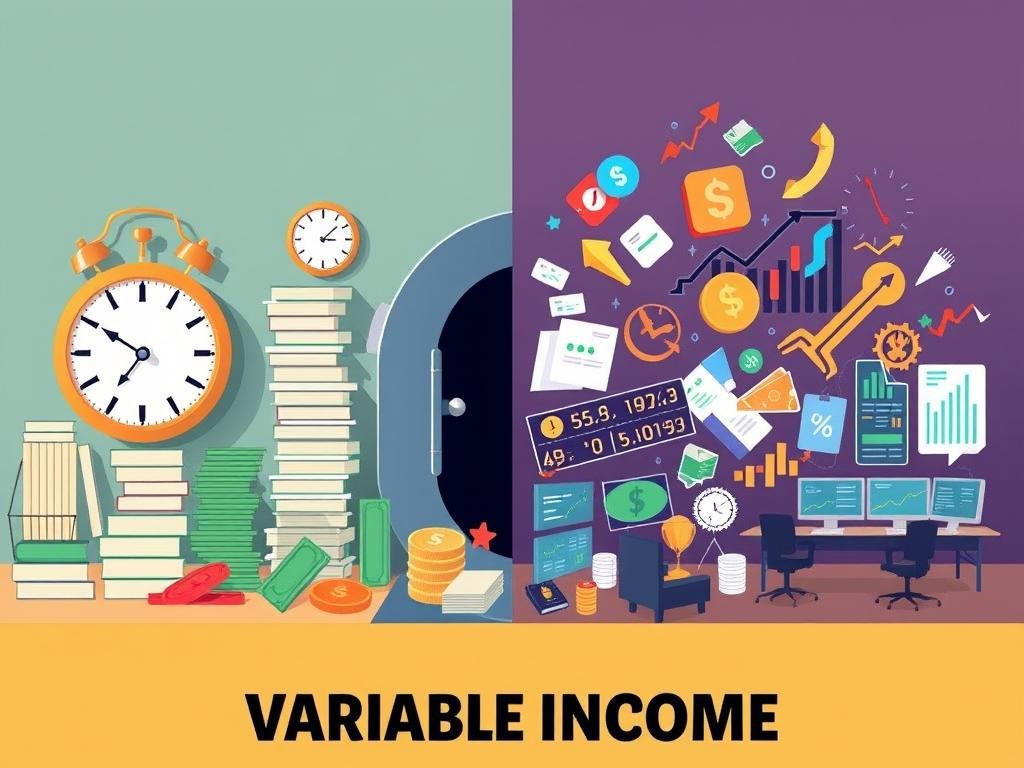
The main difference between fixed-income and variable-income investments is the predictability of the return. With fixed-income investments, we know in advance how much we will earn.
As for variable income, as in actions e multi-market funds, returns fluctuate with the market.
Profitability Comparison
Equity investments can yield higher returns in the long term. However, this means greater risk and volatility, especially in the short term.
Volatility and Risk
Fixed-income investments are safer and more predictable. Equities, on the other hand, such as actions e multi-market funds, is more affected by market fluctuations.
Fixed-income investments offer a higher level of security compared to variable-income investments. They are less susceptible to major market fluctuations.
The choice between fixed-income and variable-income investments depends on the investor's risk profile. Those who prefer security opt for fixed-income investments. Those seeking higher returns opt for variable-income investments.
How to Start Investing in Fixed Income
If you want to diversify your financial planning and search safe investments, fixed-income investments are a great choice. To get started, it's crucial to follow a few important steps.
First, think about your financial goals. Ask yourself about time frames, whether you need money quickly, and how much risk you can tolerate.
This information will help you choose the best fixed-income investments.
Then, discover your investor profile. Are you conservative, moderate, or aggressive? Knowing this is essential to choosing the right products for you.
Now that you've defined your goals and profile, it's time to explore your options. Start with simple, safe investments, such as Tesouro Direto or CDBs. First, familiarize yourself with the market.
Then, you might want to consider diversify your portfolio with other securities, such as LCI e LCA.
Don't put all your money in one place. The diversification It helps manage risks and take advantage of opportunities.
There are many free courses and resources available for learning about fixed-income securities. The B3 Course Platform, for example, offers options for all skill levels.
With planning, information, and diversification, you're ready to invest in fixed-income securities. This is an excellent way to strengthen your financial goals.
Diversification Strategies with Fixed Income
Investing in fixed-income securities requires diversifying your investment portfolio. This helps to manage risk and increase returns. It's a good idea to mix different types of securities, with varying maturities and issuers.
The “fixed-income ladder” is a popular technique. It involves dividing investments among securities with different maturity dates. This balances the portfolio’s liquidity, return, and risk.
Another strategy is to mix fixed-rate and floating-rate securities. This mix provides protection against different economic scenarios. Thus, your investment portfolio adapts better to changes in the market.
A study by B3 shows that Brazilians want diversify their portfolios to improve returns. Experts suggest that 70% of the portfolio be allocated to fixed income and 30% to variable income.
It's crucial to reassess your portfolio annually. This helps you adjust your asset allocation based on market conditions and asset performance. That way, you maintain balance and risk management appropriate.
“Diversification is the only free strategy against risk.” – Harry Markowitz, economist and university professor.
Conclusion
Fixed-income investments are a good option for many investors. They are ideal for those who are conservative, moderate or bold.
This type of investment offers security e predictability. This really helps with the financial education and long-term planning.
A good understanding of fixed-income investments helps you make better decisions. You can create a investment portfolio that meets your financial goals. This is crucial to achieving your financial dreams.
Whatever your investor profile, fixed income is important. It helps with financial education and long-term planning. Take this opportunity to learn more and build a stronger financial future.
FAQ
Q: What is fixed income, and how does it work?
A: Fixed-income investments are when you lend money to banks, companies, or the government. In return, you receive interest. It’s safe, predictable, and offers a steady return—great for those just starting out.
Q: What are the main advantages of investing in fixed-income securities?
A: Investing in fixed-income securities offers security and predictability. You know the terms of the investment up front. This helps with financial planning.
Q: What are the main types of returns in fixed-income investments?
A: There are three types: fixed in advance, fixed-rate e hybrid. In the fixed in advance, the interest rate is set from the outset. In the fixed-rate, it varies depending on the market. The hybrid Mix the two together.
Q: What type of investor is best suited for fixed-income investments?
A: Fixed-income investments are good for everyone. Conservative investors find security and predictability in them. Moderate investors can mix different time horizons and risk levels. And even the most aggressive investors use them to balance their portfolios.
Q: What are the main fixed-income products available?
A: The main ones are Tesouro Direto, CDBs, LCIs, LCAs, debentures and fixed-income funds. Each has its own term, return, and risk.
Q: What are the main risks associated with fixed-income investments?
A: The risks are credit risk and market risk. But many products offer FGC protection. This covers up to R$ 250,000 per CPF and financial institution.
Q: What is the difference between fixed-income and variable-income investments?
A: Fixed income is predictable, while variable income (such as actions) It isn't. Fixed-rate investments are safer, but offer lower returns. Variable-rate investments carry more risk, but can yield higher returns.
Q: How can I start investing in fixed-income securities?
A: First, set your financial goals and understand your risk profile. Research your options. Start with simple products, such as Tesouro Direto or CDBs. Diversification helps balance liquidity, returns, and risk.
Source links
- Financial Education: Tips to Improve Your Finances
- Fixed Income: everything you need to know to start investing
- What is fixed income? Check out the investments and understand the risks
- Best Fixed-Income Investments: How to Identify and Invest
- Fixed Income in 2025: the best investments and what to expect from the market