

Savings accounts, long viewed as a safe haven for Brazilians, have proven to be an increasingly less attractive option. If you’re looking to maximize your returns and protect your wealth from inflation, it’s time to seriously consider stopping investing in savings accounts. This comprehensive guide will reveal why and how you can really make your money work for you by exploring alternatives that offer higher returns and security.
The Reality of Savings Account Returns: Why Don't They Pay as Much as They Used to?
As you read this, inflation is eroding your purchasing power—and your savings may be accelerating that process.
A savings It is the most popular investment in Brazil. It is also, in many cases, one of the least efficient options for those looking to preserve their wealth.
How Savings Account Interest Works in 2026
O savings yield It follows a simple rule that is rarely understood.
When the Selic rate If it's above 8.5% per year, the savings account earns 0.5% per month plus the TR (Reference Rate). With the Selic rate currently at 13.75% per year, this cap of 0.5% per month is equivalent to about 6.17% per year—plus the TR, which has historically been close to zero.
In practice, this means that savings accounts will earn approximately 6.2% per year in 2026. The Selic rate, on the other hand, stands at 13.75%. The difference is staggering.
⚠️ Common mistake: Many believe that the income tax exemption on savings accounts makes them a better deal. But a CDB yielding 100% above the CDI (≈13.65% per year) still yields more than twice as much as a savings account—even after deducting 15% in income tax over the long term.
The Impact of Inflation on the Real Return on Savings
O real income That is what remains after adjusting for inflation. With the IPCA projected to be around 5.5% for 2026, the real return on savings is only about 0.7% per year.
That's not growth. It's practically stagnation.
Technically, your money increases on your statement. But it buys you less with each passing month.
The Liquidity Trap on the Investment's Anniversary
Savings have daily liquidity — You can withdraw money at any time. But there’s one detail that banks rarely mention.
Interest is credited only on the investment's anniversary date. If you withdraw your funds one day earlier, you'll lose all the interest for that period.
This creates illusory liquidity: technically free, but financially disadvantageous.
Once you understand why savings accounts offer such low returns, the next step is to calculate how much this shortfall is costing your net worth over time.
The Hidden Cost of Keeping Money in a Savings Account: ‘Cash Drag’ and Inflation
The problem isn't just how much savings earn. It's what they fail to earn—and this invisible cost has a technical name.
Cash Drag It is the opportunity cost of holding capital in low-yielding assets when better alternatives are available. To put it simply: it’s the money you lose by not having switched sooner.
How Much Does Cash Drag Cost in Practice in 2026?
We simulated a real-life scenario to bring this concept to life.
📊 Quick Simulation: > – R$ 10,000 in a savings account for 12 months in 2026 → approximate return of R$ 620 (6.2% p.a.) > – R$ 10,000 in a 100% CDI CDB for 12 months → gross return of R$ 1,365, net after 17.5% income tax = R$ 1,126 > – Real difference: R$ 506 more in the CDB — with no additional risk.
That's the cost of cash drag in just one year, with only R$ 10,000.
The Opportunity Cost That No One Shows on the Statement
Opportunity Cost — or opportunity cost — is the return you give up when you choose one option over another.
Savings accounts are exempt from income tax. That’s true. But the exemption isn’t worth it when the gross return is already less than half of what taxable alternatives offer.
What nobody tells you is that paying 15% in income tax on income of 13,65% still leaves you with more money in your pocket than paying nothing on 6,2%.
Why Inflation Makes the Problem Even More Urgent
With the IPCA projected at 5.5% for 2026, any investment that yields less than that is eroding purchasing power.
Savings accounts, with a real return of ~0.7% per year, barely offset inflation. Keeping large amounts in them for years can result in a silent, cumulative loss of real wealth.
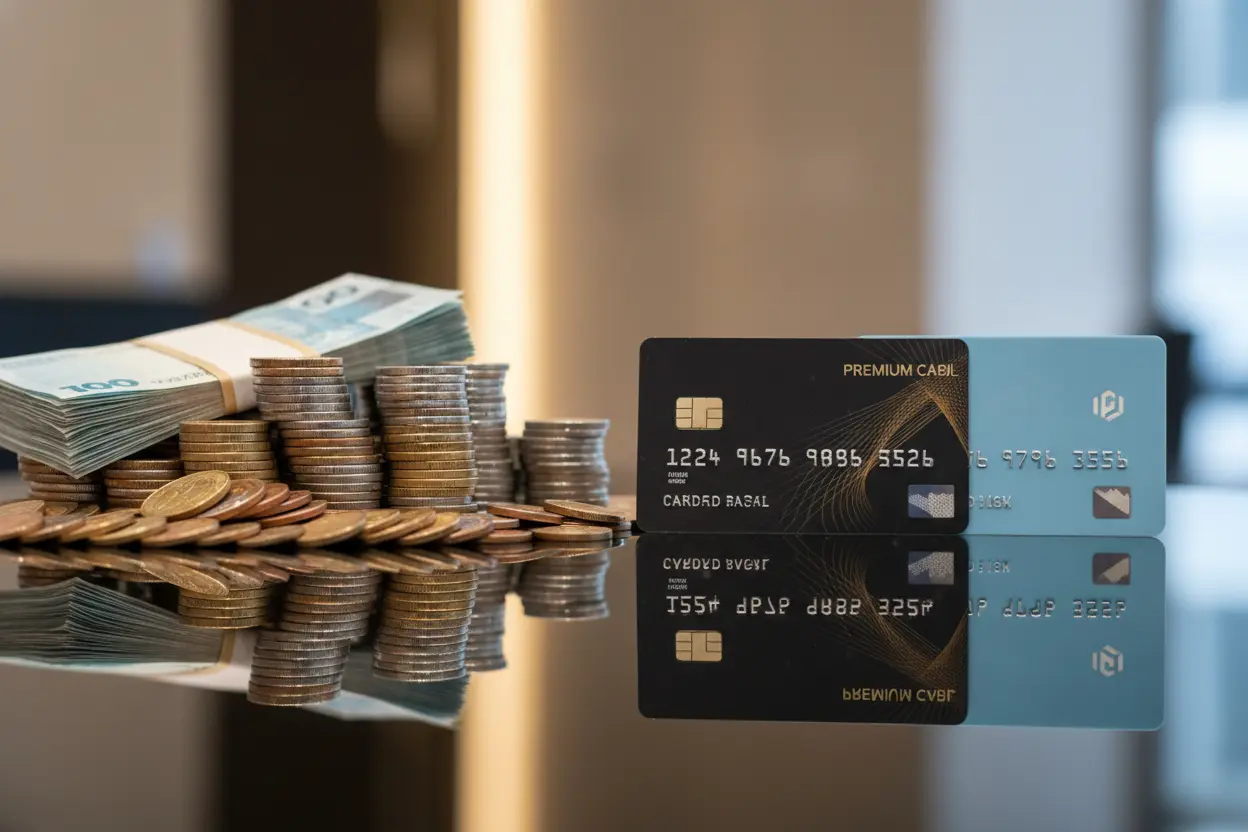
A stack of cash, coins, credit cards, and debit cards.
Now that we know the cost of a savings account, it's time to see what the alternatives actually offer—with numbers, not promises.
Savings vs. Other Investments: A Comparison of Returns
To compare investments, you need to look at the net return—what you’re left with after taxes and fees. See how savings accounts stack up against the main alternatives for fixed income available today.
Comparison Table: Savings Accounts vs. CDB, LCI, LCA, and Tesouro Direto in 2026
| Investment | Gross Profitability | IR | Estimated Net Income. | Security |
|---|---|---|---|---|
| Savings | ~6.21 TP3T per annum. | Exempt | ~6.21 TP3T per annum. | FGC up to R$ 250,000 |
| CDB 100% CDI | ~13,651 TP3T per annum. | 15% (more than 720 days) | ~11.61 TP3T per annum. | FGC up to R$ 250,000 |
| LCI/LCA | ~10% per year. | Exempt | ~10% per year. | FGC up to R$ 250,000 |
| 2029 Selic Treasury Bond | ~13,651 TP3T per annum. | 15% (more than 720 days) | ~11.61 TP3T per annum. | National Treasury |
| IPCA+ Treasury Bond 2035 | IPCA + ~7.51% (3-month average, annualized). | 15% (long-term) | Real protection + profit | National Treasury |
Estimates based on rates in effect in May 2026. Past performance is not a guarantee of future results.
Why CDBs Are Better Than Savings Accounts, Even With Income Tax
O CDB (Bank Certificate of Deposit) is taxed according to the regressive income tax schedule. But even when paying 17.5% in income tax on investments with terms of 361 to 720 days, the net return still easily exceeds that of a savings account.
Digital banks such as Nubank, Inter e C6 Bank They offer CDBs with daily liquidity at 100% of the CDI. No management fee. No red tape.
The Stability of the National Treasury as an Alternative to Savings
O Treasury Direct is guaranteed by the federal government—the issuer with the lowest credit risk in the country. The 2029 Selic Treasury Bond It offers daily liquidity and yields a return close to the Selic rate, making it ideal for an emergency fund.
The IPCA+ Treasury It protects purchasing power and even delivers a real return that exceeds inflation. For those thinking 5, 10, or 20 years down the road, it is one of the most powerful tools available.
Best choice: For those who want to withdraw funds from their savings accounts safely and with liquidity, the Tesouro Selic 2029 or a CDB with daily liquidity at 100% of the CDI are the most recommended options.
Comparing options is the first step. The second is knowing exactly which products to choose based on your profile and goals.
Fixed-Income Alternatives That Outperform Savings Accounts Today
There are alternatives to savings for all investor profiles—from conservative to moderate. The Brazilian fixed-income market has never offered so many affordable options with good liquidity and superior returns.
CDBs from Digital Banks with Yields Above 100% of the CDI
Digital banks such as Nubank, PicPay e Mercado Pago They often offer CDBs at 100% or even 110% above the CDI to attract new customers.
- Nubank CDB: 100% CDI, daily liquidity, no minimum amount
- CDB Inter: 100% CDI, daily liquidity, integrated account
- BTG Pactual CDB: up to 110% CDI for longer-term maturities, via its own platform
💡 Smart Strategy: Use a CDB with daily liquidity as a direct substitute for a savings account for your emergency fund. You retain immediate access to your money and still earn nearly twice as much.
Tesouro Direto: Selic for Short-Term Investments, IPCA+ for Long-Term Investments
O 2029 Selic Treasury Bond It is the best choice for those seeking maximum security and liquidity. It yields a rate close to the Selic rate (13.75% per year) and can be redeemed at any time without significant loss.
O IPCA+ Treasury Bond 2035 It is ideal for long-term goals—retirement, buying a home, financial independence. It guarantees a real return that outpaces inflation, regardless of the future economic outlook.
LCIs and LCAs: Income Tax Exemption with Higher Returns Than Savings Accounts
LCI (Real Estate Credit Bill) e LCA (Agribusiness Letter of Credit) They are exempt from personal income tax—just like savings accounts. But they yield significantly higher returns.
Brokerage firms such as XP Investments, Rico e BTG Pactual They offer LCIs and LCAs starting at R$ 1,000, with yields ranging from 90% to 100% of the CDI, tax-free.
In practice, this translates to a net return of approximately 10% per year—compared to 6.2% from a savings account.
Understanding the products is essential. But knowing how to take the first step is what sets apart those who read about finance from those who actually build wealth.
How to Move Beyond Savings and Start Investing Wisely: A Step-by-Step Guide
The shift from savings to profitable investments It's simpler than it seems. We've broken the process down into clear steps so you can get started today.
Step-by-Step: 6 Steps to Migrate Your Savings Account in 2026
1. Define your goals and risk profile
Are you looking for immediate liquidity? Protection against inflation? Long-term growth? There’s an ideal product for every goal.
2. Research and choose a brokerage firm or digital bank
Nubank, Inter, XP, and BTG Pactual offer free platforms with access to CDBs, Tesouro Direto, and LCI/LCA without custody fees.
3. Open your account and make the transfer
The process is 100% digital. It takes less than 10 minutes. You can transfer funds via TED or PIX directly from your checking account.
4. Choose investments that suit your profile
- Emergency Reserve → CDB Daily Liquidity or Tesouro Selic 2029
- Medium term (2 to 5 years) → LCI, LCA, or fixed-rate CDB
- Long term (more than 5 years) → Treasury IPCA+ 2035
5. Track your investments monthly
Track your real return (after adjusting for inflation) and rebalance your portfolio as your goals change.
6. Keep a separate emergency fund
Before making any long-term investment, make sure you have 3 to 6 months' worth of expenses set aside in an asset that can be liquidated daily.
📊 Quick Simulation: Anyone who transferred R$ 20,000 from a savings account to a CDB 100% CDI in January 2026 may have accumulated approximately R$ 2,320 more by December — compared to R$ 1,240 in the savings account. A difference of R$ 1,080 in a single year, with no additional risk covered by the FGC.
The Most Common Mistake When Transferring Savings
Most people transfer money but don't specify a clear destination. As a result, the money sits in their checking account for weeks, earning no interest.
Choose the product you want before making the transfer. This prevents the "cash drag" we discussed earlier.
Moving your money is a smart decision. But before you transfer any funds, it’s natural to wonder: Will that money be safe outside of a savings account?
Protecting Your Money: Security and Liquidity in New Investment Opportunities
Savings accounts have fostered the popular belief that they are the only truly safe and liquid investment. This perception is outdated—and it may be costing people dearly.
FGC: The 250,000 R$ Protection That Covers CDBs, LCIs, and LCAs
O FGC (Credit Guarantee Fund) protects investments of up to R$ 250,000 per CPF per financial institution—with an overall limit of R$ 1 million per CPF every 4 years.
This means that a CDB at Nubank, an LCI at Inter, and an LCA at BTG Pactual are just as safe as a savings account—each one is individually covered by the FGC.
- CDB → covered by the FGC ✓
- LCI → covered by the FGC ✓
- LCA → covered by the FGC ✓
- Savings → covered by the FGC ✓
The difference lies in performance, not safety.
Daily Liquidity: Savings Accounts Aren't the Only Option
Personally, I believe this is the biggest myth that keeps people tied to savings accounts: the idea that only savings accounts offer immediate access to money.
O 2029 Selic Treasury Bond They offer daily liquidity with redemption on D+1. Daily-liquidity CDBs at Nubank and Inter allow for same-day redemption. LCIs and LCAs have a minimum lock-in period—usually 90 days—but after that period, they also offer liquidity.
💡 Smart Strategy: Divide your savings into two portions. The first, equivalent to one month's expenses, should be invested in CDBs with daily liquidity. The second, equivalent to 2 to 5 months' expenses, should be invested in the 2029 Selic Treasury Bond. This way, you maintain quick access to your money while maximizing the return on your entire savings.
National Treasury Security: The Lowest Risk in the Country
O Treasury Direct It is guaranteed directly by the Brazilian federal government. It does not depend on the FGC, has no coverage limit, and is not subject to the credit risk of any private institution.
For amounts above R$ 250,000, Tesouro Direto is, technically, the lowest-risk investment available in Brazil. This includes any type of savings account.
This content is for information purposes only and does not constitute financial advice. Please consult a 2026 expert before investing.
Warning: The images used in this article are merely illustrative and may not accurately represent the content described.
Don't let your money sit idle in a savings account, losing value to inflation. Fixed-income alternatives offer security, liquidity, and—most importantly—superior returns. Take the first step toward a more prosperous financial life: explore new investments and watch your wealth truly grow. Start building your financial future today!