What is GDP?: Have you ever heard of GDP? But do you know what it really means? The GDP, or Gross Domestic Product, measures the economic activity of a country, state, or city. It is very important for understanding Brazil's economy.
Let's find out what the GDP it actually measures. And why it is so crucial to the health of the Brazilian economy.
Definition of GDP
O Gross Domestic Product (GDP) It is the sum of a country's final goods and services. This includes everything produced in a year. Countries calculate GDP in their own currencies.
It does not reflect a country's total wealth, but rather what has been produced recently. If there is no production, GDP is zero.
Composition of GDP
Various data points are used to calculate GDP. The IBGE and other organizations, such as the Central Bank, provide assistance. They take into account goods, services, investments, and government spending.
| Year | Brazil's GDP | GDP per capita |
|---|---|---|
| 2016 | R$ 6.266 trillion | R$ 30,407 |
| 2015 | - | - |
| 2017 | - | - |
In 2016, the Brazil's GDP It fell by 3.6%. This was the second consecutive year of decline. GDP stood at R$ 6.266 trillion, and per capita GDP was R$ 30,407.
In 2017, Brazil's GDP grew by 1.0%. This came as a relief after two years of contraction.
“The output of domestic and international companies is taken into account in the calculation of the Gross Domestic Product (GDP).”
There are three ways to calculate GDP: demand, supply, and income. GDP does not reflect a country's total wealth, but rather what has been produced recently.
Economic growth does not always reflect a country's development.
If we didn't measure GDP, we would lose an important benchmark. That would make it harder to make economic decisions.
Calculating GDP
O GDP calculation It is a complex process. It involves statistical data on companies, individuals, and investments. In Brazil, the IBGE has been performing this calculation since 1990.
Methods for Calculating GDP
There are three main methods for calculating the Gross Domestic Product (GDP):
- Based on the wealth produced: In this method, GDP is calculated by adding together the gross value added of industry, services, and agriculture.
- According to the request: In this case, GDP is calculated based on household and government consumption, investment, and net exports.
- By income: In this method, GDP is calculated by adding together wages, interest, profits, and rent.
Regardless of the method, the result of the GDP It's always the same.
Composition of GDP
O GDP It is calculated using the formula: GDP = CF + IP + GG + BC. Here:
- CF stands for Household Consumption
- IP is the Private Investment
- GG corresponds to the Government Spending
- BC is the result of the Trade Balance (exports minus imports)
This composition shows that the GDP It takes into account the amount spent throughout the entire production chain. It is one of the key indicators of the Brazilian economy.
Although the GDP While it is important, it has its limitations. It does not take into account income distribution or social impacts. Therefore, it is essential to analyze other indicators to better understand a country’s economic and social development.
Nominal GDP vs. Real GDP
It is crucial to understand the difference between nominal GDP and real GDP to analyze a country's economy. The Nominal GDP uses the current product prices. As for the Real GDP It considers prices without inflation, showing real growth.
In 2022, the Nominal GDP in Brazil was R$ 9.9 trillion. But the Real GDP was R$ 2.5565 billion. This difference reflects the economy's true growth, excluding the effects of inflation.
Economists use the Real GDP to assess long-term economic growth. This helps us understand growth trends without the effects of prices. Knowing the difference between Nominal GDP e Real GDP It is essential for developing effective economic policies.
O GDP per capita It divides GDP by the number of inhabitants. But it does not reflect quality of life or the Human Development Index (HDI).
In conclusion, understanding the difference between Nominal GDP e Real GDP It is essential for a comprehensive and accurate economic analysis.
What is GDP?
O GDP, or Gross Domestic Product, measures the value of goods and services produced in a year. It is crucial for understanding the economy. It helps us see how the economy is doing.
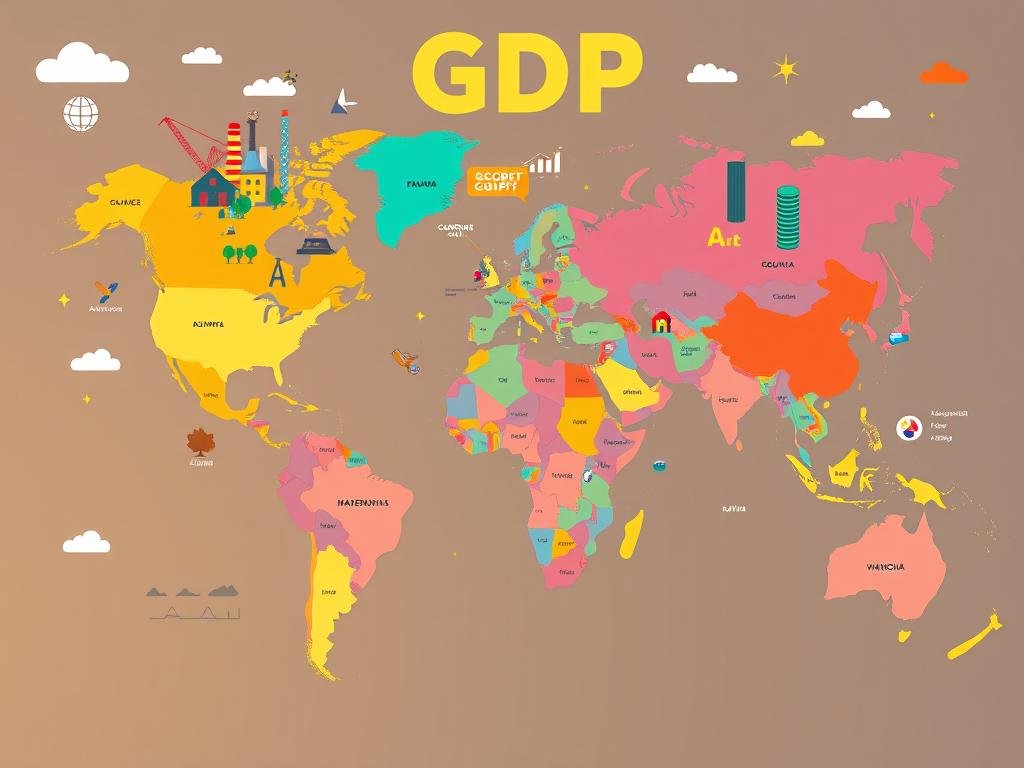
O Global GDP is from US$$71.67 trillion. The United States ranks first with US$$15.6 trillion. Brazil is in the seventh place with US$$2.19 trillion.
This indicator helps compare economic growth. It also shows which sectors generate more or less income.
O GDP takes into account the production of final goods and services. This prevents intermediate items from being counted twice. The GDP per capita It shows how wealth is distributed. But it does not consider whether that wealth is distributed fairly.
In conclusion, the GDP It is very important. It helps us understand the economy and social development. It is essential for developing public policies and attracting investment.
Importance of GDP
O Gross Domestic Product (GDP) helps us understand how a country's economy is performing. It shows the economy's growth over time. It also allows us to compare different regions and countries.
A high GDP is a sign that the country is a good place to invest. This helps create better public policies. And it attracts companies to come and invest.
O Brazil's GDP reached R$ 9.9 trillion in 2022. There was an increase of 2.91 TP3T over four quarters compared to the previous year. This shows that GDP is an important indicator for the country's economy.
After the pandemic, Brazil saw an increase of 2,9%. This shows the importance of GDP for the economy.
GDP also helps compare countries and develop better public policies. Companies and investors look at GDP to decide where to invest.
A importance of GDP It goes beyond measuring wealth. It helps us understand the economy. And it supports the development of public policies. In addition, it attracts investment to the country.
Brazil's GDP
O Brazil's GDP has grown significantly in recent years. This shows that the country's economy is improving. According to the IBGE, the Brazil's GDP rose by 1,.4% in the second quarter. This shows that the economy is picking up speed, particularly in the services and manufacturing sectors.
O Brazil's GDP R$ reached 2.9 trillion in the second quarter of 2024. This represents a 3.3% increase compared to the same period last year. This improvement has bolstered confidence in economic growth for 2024, which is now projected at 3.30%.
| Indicator | Result |
|---|---|
| GDP in the second quarter of 2024 | R$ 2.9 trillion |
| GDP Growth in the second quarter of 2024 (marginally) | 1,4% |
| GDP Growth in the second quarter of 2024 (compared to 2023) | 3,3% |
| Expected GDP growth for 2024 | 3,30% |
These figures show that Brazil's GDP is improving. This strengthens the country's economy. The improvement in Brazilian GDP Data It helps boost investor confidence. This paves the way for further growth in Brazil.
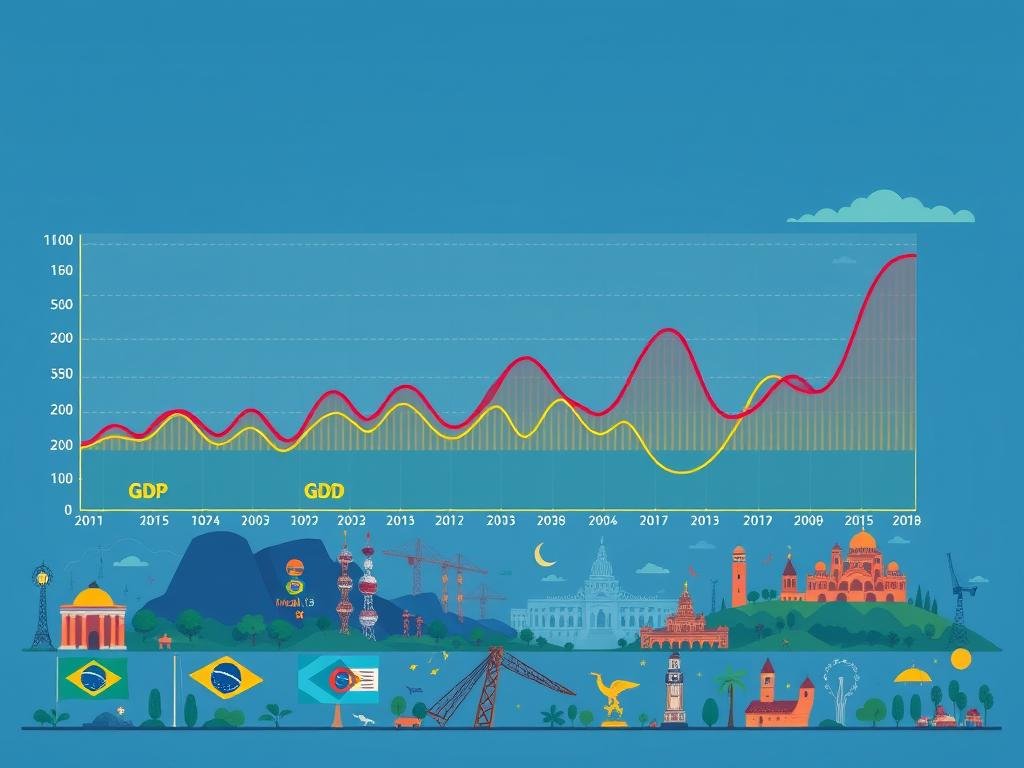
“The growth of the Brazil's GDP ”In the second quarter of 2024, the results exceeded expectations, reinforcing the economic recovery following the period of slowdown."
GDP Growth
O GDP grows when the economy improves. This leads to more jobs, businesses, and investments. The GDP growth It helps control inflation because there are more goods and services.
O Brazil's GDP It grew by 1.4% in the second quarter. That is more than in the first quarter. Compared to 2023, growth was 3.3%. The manufacturing and service sectors also grew.
However GDP doesn't tell the whole story about quality of life. Some countries with Moderate GDP growth have a better quality of life. That's because the GDP shows the economy, but not income distribution.
"O GDP growth ”It is linked to economic growth, job creation, an increase in the number of businesses, and potential investments."
In short, the GDP growth It's an important sign. But that's not all. We also need to look at income distribution and quality of life.
GDP Economic Indicator
O GDP (Gross Domestic Product) It helps show how the economy of a country, state, or city is performing. It is used by governments, businesses, and analysts. They want to know how the economy is performing, compare it with other countries, develop public policies, and attract investment.
O GDP as an economic indicator It does not directly reflect quality of life or income distribution. But it is very important for understanding the health of the economy. With the GDP analysis, we can see which sectors are growing the most, as well as the challenges and opportunities for growth.
A GDP function It shows the state of a region's economy. This helps governments, businesses, and investors make decisions based on actual data. GDP is calculated by adding up all the goods and services produced in a year.
| Indicator | Description |
|---|---|
| IPCA (National Broad Consumer Price Index) | The country's official inflation measure, indicating changes in the prices of goods and services for Brazilian consumers. |
| Selic | The benchmark interest rate in Brazil, which is one of the main economic policy tools for controlling inflation. |
| INPC (National Consumer Price Index) | It tracks changes in the prices of goods and services to adjust wages for changes in purchasing power. |
| IGP-M (General Price Index – Market) | An inflation measure that takes into account different stages of the production process, influencing adjustments to contract amounts such as rent. |
So, the GDP as an economic indicator It is very important. It helps us understand the economy and make strategic decisions in both the public and private sectors.
Meaning of GDP
O Gross Domestic Product (GDP) It is a very important economic indicator. It shows the state of a region’s economy, whether it is a country, a state, or a city. GDP reflects the total output of final goods and services in a given year.
O GDP It does not reflect quality of life or income distribution. Rather, it reflects the overall economic activity of a place. Governments, companies, and analysts use GDP to monitor economic developments and make decisions.
Interpretation of GDP
The analysis of the GDP It helps us understand the economy in various ways. For example:
- See how GDP changes over time;
- Do international comparisons regarding the size of the economies;
- View the GDP per capita, that is, the share of total wealth produced that each person possesses.
O GDP growth It also reflects the economic growth. This includes more jobs, businesses, and investments.
In 2023, the Brazil's GDP It was R$ 10.9 trillion. In the second quarter of 2024, the figure was R$ 2,887.7 billion.
"O GDP ”It is an indicator that reflects the economic dynamics of a given location, pointing to potential economic growth or a slowdown."
Thus, the meaning of GDP It's very large. It's an essential tool for understanding the The Relationship Between GDP and the Economy from a place.
How to Calculate GDP
There are three ways to calculate Gross Domestic Product (GDP). All of them yield the same result. This helps provide a better understanding of a country’s or region’s economy.
For the wealth produced
GDP is calculated as the sum of the gross output of manufacturing, services, and agriculture. This method reflects the wealth generated by each sector of the economy.
Based on demand
To calculate GDP, household and government consumption, investment, and exports are taken into account. This approach reflects the demand for goods and services.
By income
GDP can also be calculated as the sum of wages, interest, profits, and rents. This helps show how income is distributed throughout the economy.
Regardless of the method used, the goal is the same: to measure the total value of a country’s or region’s output in a given year.
| Method | Description |
|---|---|
| For the wealth produced | Sum of the gross value added for manufacturing, services, and agriculture. |
| Based on demand | Household and government consumption, investment, and net exports. |
| By income | The sum of wages, interest, profits, and rent. |
Regardless of the method used, the goal is the same: to measure the total value of a country's or region's output in a given year.
Conclusion
O Gross Domestic Product (GDP) It is an important economic indicator. It measures the value of goods and services produced in a region. Governments, businesses, and analysts use GDP to assess the economy.
It helps to do international comparisons and creating public policies. In addition, GDP is used to attract investment. Although it does not reflect quality of life, it is crucial for understanding the economy.
The calculation of the GDP It follows international standards. It can be done in various ways, such as by analyzing the wealth generated. This helps provide a better understanding of economic performance.
Thus, the GDP It is essential to the economy. It provides valuable information for economic policy. This is important for the government and for businesses.
FAQ
Q: What is GDP?
A: GDP is an economic indicator. It measures the value of goods and services produced in a year. This includes everything sold on the market.
Q: How is GDP defined?
A: GDP is the total value of goods and services produced in a year. Each country uses its own currency to calculate it.
Q: How is GDP calculated?
A: Various data points are used to calculate GDP. The IBGE and other external sources provide assistance. Final goods, services, investments, and government spending are taken into account.
Q: What is the difference between nominal GDP and real GDP?
A: O Nominal GDP uses current prices. The Real GDP It uses constant prices. This shows the real growth in production.
Q: What does GDP represent?
A: GDP measures the value of goods and services produced in a year. It is an important indicator.
Q: How important is GDP?
A: GDP helps us understand the economy. It allows for comparisons and supports public policy. It also attracts investment.
Q: What is Brazil's GDP?
A: In 2023, the Brazil's GDP It was R$ 10.9 trillion. In the second quarter of 2024, it was R$ 2,887.7 billion.
Q: How does GDP growth affect the economy?
A: GDP growth improves the economy. It creates jobs and increases the number of businesses. It also attracts investment.
Q: What does GDP stand for?
A: GDP reflects economic dynamics. It indicates economic growth.
Q: What are the methods for calculating GDP?
A: There are three ways to calculate GDP: based on output, demand, or income.
Source links
- Personal Finances How to Organize
- Gross Domestic Product - GDP
- What Is GDP: Concept, Types, Calculation, Function – Brasil Escola
- What Is GDP and How Is It Used? – Santander Blog
- What is GDP? | Politize!
- Understand What GDP Is and How It Is Calculated | CNN Brasil
- GDP: What It Is, What It’s Used For, and How It’s Calculated
- GDP – Gross Domestic Product. Calculating GDP – Mundo Educação