You know that feeling of butterflies in your stomach when your departure date gets closer? I’m not talking about a fear of flying, but that financial anxiety you feel when you look at your wallet and ask yourself, “Am I packing enough money?”.
If you've ever gotten stuck in traffic in front of a currency exchange or broken out in a cold sweat thinking about the credit card bill that'll arrive when you get back, relax. We're going to break this down right now, without any annoying “financial jargon.”.
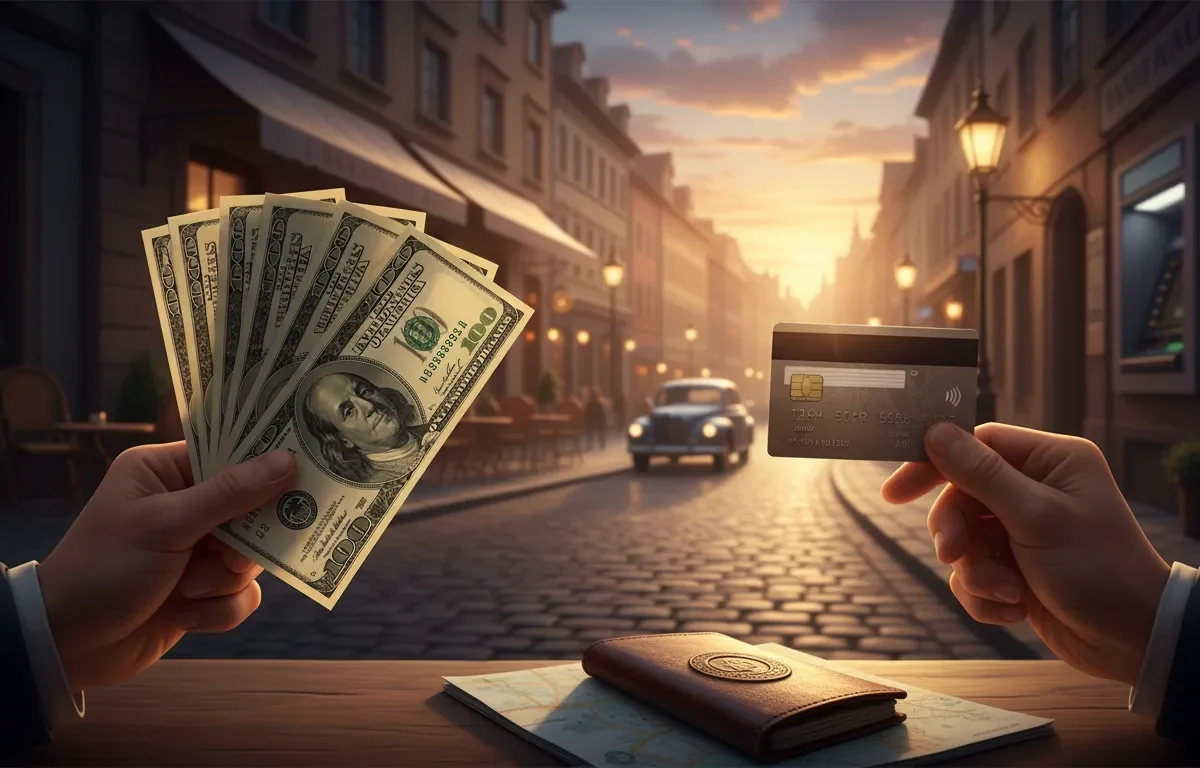
The truth is that the landscape has changed a lot in recent years. Back in the day, anyone traveling with “pockets full of cash” was the king of the hill. Today, with technology and new government regulations, the tables have turned. Let’s see what really pays off for your type of traveler.
Cash (Paper Money): Is It Still King?
Many people still fight tooth and nail to keep the good old cash. And it makes sense: the feeling of control is unbeatable. You look, count, and know exactly how much you have. No one turns down a dollar, whether at a street stall in New York or at a temple in Thailand.
The tax benefit: The IOF (Tax on Financial Transactions) on the purchase of paper money is 1.1%. For a long time, this was the main advantage against the credit cards, who were burdened with much higher rates.
But it's not all roses. Carrying a lot of cash is, quite literally, like having a target on your back. Did you lose it? It's gone for good. Were you robbed? There's no toll-free number to call to request a refund. On top of that, you're at the mercy of the tourism exchange rate, which is usually much saltier than the store-bought kind.
The Traditional Credit Card: Convenience or Trap?
Your credit card bank The traditional one (that sleek “platinum” or “black” model) offers something money can’t buy: immediate peace of mind and miles. But that peace of mind usually ends when the bill comes due.
Until recently, the 6.38% IOF was a real downer. The good news is that the government has begun to gradually reduce this tax rate (which is expected to reach zero by 2028), but even so, the cost remains high.
The real villain here—which almost no one tells you about—is the Bank Spread. It’s the difference between the dollar rate the bank pays and the rate it charges you. At “big banks,” this can be as high as 4% or 5% above the official exchange rate. In other words, you pay a high price for the convenience.
To better understand how the rates officially work, it's worth checking the rules on the Central Bank of Brazil, which explains the current foreign exchange regulations.

The Global Accounts Revolution (The “Trick”)
This is where the magic happens. In recent years, global accounts (such as Wise, Nomad, C6 Global, etc.) have emerged. They combine the best of both worlds.
How do they work? You make a PIX transfer in reais, and the money arrives abroad in dollars (or euros) almost instantly.
- Commercial Exchange Rate: Much cheaper than tourism.
- Reduced IOF: Usually 1.1% (equivalent to cash).
- Low Spread: Many charge between 1% and 2%.
It's basically an international debit card that you can use as a credit card at payment terminals abroad. If you want to learn more about how to plan your budget before leaving Brazil, check out our article on Financial Planning for International Travel. This helps determine how much to deposit into those accounts.
Comparison Table: An X-Ray of Costs
To make things easier for you, I put together this quick table. Prices may vary, but this is the market average:
| Modality | IOF (Approx.) | Used Price Quote | Average Spread | Security |
|---|---|---|---|---|
| Cash | 1,1% | Tourism (More Expensive) | Variable (Currency Exchange) | Low |
| Credit Card (BR) | 4,38% (down) | PTAX + Bank Spread | 4% to 6% | High |
| Global Account (Debit) | 1,1% | Commercial (Cheaper) | 1% to 2% | High |
Pros and Cons: The Moment of Truth
Cash
Pros:
- I accept 100% at various locations (including tips and street markets).
- Lower IOF than a traditional credit card.
- It helps you keep track of your spending at a glance.
Cons:
- High risk of loss or theft.
- Tourism exchange rates make purchases more expensive.
- Do you have any change left? Selling it back will result in a loss.
Traditional Credit Card
Pros:
- Insurance against theft and fraud.
- Earning miles and points.
- Additional benefits (travel insurance, VIP lounge).
Cons:
- IOF remains high.
- Bank spreads are often excessive.
- Risk of exchange rate fluctuations until the invoice is settled (although many banks already lock in the dollar exchange rate on the day of purchase).
Global Accounts
Pros:
- Best exchange rate (Commercial).
- Low IOF (1.1%).
- The convenience of a card without the fees charged by “big banks.”.
Cons:
- Some places (such as self-service gas stations and toll booths) may not accept prepaid or debit cards.
- You need an internet connection to check your balance in the app.
Practical Checklist: Before Boarding
Don't leave home without checking these things. Seriously, it'll save you from a lot of hassle.
- [ ] Enable Travel Alerts: Even if you don't plan on using the bank's credit card, make sure to activate it. If you need it in an emergency and it's blocked, you'll be in for a world of trouble.
- [ ] Get a “Mixed Kit”: The golden strategy. Set aside about 20% to 30% in cash for miscellaneous expenses and unexpected tech issues. Leave the rest in the main account.
- [ ] Check the Expiration Date: It seems obvious, but running out of credit on your card in the middle of a trip is a classic mistake made by the inattentive.
- [ ] Installed and Signed-In Apps: Make sure your banking apps and global accounts are working on the cell phone you’ll be taking with you. Security tokens often require an SMS, and your Brazilian SIM card might not work abroad.
- [ ] Backup Copy: Keep a spare card in your suitcase, separate from your wallet. If you get pickpocketed on the street, you won't be left with nothing.

Expert Tips for Saving Money on Currency Exchange
You know that saying, “Those who save don’t have fun”? Forget it. It’s the people who save the wrong way who don’t have fun—because their money runs out sooner.
- Buy a little at a time: Don't try to guess when the dollar will hit rock bottom. Buy a little bit every month before your trip. That way, you'll “average out” the price and protect yourself from the market's wild fluctuations.
- Avoid currency exchange at airports: Exchanging money at the airport is a sure way to lose money. The exchange rates are the worst possible because of the convenience.
- Note regarding the local currency: If you're going to Europe, take euros. If you're going to the U.S., take dollars. If you’re traveling to a country with a “weak” currency (such as the Argentine or Colombian peso), it’s usually better to take U.S. dollars and exchange them there, or use services like Western Union, rather than buying the foreign currency in Brazil. To understand more about the dynamics of strong and weak currencies, the Wikipedia It has a very comprehensive article on exchange rates.
The Verdict: International Travel: Should You Bring Cash in U.S. Dollars or Use a Credit Card?
At the end of the day, there isn't a single winner, but there is a winning strategy: diversification.
Betting everything on a single chip is risky. The card system could crash, and the chips could get wet or go missing.
The best strategy for the modern traveler is to focus most of their spending on Global Account (because of its unbeatable value), keep a traditional credit card with a high credit limit for emergencies and car/hotel rental deposits, and carry some loose change in species to the coffee shop on the corner.
Traveling is about relaxing, not about counting every penny for every ice cream. Plan ahead and enjoy your trip!
Frequently Asked Questions
It depends on the destination. In South American countries (such as Argentina and Uruguay), the Brazilian real is widely accepted and highly valued. In the U.S., Europe, or Asia, however, the exchange rate will be terrible. In those cases, take U.S. dollars or euros.
IOF stands for Tax on Financial Transactions. For cash and cross-border transfers (to the same account holder), the rate is 1.1%. For international credit cards, the rate in 2024 is around 4.38%, but it will gradually decrease until it reaches zero in 2028.
No. International purchases, whether made with a credit or debit card, are processed as a one-time payment. If you want to pay in installments, you’ll have to pay the interest charged by your Brazilian bank on the installment plan, which we do not recommend at all.
The "Commercial" rate is used for transactions between companies and banks (cheaper). The "Tourism" rate is what you pay at currency exchange bureaus and includes logistics costs, security fees, and the broker's profit (more expensive).
If you leave Brazil with cash in excess of US$$ 10,000 (or the equivalent in another currency), you are required to declare it to the Federal Revenue Service via e-DBC. Credit cards and global accounts are not included in this physical cash limit.
Did you like these tips? Then don't waste any time! Open your global account app, check today's exchange rate, and start building your travel fund right now. Your “future self” will thank you!