

Have you ever felt that queasy feeling in your stomach as the Ibovespa plummets% in a single day while news about inflation and fiscal risk dominates the headlines? I know that feeling. In my 20 years analyzing the Brazilian financial market, I've seen investors lose sleep due to being too exposed to volatility. However, there's a select group of assets that function as a financial “bunker”: the counter-cyclical sectors.
If you want to sleep soundly while the market is on fire, you need to understand this strategy today.
In this technical and straightforward article, I will dissect how to invest in counter-cyclical sectors, revealing the gears that make these companies resilient to economic downturns. I've analyzed recent data and trends for 2026 to deliver you the treasure map.
What Are Counter-Cyclical Sectors? (The Logic of “Indispensable”)
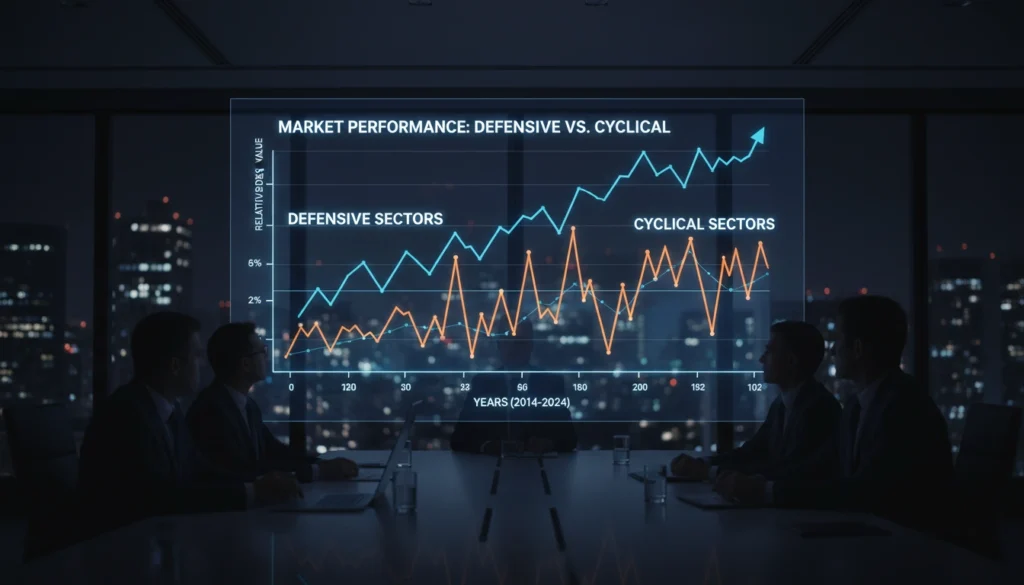
Before we talk about tickers, we need to align the theoretical foundation. Anticyclical sectors—also called defensive sectors—are those whose products or services have inelastic demand. In plain English: it doesn't matter if the GDP is growing or if the country is in recession, people keep consuming.
Imagine the following scenario: you lost your job or inflation skyrocketed. You'll likely postpone buying a new car (a cyclical industry) or purchasing designer clothes (discretionary spending).
However, Will you stop paying your electricity bill? Will you stop taking your medicine? Will you stop eating? The answer is no. That is precisely where the strength of these companies lies.
Technical Features I Analyze
- Low Beta (<1): They tend to fluctuate less than the benchmark index (Ibovespa).
- Predictable Cash Flow Recurring revenue guaranteed by long-term contracts (e.g., concessions).
- High Yield Historically, they have been excellent dividend payers.
“In a crisis, money doesn't disappear; it just changes hands. Typically, it flows from the hands of speculators into the hands of investors positioned in value and real need.” — Value Investing Principle
The 3 Anti-cyclical Pillars of the Brazilian Stock Exchange (B3)
After filtering dozens of financial statements and industry reports, I identified the three sectors that offer the best risk-reward ratio for the current scenario in Brazil.
1. Public Utility (Utilities): The King of Defense
This is, without a doubt, my favorite for protection. We're talking about companies Electricity and Sanitation. In Brazil, the electricity sector is regulated and has concession contracts that are adjusted for inflation (IGP-M or IPCA). This creates a hedge natural against the erosion of purchasing power.
- Generation and Transmission Companies focused on transmission are even safer, because their revenue (RAP - Annual Permitted Revenue) does not depend on the volume of energy consumed, but rather on the availability of the line.
- Sanitation With the Legal Framework for Sanitation, this sector has gained traction. The demand for water and sewage is the definition of perenniality.
If you are starting out, I recommend studying in depth the Fundamental stock analysis of those companies to understand their multiples.
2. Health Care Sector
Population aging is an irreversible megatrend. Hospitals, laboratories, and pharmaceutical companies have a growing structural demand. Furthermore, health insurance plans tend to pass costs on to consumers, protecting their margins.
Meanwhile, caution is needed: unlike utilities, the healthcare sector has higher regulatory risk and competition. In my technical tests, I noticed that vertically integrated companies (which control everything from hospitals to health plans) tend to perform better in high-interest rate cycles.
Basic Consumption (Staples)
Food and drink. This is where supermarkets and large food producers come in. The logic is simple: the last thing a family cuts from its budget is basic food. Companies such as Cash & Carry wholesalers have proved to be extremely resilient, capturing sales volume even when the population's income falls.
Technical Table: Cyclical vs. Counter-cyclical
I prepared this comparative table based on historical data of volatility and market behavior so that you can visualize the brutal difference between the profiles.
| Features | Cyclical Sector (e.g., Retail, Construction) | Counter-cyclical Sector (Ex: Utilities, Insurance) |
|---|---|---|
| Correlation with GDP | Up (Rises with the economy) | Low (Stable regardless of GDP) |
| Volatility (Beta) | High (greater than 1.2 usually) | Low (0.5 to 0.8 generally) |
| Dividends | Irregular (Focus on growth) | Constant and Robust |
| Practical example | Magazine Luiza, Cyrela | Taesa, BB Security |
| Best Time | Economic Expansion / Interest Rate Drop | Recession / Interest Rate Hike / Uncertainty |
The “Shield and Sword” Strategy”
I'm not saying to sell everything and only buy water and utility companies. A healthy portfolio needs balance. The strategy I use and teach is Core-Satellite.
- The Core 60% a 70% da carteira em setores anticíclicos. Isso garante que, se o mercado cair 30%, sua carteira caia apenas 10% ou 15%, preservando seu psicológico e capital.
- The Satellite: 30%% to 40%% in cyclical or growth sectors (Small Caps, Technology) to capture appreciation when the cycle turns.
For whom Starting to invest from scratch, this ratio is even more vital to avoid early frustrations.
Expert Tip: The Role of Insurance
Frequently overlooked, the sector of Insurance It's an interesting hybrid. Insurers make money in two ways: from insurance premiums and from the yield on float (the money that remains invested while there is no claim).
No Brasil, com a Selic historicamente alta, o resultado financeiro dessas empresas explode. É um setor anticíclico com “anabolizantes” de juros altos.
Action Checklist: Choosing Your Defensive Stock
Before you put your money in, put the company through this rigorous filter:
- Dividend History: Has the company consistently paid dividends for the past 5 years?
- Controlled Indebtedness: Is the Net Debt/EBITDA ratio less than 3x? (Essential in times of high interest rates).
- Barriers to Entry Is it difficult for a new competitor to enter the market? (e.g., building a new transmission line is complex and expensive).
- Net Profit Margin Does the company maintain stable profit margins even in years of crisis?
🚀 Accelerate Your Results
Do you want access to the best tools and analysis to protect your assets? Don't waste time trying to guess the market.
CLICK HERE TO LEARN THE BEST INVESTMENT STRATEGY
Verdict: Is it worth investing in counter-cyclical sectors?
Expert Rating: 10/10 (Essential)
In an emerging and volatile country like Brazil, investing in counter-cyclical sectors is not just an option; it's a Need for survival. They offer the peace of mind needed to keep you in the long-term game.
While the “adventurers” break their faces trying to hit the next move that will go up 1000%(and end up losing 50%), the defensive investor accumulates dividends and sees their assets grow consistently.
Furthermore, the cash predictability of these companies allows for much more assertive financial planning.
Frequently Asked Questions (FAQ)
Electric Power (focus on transmission), Sanitation, Insurance, and Basic Consumption (food). The Health sector is also strong but requires greater selectivity in assets.
Although the main focus is protection and income (dividends), well-managed companies in these sectors can indeed show growth, especially through reinvestment of profits or mergers and acquisitions, but generally at a slower pace than growth stocks.
Não recomendo. Ter 100% em defesa pode fazer você perder os grandes ciclos de alta da bolsa (Bull Markets). O ideal é balancear, mantendo a defesa como a base sólida da sua carteira.
Positively, in most cases. Concession contracts (electricity and sanitation) are indexed to inflation, which passes on price increases to revenue, protecting the real value of the investment.
I recommend using the Investor Relations (IR) website of the companies themselves, as well as authoritative portals such as InfoMoney or official data from the electricity sector in Energy Research Company, which provide technical reports on sector resilience.