
- What is it: A card with no annual fee is one for which the issuer does not charge a single fee—the annual fee. Other fees provided for in the terms and conditions may still apply.
- Where the cost appears: usage fees, interest on revolving credit and installment plans, late payment penalties and interest, and IOF.
- Key risks: allowing the bill to be paid only in part and watching the debt grow; purchases and cash withdrawals abroad subject to an additional tax.
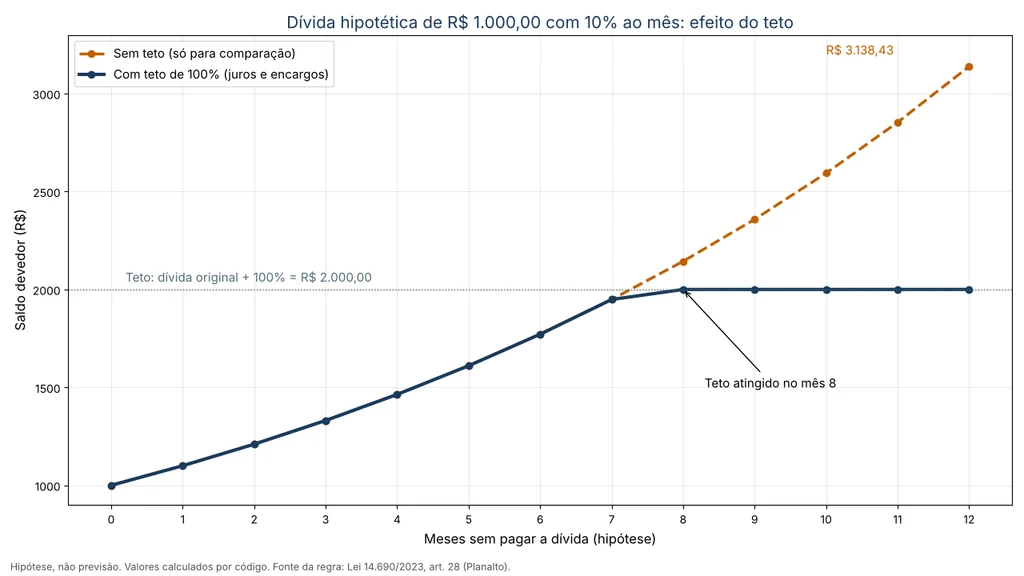
- General Protection: The total interest and fees on revolving credit and installment plans are capped at 100% of the original debt.
- Who is this guide for: Anyone who is considering or already uses a card with no annual fee and wants to understand the actual cost.
‘No annual fee’ is often interpreted as ‘no cost.’ It’s not the same thing. The phrase refers only to the single fee charged for maintaining the card and leaves out the rest of what a credit card might cost.
This guide breaks down the costs into four categories: fees, interest, late payment charges, and taxes. For each category, it explains the official rules and tells you where to check the current rates at your own financial institution.

What ‘No Annuity’ Means in Practice
Banks and other financial institutions may only charge fees for services specified in regulations. The general rule is set forth in Resolution No. 3,919/2010 of the National Monetary Council, as consolidated and published by the Central Bank (Consolidated text of Resolution 3,919).
This means that the institution chooses which of the permitted fees it will charge. By waiving the annual fee, it forgoes one of them, but not the others. The terms that apply to your card are set forth in the contract and in the institution’s own fee schedule, which it must make available to customers.
Fees That May Apply Even Without an Annual Fee
Under Resolution 3,919/2010, credit cards have their own set of fee-based services. In summary, this includes, in addition to the annual fee, replacement cards requested by the cardholder, cash advances using the card, bill payments made with the card, and emergency credit checks. The full text and the current list are included in the regulation cited above.
| Billing | When might it appear? | Where to check the price |
|---|---|---|
| Duplicate copy | When the cardholder requests a replacement card | Institution's Fee Schedule |
| Withdraw cash with your card | When withdrawing cash at an ATM | Rate Schedule and Contract |
| Paying Bills | When paying a boleto using credit | Rate Schedule and Contract |
| Emergency Credit Assessment | When a customer requests an approval above the limit | Rate Schedule and Contract |
There are also so-called “premium” services, such as automated messages or personalized plastic cards. According to the same resolution, these services may only be charged if you expressly sign up for them.
The regulation also establishes transparency requirements. The institution must provide 45 days’ advance notice of any rate changes and make an annual statement of the rates charged available by February 28 of the following year, in accordance with the consolidated text of Resolution 3,919.
Interest on Revolving Credit and Installment Plans
This is the biggest expense. If you pay less than the total amount on the bill, the remainder is financed with interest, and the rate is set by the institution in the contract. The Central Bank explains in a brochure that credit card interest rates are freely negotiated, meaning they vary from one issuer to another (Central Bank guide on credit cards).
Revolving credit—the type of credit in which the outstanding balance carries over to the next billing cycle—can only remain outstanding until the next billing cycle, according to CMN Resolution No. 4,549/2017 (consolidated text). After that, the balance must be paid in installments or renegotiated under different terms.
Hypothetical example: how the cap works
The calculation is: balance = 1,000 × 1.10 raised to the number of months, capped at R$ 2,000.00. The graph below shows the two curves for 12 months. A 100% cap is still a lot of money: the debt doubles before it stops growing.
Delay: Penalty and Late Payment Interest
Paying after the due date results in charges other than the loan interest. The Consumer Protection Code limits late payment penalties to 2% of the installment amount (Article 52, paragraph 1), and late payment interest must be specified in the contract, in accordance with Article 54-B (Consumer Protection Code at the Planalto).
For a bill of R$ 1,000.00 paid late, the maximum late fee is R$ 20.00. Late payment interest and financing charges are calculated separately, at the rate specified in the contract.
IOF: Purchases and Withdrawals Abroad and Credit Transactions
The Tax on Financial Transactions (IOF) is levied on foreign exchange and credit transactions. Decree No. 6,306/2007 serves as the legal basis, and Decree No. 12,499/2025 amended the tax rates (Decree No. 6,306 at the Planalto Palace; Decree 12,499 in the Chamber of Deputies).
Under Article 15-B of Decree 6,306, as amended by Decree 12,499, the tax rate is 3.5% on overseas purchases made with a credit card (subparagraph VII) and on other foreign exchange transactions listed in subparagraph IX. On October 17, 2026, the text of Decree 6,306 itself indicates that it was suspended by a legislative decree and refers to ADC 96 before the Federal Supreme Court, whose plenary ruling was still pending as of the date of this data review.
In credit transactions, the IOF consists of a daily component and a surcharge. For individuals, the sum of 0.0082% per day for 365 days plus the 0.38% surcharge results in a maximum rate of 3.373% for transactions lasting one year or longer. On R$ 1,000.00 in financing, this would amount to a maximum of R$ 33.73. The contract determines the applicable rate in your specific case.
What Has Changed and What Hasn't
Status as of October 17, 2026, in accordance with the legal text.
- What has changed: Law No. 14,690 of 2023 established a statutory cap on the total amount of interest and fees; Provisional Measure No. 1,393 of 2026 added Article 28-A to that law, according to the text on the Planalto.
- What hasn't changed: The 100% cap in Article 28 is included in the text under review, and the 2% late payment penalty is set forth in Article 52 of the Consumer Protection Code.
- Still under discussion: According to the sources cited, the 3.5% IOF tax rate on foreign transactions is currently in effect, but the matter is the subject of ADC 96 before the Supreme Court, and the final outcome could change the situation.
Step-by-Step Guide to Checking the Cost of Your Card
- 1 Open the rate table: Check the institution's website or app for the list of card fees and see if there are charges for cash withdrawals, replacement statements, and bill payments.
- 2 Check the interest rates for revolving credit and installment plans: It must be included in the contract and on the invoice. Write down the monthly amount.
- 3 Review contracted services: Messages, custom plastic, and other optional items can only be charged if you have ordered them.
- 4 Check your bill every month: Look for entries related to fees, IOF, and interest, and dispute any items you do not recognize through the institution's customer service channel.
- People who use or are planning to choose a card with no annual fee
- Anyone who wants to understand where the charges on the bill come from
- Anyone looking for a recommendation for a specific credit card
- Anyone seeking legal advice for a specific case
To learn more, see also The Guide to Paying Your Credit Card Bill in Installments, which explains what happens when the full payment cannot be made within the month.
See also: Credit Card with No Annual Fee
Frequently Asked Questions
Do cards with no annual fee have any other costs?
That’s possible. “No annual fee” simply means that this fee is not charged. Withdrawal fees, replacement statements, interest, late payment penalties, and IOF may apply, depending on the contract and the regulations cited, based on data verified on October 17, 2026.
Is there a limit on credit card interest?
There is a cap on the total interest and fees for revolving credit and installment plans: 100% of the original debt amount, according to Article 28 of Law 14.690/2023. There is no monthly rate set by law.
Can the late payment penalty be more than 2%?
The Consumer Protection Code sets the late payment penalty at a maximum of 2% (Article 52, paragraph 1). Late payment interest is charged separately, as provided in the contract.
Are there taxes on international purchases?
Yes, there is a 3.5% IOF tax under Decree 12,499/2025, which was in effect on the date of the conference. The issue is currently under review by the Supreme Court, so be sure to check the current rules with the Federal Revenue Service and your institution before traveling.
Where can I check my card's fees?
In the institution's fee schedule and contract, as well as in the annual statement of fees. If you have any questions, contact the institution's customer service or consumer protection agencies.
- Planalto, Law No. 14,690/2023 (accessed on October 17, 2026)
- Central Bank, CMN Resolution No. 3,919/2010, consolidated text (accessed on October 17, 2026)
- Central Bank, CMN Resolution No. 4,549/2017, consolidated text (accessed on October 17, 2026)
- Planalto, Consumer Protection Code (accessed on October 17, 2026)
- Planalto, Decree No. 6,306/2007 (accessed on October 17, 2026)
- Chamber of Deputies, Decree No. 12,499/2025 (accessed on October 17, 2026)
- Central Bank, Credit Card Guide (accessed on October 17, 2026)
Notice: This content is for educational and informational purposes only. It does not constitute an investment recommendation, advisory service, or securities analysis, and does not take into account your situation, your objectives, or your risk tolerance. All investments involve risks, and past performance is no guarantee of future results. Rates, taxes, and regulations are subject to change: the data was sourced from the official sources indicated, as of the date stated at the beginning. Consult a licensed professional before making a decision. Illustrative images, when created by artificial intelligence, do not depict real institutions, products, or people.