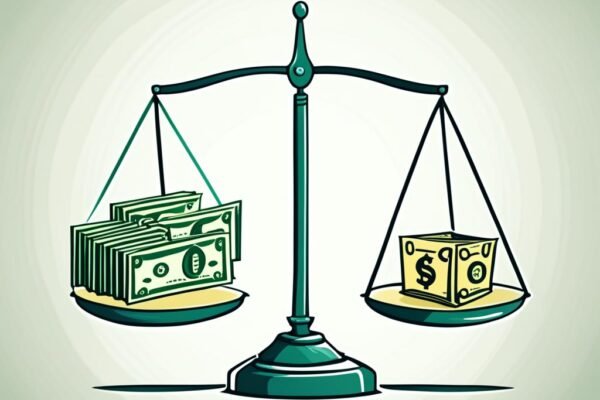
Did you know that the CDI It is a strong indicator of the financial market in Brazil? He has a profitability an average of 12,15% per year.
This makes the CDI a good option for those looking for security and stability in their investments.
However, have you ever wondered if the CDI é fixed income Or a variable? That's a common question. In this article, we'll explore this issue.
Let's take a look at how the CDI works and its relationship to the interest rate Selic and how it can influence their investments.
As you go through this guide, you'll learn about fixed income and variable. You'll also learn about the advantages and disadvantages of investing in assets linked to the CDI.
With this information, you'll be able to make better decisions about your investments, based on your profile and financial goals.
Understanding the Concept of the CDI in the Financial Market
O CDI (Interbank Certificate of Deposit) is essential in the financial system Brazilian. It is a security issued by banks to balance the interbank market. In this market, banks make short-term loans to one another.
What Does "Interbank Certificate of Deposit" Mean?
The CDI is the average of the interest rates on unsecured interbank loans backed by government securities.
A CETIP (Central Securities Depository and Financial Settlement System for Private Securities) calculates this rate daily.
It serves as a reference for fixed income investments, such as CDBs (Bank Deposit Certificates) and LCIs (Real Estate Letters of Credit).
How the Interbank Market Works
In interbank market, banks lend to and borrow from one another. They do this to balance their cash flows and comply with the law.
This dynamic creates the rate DI (Interbank Repo), which follows the Selic, a basic interest rate.
The Importance of the CDI to the Financial System
The CDI is vital to the stability of the financial system national. It serves as a benchmark for the credit market and the financial market.
Its rate affects the returns on various investments, reflecting economic health and market expectations.
“The CDI closely monitors the Selic, a basic interest rate of the economy, immediately reflecting every increase or decrease in the benchmark rate.”
The Relationship Between the CDI and the Selic Rate
O CDI and Selic are very close. The Selic rate is the basic interest rate in Brazil. It influences the CDI and the financial market.
The Selic rate affects interest rates on CDIs from the banks. This causes the CDI to track the Selic rate. Both reflect the cost of money in the market.
- A Selic rate It changes every 45 days. This is done by the Central Bank's Monetary Policy Committee (Copom).
- A CDI rate It comes from interbank lending. It shows the cost of money in the interbank market.
- The Selic rate is usually slightly higher than the CDI. This is because the Selic plays a greater role in the economy.
The Selic and the CDI are essential for investments in fixed income. This includes CDBs and government securities. Changes in these rates affect the returns on these investments.
Understanding the relationship between the CDI and Selic rate It is crucial. This connection helps predict the performance of various financial investments in Brazil.
CDI is Fixed or Variable Income
The Interbank Deposit Certificate (CDI) is viewed as a fixed income. That's because you know how much you'll earn right from the start. In contrast, the variable income It can change a lot.
Characteristics of Fixed-Income Securities Linked to the CDI
CDI investments have advantages. They offer:
- Predictable and stable returns
- Lower volatility compared to variable income
- Greater security to preserve invested capital
- Attractiveness in Times of Greater Market Uncertainty
How the CDI Affects Investments
The CDI affects many investments, especially fixed-income investments. Products such as CDBs, LCI, LCA e DI funds their returns are based on the CDI.
This makes them appear to be safe investments in the Brazilian financial market.
Differences Between Fixed and Variable Income
The main difference between fixed-income and variable-income investments is the predictability of returns. Fixed-income investments are safer, with known returns. On the other hand, variable income It may bring in more profit, but with more risks.
| Fixed Income | Equities |
|---|---|
| Predictable Returns | Returns are subject to fluctuations |
| Lower volatility | Greater volatility |
| Lower risk | Greater risk |
| Greater security | Greater earning potential |
The choice between fixed-income and variable-income investments depends on the investor. Everyone has their own financial goals.
How the CDI Affects Your Investments
O Interbank Deposit Certificate It plays a very important role in Brazil's financial market.
It directly affects the profitability of several investments, especially those from fixed income.
Products such as CDBs, LCIs, LCAs e DI funds have their profitability linked to the CDI. Thus, when the CDI rate As a result, these investments provide better returns for investors.
The CDI also serves as a benchmark for comparing the performance of others financial investments.
It serves as a benchmark to help investors analyze and compare the financial investments more clearly.
A CDI rate changes over time, affecting the return on related investments. For example, in 2023, the CDI rate The cumulative total over the past 12 months was 13,65%. This improved the profitability products such as CDBs and DI funds.
So, it's crucial to keep track of the change in the CDI rate and understand how it affects the different investments. This helps improve your strategy for investments and increase your profitability.
| Financial Product | CDI-Linked Returns |
|---|---|
| CDBs | Up to 130% of the CDI |
| LCIs and LCAs | Rates linked to the CDI |
| DI Funds | Return linked to the CDI |
Invest in products with profitability Indexing it to the CDI could be a good strategy. That's because it offers returns competitive and security in their financial investments.
But it's important to carefully analyze each investment and keep up with changes in the CDI rate. This way, you'll make more informed decisions that are aligned with your goals.
Types of Investments Linked to the CDI
The Interbank Deposit Certificate (CDI) plays a very important role in Brazil's financial market.
Many fixed income investments are based on that rate. This offers good opportunities for those seeking security and stability in their investments.
CDBs and Their Returns
Bank Certificates of Deposit (CDBs) are issued by banks. They generally pay interest based on the CDI.
These investments are safe, thanks to the Credit Guarantee Fund (FGC), up to R$250,000 per CPF.
LCIs and LCAs
Real Estate Credit Notes (LCIs) and Agribusiness Credit Notes (LCAs) are also based on the CDI.
They are exempt from Income tax for individuals. This makes them more attractive investment opportunities.
DI Funds
DI funds invest in securities linked to the CDI. They aim to track changes in the CDI. These funds offer an easy and diversified way to invest in fixed income.
These are some of the main investment options linked to the CDI. They may be a good fit for different types of investors who are looking for both security and returns.
Advantages and Disadvantages of Investing in CDI
Investing in CDI-linked products offers advantages to many investors. One major advantage is the predictability of income.
That's because the returns are tied to the Selic rate and follow market trends. In addition, these investments are safe and easy to sell, which is great for those looking for security.
However, when interest rates are low, these investments may not be as profitable. That's because there are riskier options, such as stocks, that can yield higher returns.
Some CDIs also have administration fees that reduce your earnings.
- Advantages of the CDI:
- Income Predictability
- Low risk
- Good liquidity
- Disadvantages of the CDI:
- Lower returns in low-interest-rate environments
- Management fees that reduce returns
It is crucial to carefully weigh the pros and cons before investing in CDI. You should consider your risk tolerance, your financial goals, and the current economic situation.
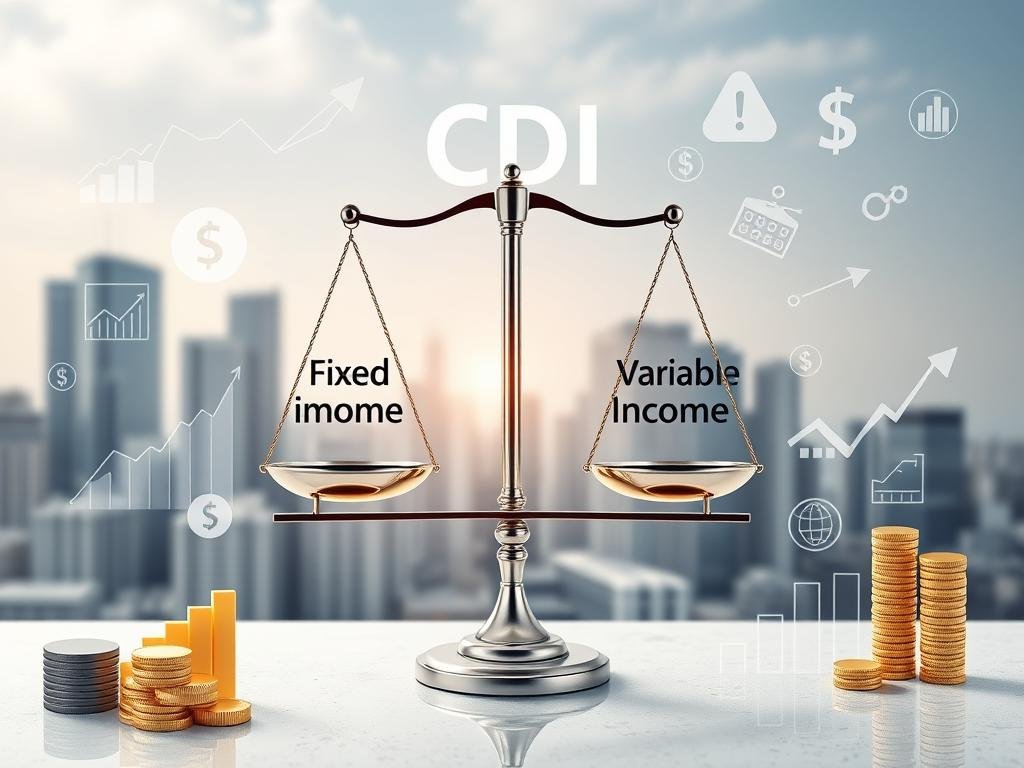
“Even with the drawbacks, investing in CDIs is still an attractive option, especially for conservative investors seeking security and predictable returns.”
CDI vs. Savings Account: A Comparison of Returns
The CDI generally offers a higher rate of return than the savings. This is because the CDI is more sensitive to the financial market. On the other hand, the savings It has a fixed rate based on the Selic.
Differences in rates of return
A savings It has a fixed rate based on the Selic 70%. On the other hand, the CDI follows market fluctuations. This can cause the CDI to offer higher returns.
The CDI is also affected by the country's monetary policy. This makes it more sensitive to changes in interest rates.
Profile of the Ideal Investor
Those looking for security and good returns can invest in the CDI. This investment is advantageous when interest rates are high. Savings accounts, on the other hand, are better for those who want simplicity and don't pay income tax.
| Year | CDI | Yield R$100,000 | Income R$200,000 | Income R$300,000 |
|---|---|---|---|---|
| 2023 | 13,04% | R$13,040.00 | R$26,080.00 | R$39,120.00 |
| 2022 | 12,39% | R$12,390.00 | R$24,780.00 | R$37,170.00 |
This table shows the annual return on the CDI for different amounts. It highlights the advantage of the CDI over a savings account.
How to Calculate the Return on CDI
The yield on the Interbank Deposit Certificate (CDI) is very important. It shows how investments are performing in Brazil.
A CETIP It calculates this every day, using interbank market transactions.
For investments linked to the CDI, such as Bank Deposit Certificates (CDBs) and DI Funds, the return is calculated. This takes into account the percentage that the product offers relative to the CDI.
An example is a CDB which yields 100% from the CDI. It will have the same yield as the CDI rate. However, it is essential to take taxes and administrative fees into account when calculating the final return on investment.
Returns can be nominal, net, real, or even negative. The nominal return does not take deductions into account.
I and net profitability deducts costs, taxes, and fees. The real profitability adjusts the return for inflation, showing the gain in purchasing power.
Understanding the difference between profitability and return is crucial. The profitability is the percentage rate of capital growth. The income It is the absolute value of the investment.
The CDI yield calculator uses a specific formula. It takes into account the Selic rate and the number of business days.
Thus, it is possible to calculate the profitability CDI-linked investments in different scenarios.
| Percentage of CDI | Daily Return | Annual Profitability* |
|---|---|---|
| 85% | 0,037% | 11,04% |
| 95% | 0,041% | 12,33% |
| 100% | 0,044% | 12,99% |
| 105% | 0,046% | 13,65% |
| 110% | 0,048% | 14,31% |
*Based on a target Selic rate of 11.75% per year and 252 business days in a year.
Therefore, the profitability The CDI is essential for evaluating investments. It helps investors make better decisions.
Understanding the types of profitability And by learning how to calculate these things, you can make better decisions to achieve your financial goals.
Taxation of CDI-Indexed Investments
Investing in financial products linked to the Interbank Deposit Certificate (CDI) has significant tax implications.
These investments generally follow a schedule of Income tax (IR) regressive. The tax rates range from 22.5% to 15%, depending on the investment term.
The real estate letters of credit (LCI) e Agribusiness Letters of Credit (LCA) are exempt from income tax for individuals.
A savings is also exempt. However, the short-term fixed-income funds (less than 365 days) have a taxation specific.
They pay 22.5% in income tax on investments with a term of less than six months and 20% on those with a longer term.
It is essential to think about the taxation when choosing investments. It affects how much you'll actually earn.
When planning, consider your gross profit and tax burden. That way, you’ll maximize your earnings.
| Investment period | Income tax rate |
|---|---|
| Up to 6 months | 22,5% |
| From 6 months to 1 year | 20% |
| 1 to 2 years | 17,5% |
| Over 2 years old | 15% |
Remember: the Taxation is a crucial factor When choosing investments linked to the CDI, make sure you understand the rules and exemptions thoroughly. That way, you’ll maximize your net return.

Risks Associated with CDI Investments
Products related to the CDI are considered low-risk. However, they are not completely free of risks. It is crucial to understand these challenges before investing in the financial market and fixed income.
O credit risk It's a major problem. It refers to the financial stability of the institution issuing the security. If that institution experiences financial difficulties, investors may not receive their money.
O liquidity risk It is also an important factor. It varies depending on the type of investment. Some products may be easier to sell, while others are not.
If the interest rate to fall, the profitability Returns on CDI investments may not meet expectations. This can happen even with low-risk investments.
To reduce these risks, it is important to carefully analyze the risk profile for the investor. Diversifying your portfolio is essential.
This includes not only investments in the CDI, but also in other options for fixed income e variable.
Understanding the investment risks Investing in CDI products helps investors make better decisions. This ensures that their choices are aligned with their long-term financial goals.
CDI in Scenarios of Rising and Falling Interest Rates
The Interbank Deposit Certificate (CDI) is affected by the benchmark interest rate, the Selic rate. When the Selic rate rises, CDIs pay higher yields, attracting investors.
When interest rates are low, CDIs yield less, prompting investors to seek other options.
By 2025, inflation (IPCA) is expected to be 4.10%, and the Selic rate, 12.00% per year. This suggests that investing in CDI may be a good strategy. This way, you protect your money from inflation and earn good returns.
There are several fixed-income investment options linked to the CDI:
- Government Securities: Selic Treasury Bonds, Fixed-Rate Treasury Bonds, and IPCA+ Treasury Bonds
- Bank Securities: CDBs, LCIs, and LCAs
- Corporate Securities: Debentures, CRIs, and CRAs
- Fixed-Income ETFs
- Infrastructure Investment Funds
It's essential to keep an eye on the market and interest rates. Diversifying your portfolio helps you take advantage of opportunities when the Selic rate rises or falls.
| Investment | Performance in a Rising Interest Rate Environment | Performance in a Low-Interest-Rate Environment |
|---|---|---|
| Selic Treasury Bills (LFT) | Returns linked to the Selic rate, with good daily liquidity | Yields track the Selic rate, making them less attractive compared to other securities |
| IPCA+ Treasury Bond (NTN-B) | Potential for real returns exceeding 6% per year | Protection against inflation, competitive returns even with low interest rates |
| CDBs, LCIs, and LCAs | Attractive returns, keeping pace with the rise in the Selic rate | Yields have fallen, but they may still be an attractive option |
It's important to diversify your investments. Stay informed about economic changes so you can make good choices.
Conclusion
O CDI It is essential for anyone who invests in fixed income in financial market in Brazil. Understanding how it works helps you make sound financial decisions. This is vital for pursuing your investment strategy.
Investing in the CDI offers security and predictability. However, it is important to consider the economic scenario and your risk profile. It’s also crucial to understand your financial goals before making a decision.
To improve your investments, it's a good idea to diversify your portfolio. And always keep an eye on the market. That way, you can make better decisions and achieve your financial goals.
FAQ
Q: What does CDI stand for?
A: CDI stands for Interbank Certificates of Deposit. These are securities issued by banks to balance the financial system. They function as short-term loans between banks in the interbank market.
Q: What is the relationship between the CDI and the Selic rate?
A: The CDI and the Selic are closely linked. The Selic is Brazil's benchmark interest rate. It influences the CDI. Both affect the financial market and investment decisions.
Q: Is the CDI considered a fixed-income or variable-income investment?
A: The CDI is a fixed-income instrument. Its yield is known from the outset. Thus, investments linked to the CDI offer predictability, unlike variable-income investments.
Q: How does the CDI affect investments?
A: The CDI affects the profitability of fixed income investments. Products such as CDBs, LCIs, LCAs, and DI funds have returns linked to the CDI.
Q: What are the main investments linked to the CDI?
A: Fixed-income investments linked to the CDI include CDBs, LCIs, LCAs, and DI funds.
Q: What are the advantages and disadvantages of investing in CDI?
A: Investing in CDIs offers advantages such as predictability and security. However, when interest rates are low, it may not be as profitable. In addition, management fees can reduce your return.
Q: How does the CDI compare to a savings account in terms of returns?
A: The CDI generally offers a higher rate of return than a savings account, especially when interest rates are high. Savings accounts have fixed terms, while the CDI tracks market conditions.
Q: How is the CDI yield calculated?
A: The CDI yield is calculated by the CETIP daily. It takes interbank transactions into account. For investments linked to the CDI, the calculation considers the percentage of the product relative to the CDI.
Q: What are the risks associated with investing in CDIs?
A: Investments in CDIs carry low risk. However, there are credit and liquidity risks. These risks vary depending on the type of investment.
Q: How is the CDI affected by scenarios of rising and falling interest rates?
A: The CDI fluctuates with the benchmark interest rate. When it rises, it offers better returns. When it falls, returns decrease.
Source links
- Financial Education: Tips to Improve Your Finances
- Fixed or variable income: investment strategies
- Does the CDI yield more than a savings account? Check out the historical data and charts!
- What are the differences between fixed and variable income? | B³
- CDI: What It Is, How Much It Pays, and More
- CDI: What It Is, Its Importance, and Examples of Returns