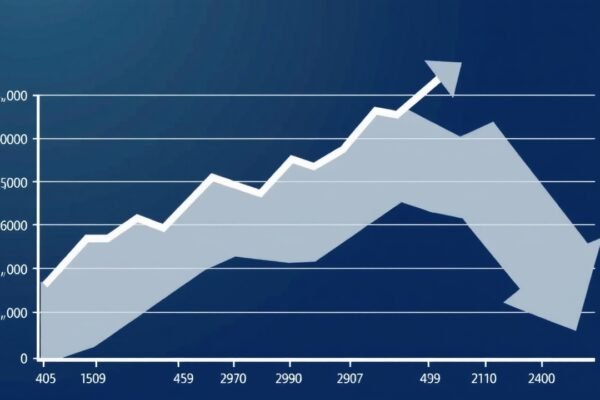

What is Gross Domestic Product?: Gross Domestic Product, known as GDP, is one of the key economic indicators used to measure the economic activity of a region—whether a country, state, or city. It reflects the sum of all final goods and services produced during a given period, usually one year. Understanding GDP is essential for assessing a nation’s economic performance and level of wealth.
Key Points
- GDP represents the sum of all final goods and services produced in a region during a specific period.
- There are different methods for calculating GDP, including the production, income, and expenditure approaches.
- Nominal GDP is calculated at current prices, while real GDP is adjusted for inflation.
- GDP per capita is calculated by dividing total GDP by the population, providing a more accurate picture of the average standard of living.
- Although GDP is an important indicator, it has limitations, such as not taking into account the informal economy and environmental issues.
The Concept of Gross Domestic Product (GDP)
Definition of GDP
Gross Domestic Product (GDP) is the sum of all final goods and services produced within a country, state, or city, typically over the course of a year. It is an essential measure for understanding a region's economic activity. GDP does not account for the stock of goods and services, but rather for the volume produced during a specific period.
History of GDP
The concept of GDP was developed during the Great Depression in the 1930s as a way to measure a country’s economic health. Since then, it has become one of the key economic indicators used globally. The idea was to create a metric that could reflect economic output and aid in planning and decision-making.
Importance of GDP
GDP is crucial for assessing a country's economic performance and comparing it with other nations. Rising GDP indicates a booming economy, while falling GDP can be a sign of recession. In addition, GDP is used to calculate other important indicators, such as GDP per capita, which measures the average wealth per person.
GDP serves as a barometer of the economy, helping to identify periods of growth or recession and to guide economic policy.
Components of GDP
Gross Domestic Product (GDP) is made up of various components that reflect a country's economic activity. Each component plays a crucial role in the calculation of GDP, helping to provide a better understanding of a nation's economy.
Methods for Calculating GDP
To calculate Gross Domestic Product (GDP), there are three main methods that, although different, yield the same result. These methods are: the production perspective, the income perspective and the expenditure perspective. Each offers a unique perspective on a country's economy.
Production Perspective
From a production perspective, GDP is calculated by adding together the gross value added of all sectors of the economy, such as manufacturing, services, and agriculture. This method focuses on the total production of goods and services within a given area.
The Economics of Income
The income approach calculates GDP by adding up all the income generated in the economy, such as wages, interest, distributed profits, and rent. This method reflects the distribution of income among different economic agents.
Expenditure
From the expenditure perspective, GDP is calculated as the sum of all expenditures in the economy. The formula used is:
GDP = C + I + G + (X – M)
Where:
- C: Household Consumption
- I: Business Investments
- G: Government spending
- X: Exports
- M: Imports
This approach takes into account household consumption, business investment, government spending, and trade balance (exports minus imports).
Nominal GDP vs. Real GDP
Difference Between Nominal and Real GDP
When we analyze the GDP When analyzing a country's economic performance over time, it is essential to distinguish between nominal GDP and real GDP. Nominal GDP is calculated based on current prices—that is, the prices in the year the goods were produced and sold. Real GDP, on the other hand, is calculated using constant prices, with a base year chosen to eliminate the effect of inflation.
Impact of Inflation
Inflation can distort the analysis of economic growth. For example, if a country had a nominal GDP of R$ 2 trillion in one year and, in the following year, economic activity remained the same but prices rose by 30%, nominal GDP would show a 30% increase. However, real GDP would show that the quantity of goods and services produced remained unchanged. This is important for understanding the economy’s real growth.
Practical examples
Let's consider a practical example. Suppose that in 1994, during the Real Plan, R$ 1 was worth much more back then than it is today. By way of comparison, R$ 1 from 1994 is equivalent to R$ 8.08 today. This shows how inflation can affect the value of money over time. Therefore, when analyzing GDP, it is crucial to use real GDP to obtain a more accurate picture of economic growth.
Limitations of GDP
Informal Activities
GDP does not take into account economic activities that occur outside the formal market, such as volunteer work and the exchange of goods online. This means that a significant portion of society’s production and well-being is not accounted for. Economists warn that Comparisons between products from different countries may have limitations because of these informal activities.
Environmental Issues
GDP does not account for the environmental impacts of production. For example, a country could increase its GDP by cutting down and selling all its trees, but this would result in significant environmental damage, such as loss of biodiversity and pollution. These externalities are not reflected in GDP, which can lead to a distorted perception of economic development.
Social Inequality
GDP measures a country’s total output, but it does not take into account how that wealth is distributed among the population. This means that a country can have a high GDP, yet still have a large portion of its population living in poverty. The distribution of wealth is a crucial factor for long-term economic and social development.
GDP is an important measure, but it has its limitations. It does not capture all the nuances of the economy and social well-being, which can lead to public policies that do not meet all the needs of the population.
GDP Per Capita
Definition of GDP Per Capita
Per capita GDP is an economic indicator that represents the the average amount each resident would have of the total wealth produced in a country. To calculate this, divide the GDP by the population of the region being analyzed. This average value It helps us understand the distribution of wealth, but it has its limitations.
The Importance of GDP Per Capita
Per capita GDP is important because it allows for comparisons between different countries or regions, regardless of population size. It helps determine whether the wealth generated is sufficient to improve residents’ quality of life. However, it is important to remember that it does not take into account the income distribution or other factors such as health and education.
International Comparisons
Countries such as Switzerland, Norway, and Denmark have a moderate GDP per capita, but it is sufficient to ensure an excellent quality of life for their residents. On the other hand, countries with a high GDP but a large population, such as India and China, may have a low GDP per capita, indicating that wealth is not evenly distributed among all residents.
Per capita GDP is a useful tool, but it should not be used on its own to assess a population’s quality of life.
GDP and Economic Development
The Relationship Between GDP and Development
Gross Domestic Product (GDP) is often used as an indicator of economic performance of a country. A growing GDP generally indicates a healthy economy, with more jobs and higher incomes for the population. However, it is important to remember that GDP does not measure the distribution of wealth, quality of life, or social well-being.
Supplementary Indicators
For a more comprehensive analysis of economic development, it is necessary to consider indicators other than GDP. Some of these indicators include:
- Human Development Index (HDI)
- Gini coefficient (a measure of income inequality)
- Literacy rate
- Life expectancy
These indicators help provide a broader and more detailed picture of a nation's development.
Criticism of the Use of GDP
Although GDP is a useful tool, it has its limitations. Some common criticisms include:
- Does not include informal and illegal activities
- Ignores environmental issues
- It does not reflect social inequality
GDP can grow even as part of the population becomes poorer. Therefore, it is crucial to use other indicators to gain a more complete picture of economic development.
In summary, while GDP is a good starting point for assessing the economy, it should be supplemented with other indicators to ensure a more accurate and fair analysis.
GDP is one of the key indicators used to measure a country’s economic development. It reflects the total value of all goods and services produced during a given period. Would you like to learn more about how GDP affects the economy and your daily life? Visit our website and discover valuable information to improve your financial knowledge.
What Is Gross Domestic Product? Conclusion
Gross Domestic Product (GDP) is an essential tool for understanding a country’s economic health. It shows us how much we are producing and consuming, which directly reflects the well-being of the population. However, it is important to remember that GDP does not measure the distribution of wealth or quality of life. Therefore, when analyzing GDP, we must consider other indicators to gain a more complete picture of economic and social development. Understanding GDP is essential for making informed decisions and promoting sustainable and inclusive growth.
Frequently Asked Questions
What is GDP?
GDP, or Gross Domestic Product, is the sum of all final goods and services produced in a country, state, or city, typically over the course of a year.
Why is GDP important?
GDP is important because it measures a region's economic activity and level of wealth. It helps us understand whether the economy is growing or shrinking.
What is the difference between nominal GDP and real GDP?
Nominal GDP is calculated using current prices, while real GDP is adjusted for inflation, showing the economy's actual growth.
How is GDP calculated?
GDP can be calculated in three ways: by output, by income, or by expenditure. Each method uses different data to arrive at the total figure.
What is not included in the GDP calculation?
Intermediate goods, unpaid services, existing goods, and informal or illegal activities are not included in the calculation of GDP.
What is GDP per capita?
Per capita GDP is calculated by dividing total GDP by the number of people in a region. It shows the average output per person.