
- What is it: the annual yield on each security.
- Formats: Selic plus a fixed point, fixed-rate, or IPCA plus a fixed rate.
- Costs: A 0.20% annual custody fee on B3 and income tax ranging from 22.5% to 15% on the income.
- Risks: Selling before maturity may yield less than expected.
The Tesouro Direto rate is the number next to each security: it indicates the annual yield if you hold it until maturity. As of October 29, 2026, the official list included securities ranging from those paying the Selic rate plus 0.1034% to fixed-rate securities with yields above 15% per year.
However, the Treasury Direct rate is presented in different formats and doesn't tell the whole story: it doesn't account for custody fees, taxes, or what happens if you cash out early.
Find out how to interpret each format, what costs are included in the bill, and how much tax you'll owe, with a sample calculation.
{{IMAGEM_02}}

What is the Tesouro Direto rate, and what does it indicate?
The Treasury Direct rate is the annual yield that the National Treasury reports for each security offered for sale. It fluctuates with the market, and buyers lock in the rate at the time of purchase. To understand the program itself, see A guide to what Tesouro Direto is.
In the official table, each row lists the security name, annual yield, minimum investment, unit price, and maturity date. As of October 29, 2026, the minimum investment for nearly all securities was equal to 1% of the unit price; therefore, more expensive securities have higher minimum investment requirements.
Selic, Fixed-Rate, and IPCA+: How Each Rate Is Calculated
The Treasury Direct fee structure outlines what you know in advance and what is still subject to change. Here are the four types listed in the table:
- Tesouro Selic yields the SELIC rate plus a fixed point. For the 2031 bond, the table showed SELIC + 0.1034%.
- Fixed-Rate Treasury Bond: The rate is set at the time of purchase. The 2029 bond had a rate of 14.95% per year, and the 2032 bond had a rate of 15.32%.
- IPCA+ Treasury Bonds: It pays the IPCA inflation rate plus a fixed rate. The rates were IPCA + 7.93% for the 2032 bond and IPCA + 7.21% for the 2050 bond.
- Renda+ and Educa+: They also use the IPCA plus a fixed rate, but they repay the money in monthly installments on dates spaced far apart.
The Selic, in turn, is the benchmark interest rate: Copom lowered the target to 13.75% per year at its meeting on September 15 and 16, 2026 (Central Bank, Monetary Policy Report). To understand the inflation indicator, read What is the IPCA?.
Treasury Direct Rates Today: Table as of October 29, 2026
The table below contains examples from the yield file published by Tesouro Direto and downloaded on October 29, 2026. This is not a list of recommendations, but rather a sample to illustrate how the formats appear.
| Title | Annual Income (Gross) | Due Date | Minimum investment |
|---|---|---|---|
| 2031 Selic Treasury Bond | SELIC + 0.1034% | 01/03/2031 | R$ 201.01 |
| Fixed-Rate Treasury Bond 2029 | 14.95% per year | 01/01/2029 | R$ 7.41 |
| Fixed-Rate Treasury Bond 2032 | 15.32% per year | 01/01/2032 | R$ 4.80 |
| IPCA+ Treasury Bond 2032 | IPCA + 7.93% per year | 15/08/2032 | R$ 30.74 |
| IPCA+ Treasury Bond 2040 | IPCA + 7.53% per year | 15/08/2040 | R$ 17.62 |
| Treasury IPCA+ 2050 | IPCA + 7.21% per year | 15/08/2050 | R$ 9.19 |
| Treasury Income+ Extra Retirement 2030 | IPCA + 7.54% per year | 15/12/2049 | R$ 20.07 |
| Tesouro Educa+ 2027 | IPCA + 7.78% per year | 15/12/2031 | R$ 39.35 |
Costs That Reduce the Treasury Direct Rate
B3 charges a custody fee of 0.20% per year on the position, calculated daily and debited only when a specific event occurs: interest payment, sale before maturity, or maturity itself—whichever comes first. This is stated in the B3 Circular Letter No. 014/2024-VPC, dated November 19, 2024, effective as of December 31, 2024.
| Title | How Custody Fees Are Charged |
|---|---|
| Fixed-rate and IPCA+ | 0.20% per year, prorated based on the period, in the event of custody |
| Selic Treasury | Exempt up to R$ 10,000.00 per CPF; the tax applies to amounts exceeding that |
| Income+ | No penalty for maturity if the amount is within 6 times the minimum monthly wage; early redemption incurs an annual fee of 0.50%, 0.20%, or 0.10%, depending on the term |
| Educa+ | No penalty for maturity within 4 minimum monthly wages; early redemption incurs an annual fee of 0.50%, 0.20%, or 0.10%, depending on the term |
Also, check to see if your financial institution charges any fees that reduce your net Tesouro Direto rate. Its policy applies to anyone who trades through it.
Income Tax on Treasury Direct Interest
The tax is levied on income—that is, the difference between what you receive and what you invested. It is not levied on the amount invested. The Law No. 11,033 of 2004, Article 1 sets the tax rate based on the term of the investment:
| Application Deadline | Tax rate on income |
|---|---|
| Up to 180 days | 22,5% |
| From 181 to 360 days | 20% |
| From 361 to 720 days | 17,5% |
| Over 720 days | 15% |
That is why the Tesouro Direto rate shown in the table is gross: the net amount is calculated after taxes and custody fees are deducted. That is the general rule, and your accountant or the Internal Revenue Service can provide guidance specific to your situation.
What Has Changed and What Hasn't
Status as of October 29, 2026, according to the official documents made public on that date.
- What has changed: Provisional Measure No. 1,303, dated June 11, 2025, dealt with the Taxation of Financial Investments and Virtual Assets. O Declaratory Act No. 67 of the Chair of the Board, dated October 14, 2025, declared that the provisional measure would expire on October 8, 2025.
- What hasn't changed: the table in Article 1 of the Law No. 11,033 of 2004 It remains the authoritative text regarding the tax rates described above.
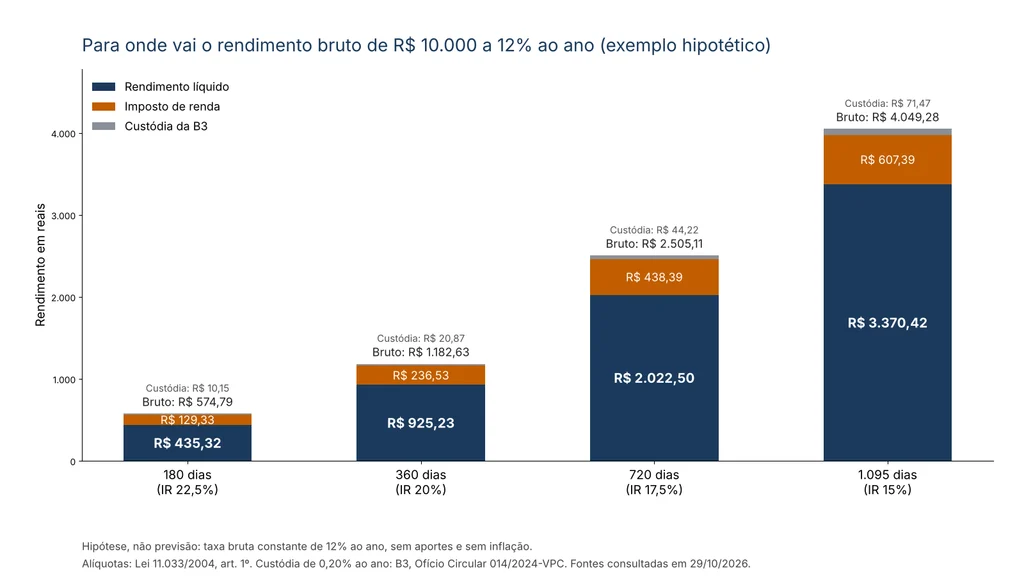
Hypothetical example: R$ 10,000 in four installments
| Deadline | Gross income | Income Tax | Custody | Net income | Net annual rate |
|---|---|---|---|---|---|
| 180 days | R$ 574.79 | R$ 129.33 (22.5%) | R$ 10.15 | R$ 435.32 | 9,02% |
| 360 days | R$ 1,182.63 | R$ 236.53 (20%) | R$ 20.87 | R$ 925.23 | 9,39% |
| 720 days | R$ 2,505.11 | R$ 438.39 (17.5%) | R$ 44.22 | R$ 2,022.50 | 9,79% |
| 1,095 days | R$ 4,049.28 | R$ 607.39 (15%) | R$ 71.47 | R$ 3,370.42 | 10,17% |
Note that the longer term not only yields more in reais: it also reduces the tax rate, and the annual net Treasury Direct rate rises from 9.02% to 10.17%. With a lower rate of 9% per year, the net return would be R$ 689.12 in 360 days and R$ 2,439.27 in 1,095 days, which shows how the result depends on the rate. The amounts are rounded, and the totals may differ by R$ 0.01. For another set of figures, see How much does R$10,000 yield in Tesouro Direto?.
How to Evaluate the Treasury Direct Rate Before Making a Decision
Comparing rates requires the same criteria on both sides. These points help organize the analysis:
- Deadline: When might you need the money? Selling before maturity may yield less than expected.
- Fee type: The fixed-rate and IPCA+ rates cannot be compared without estimating inflation for the period.
- Net value: Deduct custody fees and taxes from the term you intend to serve.
- Base: per year, gross or net, and always on the same date.
None of this constitutes a recommendation to buy. The decision depends on your time horizon, your risk tolerance, and the costs involved, and a qualified professional can help you evaluate it. See also how to invest in Tesouro Direto step by step.
Frequently Asked Questions
Where can I see the updated Treasury Direct rate?
In the yield table for Treasury Direct securities and in your institution’s investment section. Since the rate changes, always note the date and time of your inquiry.
Does the Treasury Direct rate change after I make a purchase?
With a fixed-rate bond, the purchase rate is locked in if you hold it until maturity. With Selic and IPCA+ bonds, only the fixed portion is locked in, while the Selic or IPCA continues to fluctuate. If you sell before maturity, the price follows market conditions.
How much does it cost to invest in Tesouro Direto?
These costs reduce the gross Tesouro Direto rate: there is a 0.20% annual custody fee charged by B3, with an exemption for Tesouro Selic up to R$10,000.00 per CPF, and income tax on the returns. Be sure to check your institution’s policy as well.
Is the tax levied on the entire amount invested?
No. It applies only to income, with a tax rate that decreases over time, from 22.5% to 15%, in accordance with the law cited above.
Before making a decision, open the table and note the gross Tesouro Direto rate for the security you’re interested in, along with its maturity date. Then, subtract custody fees and taxes from the term you intend to hold the security for, and compare only figures on the same basis.
- Tesouro Direto, bond yield table (CSV file) (accessed on October 29, 2026)
- B3, Circular Letter 014/2024-VPC, Tesouro Direto Fee Policy (accessed on October 29, 2026)
- Central Bank of Brazil, September 2026 Monetary Policy Report (accessed on October 29, 2026)
- Chamber of Deputies, Law No. 11,033 of 2004 (updated text) (accessed on October 29, 2026)
- Chamber of Deputies, Declaratory Act No. 67/2025 Issued by the Speaker of the House (accessed on October 29, 2026)
- Chamber of Deputies, Provisional Measure No. 1,303 of 2025 (accessed on October 29, 2026)
Notice: This content is for educational and informational purposes only. It does not constitute an investment recommendation, advisory service, or securities analysis, and does not take into account your situation, your objectives, or your risk tolerance. All investments involve risks, and past performance is no guarantee of future results. Rates, taxes, and regulations are subject to change: the data was sourced from the official sources indicated, as of the date stated at the beginning. Consult a licensed professional before making a decision. Illustrative images, when created by artificial intelligence, do not depict real institutions, products, or people.