In the world of digital finance, the quest to buy Bitcoin at a low price is a constant for those looking to optimize their investments. Given market volatility and the growing interest in digital assets, understanding the nuances and opportunities is crucial. This comprehensive guide from Fórmula da Riqueza unpacks the strategies, risks, and regulatory implications so you can make smart financial decisions and build a solid foundation for your security and success.
What Do Official Bodies Say About Bitcoin in Brazil?
In 2026, Bitcoin generates billions of reais in Brazil—and yet it is not recognized as a currency by the Central Bank. This contrast sums up everything you need to understand before making any purchase decision.
The Central Bank and the Official Position
O Central Bank of Brazil does not recognize Bitcoin as legal tender. The institution classifies cryptoassets as virtual assets, without government guarantees and without coverage from the Credit Guarantee Fund (FGC).
This means that if an exchange goes bankrupt or is hacked, there is no official mechanism for reimbursement. Unlike a CDB at Nubank or Inter, where up to R$ 250,000 per CPF is protected, Bitcoin exposes investors to a real counterparty risk.
⚠️ Common mistake: Many beginners compare Bitcoin to a bank investment. The lack of regulation as a currency completely changes the asset's risk profile.
The Federal Revenue Service and the Mandatory Filing Requirement
The Federal Revenue Service treats Bitcoin as an asset subject to capital gains tax. The reporting requirement applies regardless of the amount invested.
The rule of thumb in 2026:
- Monthly sales of crypto assets exceeding R$ 35,000 trigger a tax filing requirement
- Tax rates range from 15% to 22.5% on profits, depending on the income bracket
- Filing an income tax return is mandatory for anyone who holds crypto assets worth more than R$ 5,000
Failure to comply with these rules may result in a fine of 75% on the tax due, plus Selic interest. In many cases, the cost of this oversight exceeds the profit earned.
The Legal Framework for Cryptocurrencies in Brazil
A Law No. 14,478 of 2022 It established an initial regulatory framework for virtual asset service providers. In 2026, the Central Bank is moving forward with regulations for exchanges operating in the country.
This advancement brings greater operational safety to the sector, but it does not eliminate the volatility of the asset itself. The regulation protects the environment, not the price.
Once you understand the regulatory landscape, the next step is to analyze how to invest strategically—rather than simply reacting to the market.
Strategies for “Buying Bitcoin Cheaply”: DCA vs. Buy the Dip
There are two predominant approaches among investors in bitcoin investment, and each one caters to different profiles and goals. Understanding the difference can determine whether you enter the market with a strategic approach or on a whim.
Dollar-Cost Averaging: The Strategy of Consistency
O dollar-cost averaging (DCA) involves investing a fixed amount in Bitcoin at regular intervals, regardless of the price. You buy more units when the price falls and fewer when it rises.
In practice, this means:
- Reducing the impact of volatility on the average purchase price
- A discipline that eliminates the temptation to “go all in”
- A good fit for those with a steady monthly income who want to build their position gradually
📊 Quick Simulation: Those who invested R$ 300 per month in Bitcoin for 12 consecutive months during a period of high volatility have historically tended to achieve a more favorable average price than those who tried to buy only at the “bottoms” and got their timing wrong in 60% of their attempts.
Platforms such as Mercado Bitcoin, Coinbase, and Binance offer automated recurring purchase features, making it easy to implement DCA without any manual effort.
Buy the Dip: Opportunity or Trap?
“Buy the dip” is a strategy of buying Bitcoin after significant drops, betting on a recovery. It sounds simple. It rarely is.
The central issue: no one knows for sure whether a 20% drop marks the start of a recovery or the beginning of a 60% decline. Bitcoin has already fallen more than 80% from its peak in previous cycles.
This strategy requires:
- Consistent technical analysis or monitoring of indicators such as RSI and moving averages
- Capital reserve separate from the main equity
- Emotional resilience to withstand temporary losses without selling out of panic
💡 My personal take on this is straightforward: for most investors with a steady income, dollar-cost averaging delivers more predictable results and less stress than trying to time the market.
Best choice
For beginners and long-term investors: DCA with fixed monthly contributions.
For experienced investors with available capital: "Buy the dip" as a complementary strategy, never as the main one.

Visual Comparison of Investment Strategies for Bitcoin, Tesouro Direto, and CDB
Knowing how to buy is only half the equation. The other half—which most people overlook—lies in the costs that erode your profitability before you even realize it.
Costs, Fees, and Taxes: The Impact on Your Profitability with Bitcoin
A cryptocurrency taxation and operating expenses form a layer of costs that turns an apparent profit into a mediocre result. Mapping out these costs before investing is just as important as choosing the right strategy.
Exchange Fees: The Hidden Cost
Every buy and sell transaction on an exchange incurs a fee. The major platforms available in Brazil in 2026 charge:
| Exchange | Trading Fee (approx.) | Highlight | Who is it ideal for? |
|---|---|---|---|
| Bitcoin Market | 0.30% to 0.50% | Regulated Brazilian platform | Beginners and conservative investors |
| Binance | 0.101 TP3T (with BNB discount) | Greater global liquidity | Intermediate investors |
| Coinbase | 0.40% to 0.60% | Simple and secure interface | Those who prioritize usability |
| BTG Pactual Digital | Variable rate | Integration with a BTG digital account | Investors with a banking background |
📊 Quick Simulation: With an investment of R$ 10,000 and a monthly turnover on an exchange of 0.50% per transaction (buy + sell), the annual cost can reach R$ 1,200—equivalent to 12% of the capital. And that’s before any taxes.
Capital Gains Taxation
A cryptocurrency taxation In Brazil, a progressive scale is used:
- Income up to R$ 5 million: tax rate of 15%
- From R$ 5 million to R$ 10 million: 17.5%
- From R$ 10 million to R$ 30 million: 20%
- Above R$ 30 million: 22.5%
Payment is made via DARF by the last business day of the month following the sale. Late payments incur a fine of 0.33% per day, capped at 20%, plus Selic interest.
A Comparison of Actual Costs
Comparing Bitcoin to other assets requires honesty about total costs.
A CDB at Nubank yielding 100% of the CDI (approximately 13.25% per year in 2026) is subject to a regressive tax rate of 15% for terms longer than 720 days. There is no trading fee. Many products offer daily liquidity.
Bitcoin may outperform this return. However, transaction costs and taxes on gains significantly reduce the net return on short-term trades.
Knowing the costs changes the decision. The next step is to learn how to operate safely from the start.
Now that the numbers are on the table, it's time to figure out how to structure your market entry without making the mistakes that cost most beginners dearly.
Step-by-Step Guide: How to Start Investing in Bitcoin Safely
Opening an account on an exchange involves fewer steps than opening a digital account at a traditional bank. But operational simplicity does not eliminate the need for careful consideration when choosing a platform.
Choosing the Best Bitcoin Broker
A best Bitcoin broker For you, it depends on your profile. Be sure to evaluate:
- Central Bank Regulations (required starting in 2026)
- Safety Record and Public Audits
- Liquidity: daily trading volume on the platform
- Support in Portuguese and responsive customer service
- Withdrawal Fees for Brazilian Bank Accounts
Mercado Bitcoin and Foxbit are leading Brazilian platforms with years of experience. Binance and Coinbase offer greater global liquidity. BTG Pactual Digital integrates crypto assets into the banking ecosystem for customers who already bank with the bank.
💡 Smart Strategy: Start with a regulated domestic exchange for your first investments. Once you’ve become familiar with the market, consider international platforms to gain access to greater liquidity and more trading pairs.
Digital Wallet Security
Keeping Bitcoin on an exchange is convenient, but it poses a custody risk. The industry rule is clear: “Not your keys, not your coins.”
For amounts greater than R$ 5,000, consider the following:
- Software Portfolio (hot wallet): apps like Trust Wallet or MetaMask for frequent use
- Hardware portfolio (cold wallet): physical devices such as Ledger or Trezor for long-term storage
- Back up your seed phrase (12 to 24 words) in a secure physical location—never in the cloud
Setting Your Exposure Limit
Before buying, determine how much of your total net worth can be invested in crypto asset risks without jeopardizing your financial stability.
A widely used technical benchmark: between 1% and 5% of total assets for conservative investors. Up to 10% for moderate investors with a long-term horizon.
Never invest in Bitcoin with money from your emergency fund or with funds you'll need within the next 12 months.
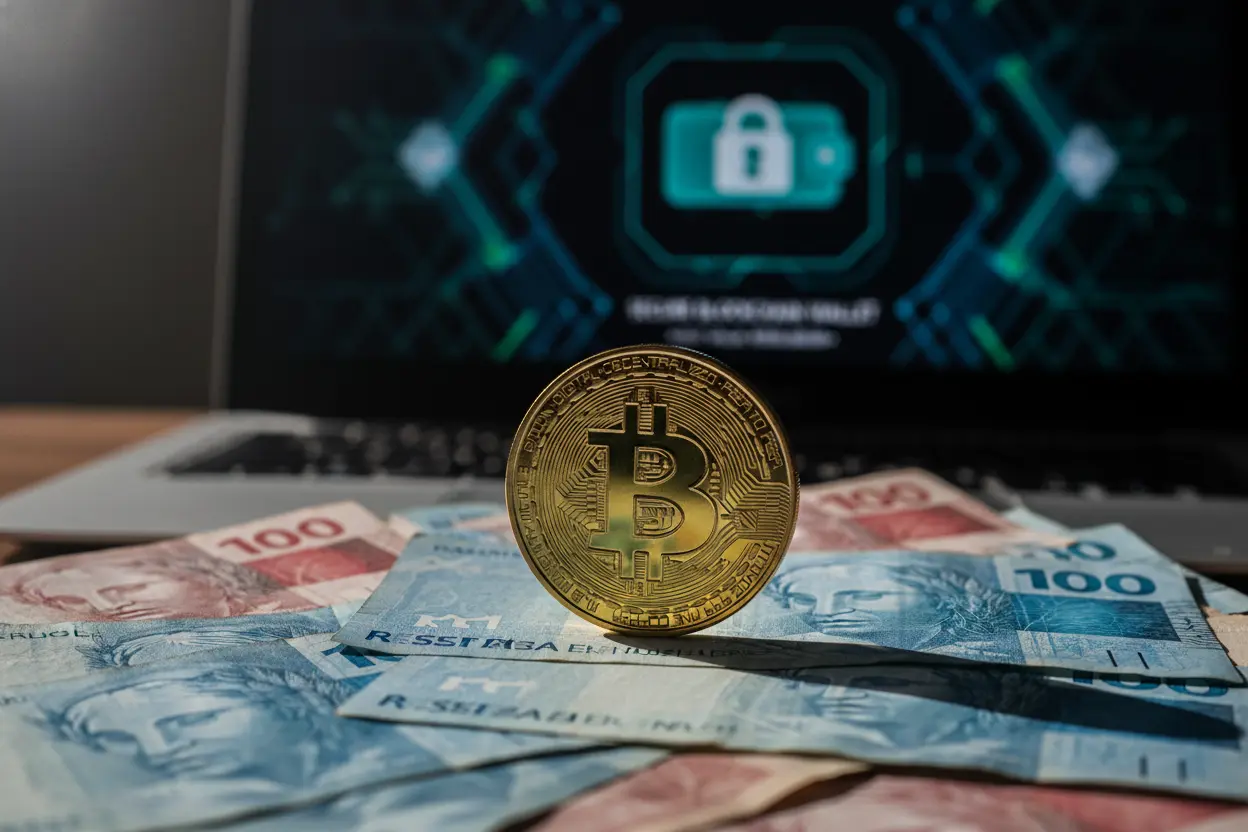
Security and planning are fundamental pillars for investing in Bitcoin responsibly
The domestic landscape takes on a whole new level of depth when we look at what is happening globally with Bitcoin as an asset class.
Global Trends and the Future of Bitcoin: ETFs and Institutional Adoption
The approval of Bitcoin ETFs The 2024 U.S. election marked a historic turning point. In 2026, the impact of that decision continues to reverberate through the structure of global demand for the asset.
Bitcoin ETFs: What Has Changed in Practice
The Bitcoin ETFs Spot markets allow institutional investors—pension funds, insurance companies, and asset managers—to gain exposure to Bitcoin without having to directly hold the asset in custody.
The observed result:
- Billions of dollars in institutional capital have flowed into the market
- Relative reduction in volatility compared to previous cycles
- Increased Correlation Between Bitcoin and Traditional Risk Assets During Times of Market Stress
In Brazil, the CVM has already authorized investment funds with exposure to cryptoassets. Asset management firms such as Hashdex and QR Asset offer regulated products for investors who prefer not to trade directly on exchanges.
The MiCA Global Regulation and Its Effects
The European MiCA (Markets in Crypto-Assets) regulation took full effect in 2026, establishing standards for crypto-asset issuers and service providers throughout the European Union.
The practical impact for Brazilian investors:
- Exchanges operating in Europe must comply with transparency and reserve requirements
- European regulatory standards tend to influence Brazilian regulations currently under development
- Greater legal certainty for international transactions
💡 Smart Strategy: Keeping up with global regulations is not optional for Bitcoin investors. Regulatory changes in major economies have historically tended to impact the asset’s price within weeks.
Institutional Adoption and the Demand Landscape
The outlook points to growing structural demand for Bitcoin as an alternative store of value. Companies such as MicroStrategy and sovereign wealth funds from Middle Eastern countries increased their holdings in 2025 and 2026.
This does not eliminate volatility. But it changes the profile of market participants—and, consequently, price dynamics during bull and bear markets.
Understanding global trends is essential. But no trend can eliminate the risks that must be at the heart of your capital protection strategy.
Even with all the knowledge about strategies and trends, an investor who ignores operational risks is exposed to losses that no market analysis can predict.
Protect Your Capital: Essential Safety Tips for Crypto Investors
The crypto asset risks are not limited to price volatility. Fraud, operational errors, and digital security breaches account for billions in global losses every year.
Volatility: The Risk You See
Bitcoin has already fallen more than 70% in less than 12 months in previous cycles. In 2026, volatility remains significantly higher than that of any fixed-income asset or even stocks of large companies.
⚠️ Common mistake: Invest an amount that you can’t afford to lose 50% without having to cash out. If a 50% decline would force you to sell, the amount you’ve allocated exceeds your actual risk tolerance limit.
Practical parameters for risk management:
- Set a maximum acceptable loss percentage before investing
- Never use leverage if you're a beginner—futures contracts can wipe out positions in a matter of hours
- Review your asset allocation every quarter as your total net worth changes
Fraud and Scams: The Risk You Don't See
The crypto asset space attracts fraudulent schemes at a rate higher than the average for the traditional financial market. The most common ones in 2026:
- Phishing: fake emails and websites that impersonate real exchanges to steal login credentials
- Rug pull: projects that raise funds and then disappear with investors' money
- Pyramid schemes disguised as staking: promises of high fixed returns with no real backing
- Romance Scams (Pig Butchering): emotional manipulation to induce transference
The first step in staying safe is to double-check: always access exchanges by typing the address directly into your browser. Never click on links received via email or WhatsApp.
Digital Security: The Layer That Protects Everything
Basic measures that drastically reduce operational risk:
- Two-factor authentication (2FA) using an authenticator app, not SMS
- A dedicated email address for crypto asset accounts, separate from your personal email address
- A unique and complex password for each platform, managed by a password vault
- Never share your seed phrase with anyone, under any circumstances
📊 Quick Simulation: An investor with R$ 20,000 in Bitcoin whose account is compromised by phishing because they did not use 2FA loses their entire investment, with no possibility of recovery through the Central Bank or the FGC. The cost of setting up 2FA: zero reais and five minutes.
Digital security is not optional. It is the foundation of any cryptoasset investment strategy.
This content is for information purposes only and does not constitute financial advice. Please consult a 2026 expert before investing.
Warning: The images used in this article are merely illustrative and may not accurately represent the content described.
Buying Bitcoin at a low price requires more than just luck: it demands strategy, knowledge of regulations, and an awareness of risks. By adopting approaches like DCA and understanding the tax implications, you’ll be better prepared. Remember: financial success comes from information and informed decisions. Start your journey safely and wisely!
FAQ – Common Questions About Buying Bitcoin Cheaply
We've created this section to directly address the most common questions we receive about investing in Bitcoin and the best time to get started.
No, Bitcoin does not offer a guaranteed return or predictable monthly dividends. Your earnings depend solely on the price appreciation in the market, which requires patience and a clear strategy for dealing with price fluctuations.
We must report cryptocurrencies on the Assets and Rights (Group 08) whenever the purchase price exceeds R$ 5,000.00. Please note that sales with a profit exceeding R$ 35,000 in a single month are subject to capital gains tax at rates starting at 15%.
Trying to predict the exact minimum price is extremely difficult; therefore, we suggest the strategy of DCA (regular contributions). This technique mitigates the risk of volatility and allows you to consistently capitalize on market declines without the pressure of having to “guess” the perfect timing.
Exchanges are great for trading, but for large amounts, we recommend using private wallets. Keeping your private keys in your own custody is the safest way to protect your assets against potential attacks or platform insolvency.
When you invest directly, you own the asset and have complete freedom to manage it, but you need to ensure its security. On the other hand, the ETF It is traded on the Stock Exchange (B3), offering the convenience of investing through a traditional brokerage firm, though management fees apply.