
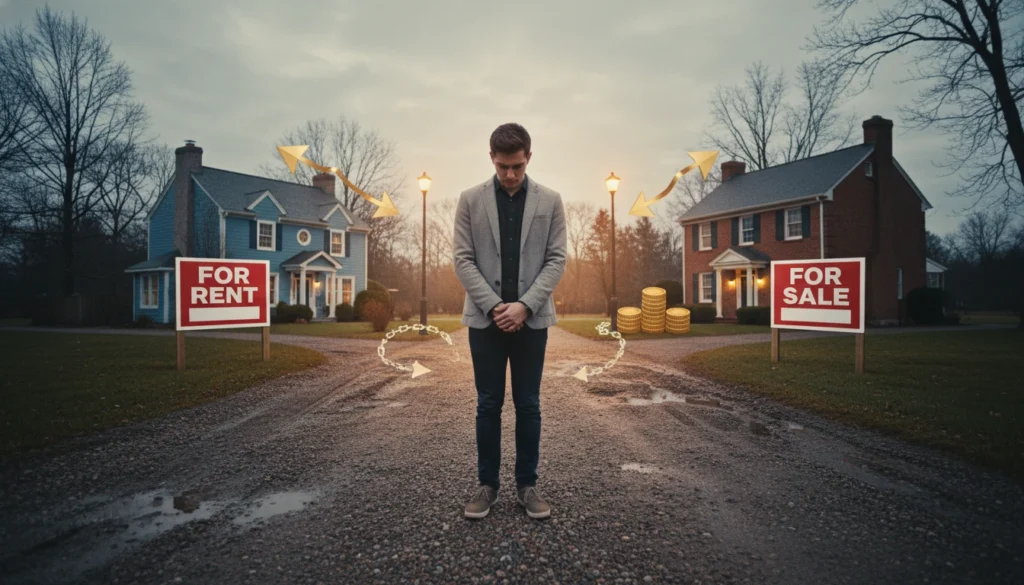
Should I rent or buy a home? This is a question that resonates with many Brazilians, representing one of the biggest financial and lifestyle dilemmas. The answer, as you can imagine, is not simple and is rarely straightforward.
It depends on a number of personal, economic, and even emotional factors. After all, we’re talking about a home—a place to call your own or a strategic investment for the future.
Highlights
- The decision between renting and buying a home goes beyond financial considerations; it also involves lifestyle.
- Initial costs, flexibility, and value are crucial factors to consider.
- Analyzing the market and its projections is essential for making an informed choice.
- Each option has clear advantages and disadvantages, which suit different profiles.
What is the main difference between renting and buying a property?
The main difference lies in ownership and costs. Renting offers flexibility and lower upfront costs, but does not build equity.
Buying guarantees ownership of the property and the potential for appreciation over time, although it requires a significant initial investment and full responsibility for maintenance and taxes.
This fundamental distinction shapes the entire analysis we will conduct below.
Renting: Freedom and Lower Upfront Costs?
Choosing to rent may seem like the easiest option for many people. There are no concerns about property taxes like IPTU, nor about major structural renovations.
Tenants are free to move with relative ease, adapting to new cities, jobs, or family needs. This provides a flexibility valuable in an ever-changing world.
Initial costs are generally lower, limited to a security deposit or rental insurance, in addition to the first month’s rent. This lower barrier to entry appeals to those who do not have substantial savings to cover the down payment on a property.
However, it’s important to recognize that rent money does not translate into equity. It is a fixed monthly expense that does not build an asset for the future.
Buying: Wealth and Long-Term Stability?
For many people, buying a home is a dream come true and a major step toward financial security. The buyer becomes the owner, building equity that can appreciate over time.
This appreciation in value, especially in booming markets, can be an excellent investment. In addition, owning your own home provides a sense of stability and the freedom to personalize the space without restrictions from a landlord.
The initial costs, however, are significant. The down payment, notary fees, ITBI (Real Estate Transfer Tax), and financing costs can add up to a considerable amount.
Responsibilities also increase dramatically. The owner is responsible for all maintenance, renovations, and taxes associated with the property.

The Mistake Many People Make When Making Decisions (and How to Avoid It)
A common mistake is to focus only on the monthly mortgage payment versus the rent. This simplistic comparison overlooks many other hidden costs and lost opportunities.
It is essential to look at the total cost of ownership or total rental cost over time. This includes taxes, insurance, maintenance, homeowners' association fees, and even the opportunity cost of the money that would be invested in the purchase.
To avoid this mistake, create a detailed spreadsheet. List all the costs associated with each option and compare them realistically. Also consider interest rates and inflation.
Quote: “Homeownership is more than just an asset; it’s a home and a refuge, but its financial value must be carefully considered.” – Robert Kiyosaki
Essential Tips for Your Decision: Rent or Buy?
The best choice depends largely on your current situation and your future plans. Consider these tips to help you make the best decision:
- Assess Your Financial Stability: Do you have an emergency fund? Is your income stable? Unexpected expenses related to your home can throw your budget off balance.
- Deadlines and Life Plans: Do you plan to live in the same city for many years? Do your career or family plans call for stability? Buying makes more sense for those looking for a long-term home. For more information on the Brazilian real estate market, visit the IBGE provides relevant data.
- Assessing Opportunity Cost: If you have the money for a down payment but decide to rent instead, where would you invest that capital? Could the returns on that investment outweigh the costs of owning a home?
- Learn About the Costs Beyond the Monthly Payment:
- Purchase: Down payment, property transfer tax (ITBI), notary fees, mandatory insurance, loan interest, maintenance, property tax (IPTU), and condominium fees.
- Rent: Security deposit/insurance, rent, condo fees, minor maintenance (as specified in the lease agreement).
- Real Estate Market Forecasts: Is the market in your region rising, falling, or stagnant? Buying in a rising market can be risky, while a falling market can present a good trading opportunity. Check interest rate data at the Central Bank of Brazil.
Comparison Chart: Renting vs. Buying
| Features | Rent | Buy |
|---|---|---|
| Initial Costs | Deposits (security deposit, first month's rent) | High (entry fees, taxes, fees) |
| Flexibility | Check-in (ease of moving in) | Decline (time-consuming sales processes) |
| Assets | It doesn't build | Builds and can add value |
| Responsibilities | Write-offs (minor maintenance) | Expenses (all maintenance costs, taxes) |
| Investment | Funds freed up for other investments | Fixed capital, with potential for return |
| Stability | Fixed-term contract | Permanent (with possession of the property) |
The Impact of Interest Rates and Inflation
Mortgage interest rates and inflation are crucial factors. High interest rates significantly increase the total cost of the purchase. Inflation, on the other hand, can erode the purchasing power of your rent or, paradoxically, increase the value of your property.
Long-term planning should take these macroeconomic factors into account. Don't forget that financing is a commitment that spans decades.
Conclusion: Rent or Buy a Home? The Financial Dilemma Explained!
The decision between renting and buying a home is a personal journey, full of financial and life-related considerations. There is no one-size-fits-all answer—only the best answer for you at this specific point in your life.
Consider your goals, your financial situation, and your lifestyle. Do thorough research, talk to experts, and use simulation tools. Whatever you decide, make sure it’s an informed decision that brings you peace of mind for the future.
Frequently Asked Questions
Not necessarily. It depends on the property's appreciation, maintenance costs, mortgage interest rates, and the returns on alternative investments you could make with the down payment.
Experts recommend a down payment of at least 20% to 30% of the property's value to secure better financing terms and reduce the total amount of interest paid.
It is the value of the benefit you give up when you choose one option over another. For example, if you buy a property, the opportunity cost could be the return you would earn by investing the down payment and monthly payments elsewhere.
The main taxes and fees are the Real Estate Transfer Tax (ITBI), notary fees for registration, and, annually, the Urban Property Tax (IPTU) and condominium fees (if applicable).
Indirectly, yes. If, when renting, you invest the difference you would spend on a purchase (down payment, interest, taxes) in high-yield financial investments, you can accumulate greater and more liquid assets than you would by buying a property.