

Organizing your personal finances is the first step towards building a solid financial life and achieving the freedom you dream of. Many people are looking for effective methods, and the 50-30-20 rule for organizing finances has emerged as a practical solution. This complete guide to the “Wealth Formula” will show you how to apply this strategy to optimize your budget, increase your investments and ultimately build a prosperous financial future. Get ready to transform your relationship with money.
What is the 50-30-20 Rule and why use it?
Many Brazilians feel that their salary disappears before the end of the month. Organizing the budget seems an impossible task without a clear method. Learn how to use the 50-30-20 rule to organize finances has emerged as the most practical solution for those looking for predictability.
The logic of this method is to divide your net income into three large slices. You allocate 50% for basic needs, 30% for personal desires and 20% for your financial future. This division prevents you from overspending on leisure while neglecting the investment monthly payment necessary for your freedom.
This structure works because it is flexible and realistic. Unlike restrictive financial diets, it allows you to spend on what you like. The key is to keep fixed costs under control so that the rest of the plan doesn't fall apart.
If you use credit card, You know how easy it is to lose track of the limit. The 50-30-20 rule creates invisible barriers that protect your assets. It transforms the mess of bills into a system of priorities where you own your money.
Step by step: how to use the 50-30-20 rule to organize finances
First, you need to calculate your real net income. Add up all your monthly earnings after tax and social security deductions. Use your digital account to identify exactly how much goes into your account each month.
Categorize each expense from the last thirty days. Separate what is essential, such as rent and groceries, from what is superfluous, such as streaming subscriptions and dining out. If your essential expenses exceed 50%, you'll need to cut costs or look for immediate extra income.
Adjust the values to fit the suggested percentages. Use applications such as Mobills or the Google Sheets spreadsheet itself to monitor progress. It's essential that you review these figures every week so that you don't get any nasty surprises on the 30th.
I particularly notice that people's greatest difficulty is not mathematics, but the discipline to classify spending correctly. We often call something a “need” that is just a momentary desire for consumption. Be honest with yourself during this sorting process.
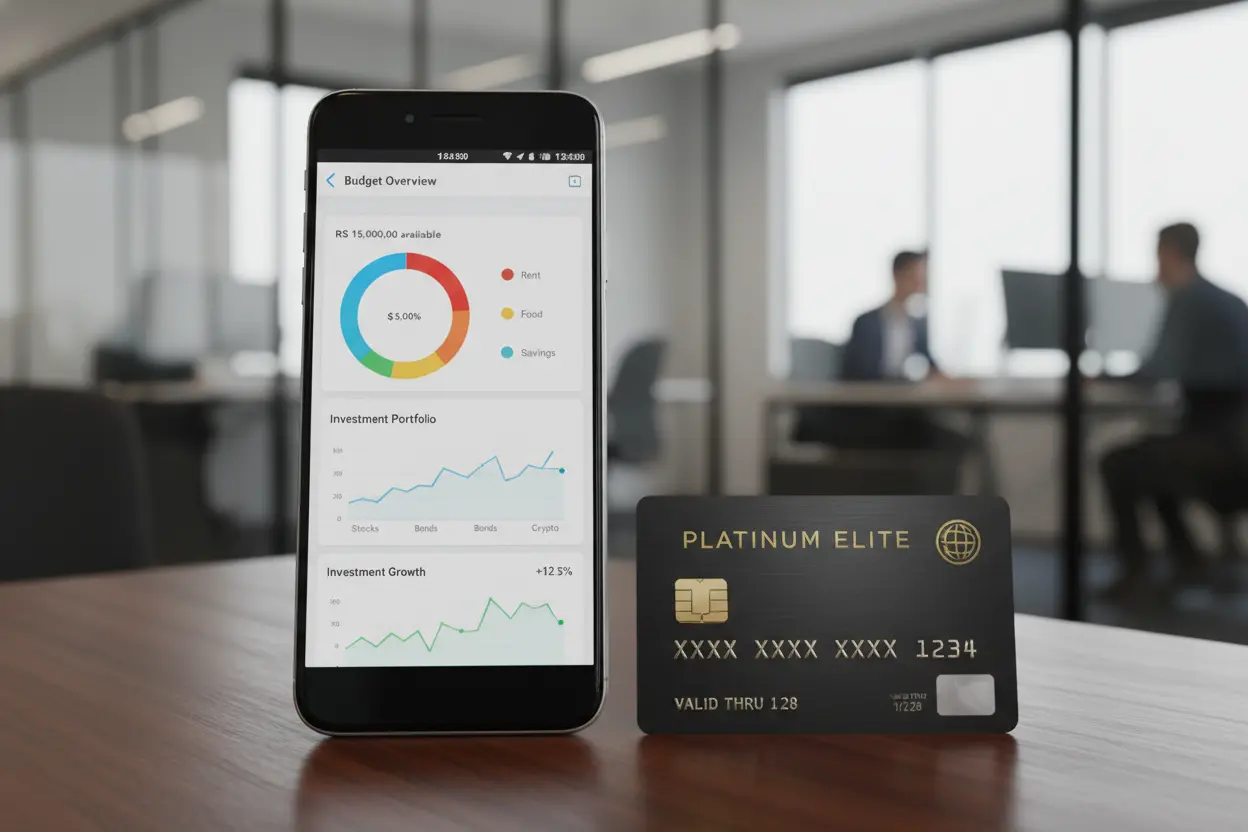
Learn how to distribute your money wisely with the 50-30-20 rule.
50% Needs: Optimizing essential spending with apps
Essential expenses are those you can't ignore without suffering serious consequences. Rent, condominium, electricity, water, internet and basic food fall into this category. Keeping these costs within 50% of your income requires strategy and constant monitoring.
Digital banks like Nubank and Banco Inter offer automatic categorization tools. They help you see if your cost of living is overinflated. If rent consumes 40% of your income, there will be little left over for other needs, which unbalances the rule.
Negotiate your service contracts annually. Internet and telephone plans usually have better prices for new customers, and you can demand the same amount. Small savings on these bills free up margin for you to focus on what really matters.
Keep a reserve for unforeseen household circumstances within this slice. Urgent repairs or medicines are among the necessities. Planning for these expenses prevents you from resorting to expensive loans or using the overdraft limit in a disorderly manner.
30% Desires: Financial balance and conscious consumption
Living isn't just about paying bills, and the 50-30-20 rule respects that. The 30% earmarked for personal desires includes going to the movies, traveling, hobbies and that gourmet coffee. This slice ensures that you maintain the motivation to keep saving in the long term.
Managing your card limit is vital here. The ideal is to concentrate these expenses on a single card to make it easier to see the total amount. If you reach the 30% ceiling before the month is out, the extra pleasures should be paused immediately.
Conscious consumption means choosing where to spend for maximum satisfaction. Prefer experiences that add value to your life rather than impulse purchases that will stay in the drawer. Financial balance comes from the ability to say “no” today in order to have a bigger “yes” tomorrow.
Many experts focus only on cutting costs, but leisure is an investment in your mental health. When you know exactly how much you can spend on fun, guilt disappears. You enjoy the moment knowing that the mandatory bills are already taken care of.

Use technology to control your spending and investments according to the 50-30-20 rule.
20% Investments: Profitability and the best CDB or Treasury
A parte mais importante da estratégia é o destino dos 20% finais. Esse dinheiro deve trabalhar para você através de juros compostos. Antes de buscar ativos arriscados, foque em construir sua reserva de emergência em ativos de alta liquidez.
O CDB with daily liquidity is an excellent entry point. Institutions such as Banco Daycoval or Sofisa Direto usually offer rates above 100% of the CDI. Always compare the net yield, minus income tax, before investing.
Another solid option is Treasury Direct, especificamente o Tesouro Selic. Ele é considerado o investimento mais seguro do país. É ideal para quem busca estabilidade e quer fugir da poupança, que rende muito menos que a inflação atual.
| Financial Product | Estimated profitability | Liquidity | Risk |
|---|---|---|---|
| CDB 100% CDI | ~10,65% per year | Daily | Low (FGC) |
| Selic Treasury | Selic + Rate | Daily (D+1) | Minimum |
| LCI/LCA | Exempt from income tax | 90 days + | Low (FGC) |
To find best interest rate in fixed income, Use brokers such as XP Investimentos or Rico. They offer access to products from smaller banks that pay higher premiums than traditional banks. Diversifying these 20% between safety and a little risk is the way to get rich.
50-30-20 Rule vs. Traditional Budget: Which pays more?
Traditional budgeting usually focuses on writing down every penny spent in complex spreadsheets. Although detailed, it is often abandoned because it is too tiring and bureaucratic. Understanding how to use the 50-30-20 rule to organize finances simplifies this process by focusing on macro categories.
The great advantage of the 50-30-20 rule is the focus on saving right from the start. In the traditional method, people tend to save only what's left over, which rarely happens. By separating the 20% as soon as your salary drops, you prioritize your future self.
For more conservative profiles, zero-based budgeting can be more precise. In it, every dollar has a specific destination before the month begins. However, the 50-30-20 rule wins in longevity, as it is easier to maintain for years on end without stress.
I believe that the method that “yields the most” is the one that you can execute consistently. There's no point in having a perfect spreadsheet if you haven't opened it for three months. The simplicity of the 50-30-20 rule is what allows you to accumulate real wealth over the long term.
Banks and Brokers: Where to invest with the 50-30-20 Rule
Choosing the right institution makes all the difference when it comes to implementing your plan. Nubank and C6 Bank are great for managing 50%s and 30%s because of their intuitive interfaces. They allow you to create “little boxes” or “goals” that separate the money visually.
For 20% investments, independent brokers have the edge over retail banks. BTG Pactual and Toro Investimentos offer robust platforms with free market analysis. This helps identify opportunities where your money will yield more with the same security.
| Institution | Main advantage | Usage Profile |
|---|---|---|
| Nubank | Ease of use and organization | Daily expenses |
| Inter Bank | Cashback shopping and investments | Hybrid use |
| XP Investments | Variety of fixed income products | Focus on 20% |
| Bank of Brazil | Institutional security and tradition | Conservative profile |
We recommend using a digital account for day-to-day life and a separate brokerage for investments. This physical separation of money avoids the temptation to withdraw what should have been saved to cover a superfluous expense. Keeping your money out of sight helps keep it safe in your wallet.
Credit Card and Loan: Impact of the rule on the limit
Following this methodology drastically improves your credit profile with institutions. When you organize your finances, you avoid late payments and maintain a low debt ratio. This reflects directly on your Serasa Score and market confidence.
Banks like Santander and Bradesco use algorithms that reward financial constancy. By demonstrating that you save 20% of your income, the bank understands that you are a low-risk customer. This makes it easier to obtain higher limits and approval for real estate financing.
Know how to use the 50-30-20 rule to organize finances also allows you to negotiate lower rates. If you need a personal loan, you'll have arguments to demand lower interest rates because you're a good payer. Financial organization is your greatest bargaining tool vis-à-vis the banking system.
Remember that credit should be a leverage tool, not an income supplement. Use the card to centralize spending and earn miles, but always pay the full amount of the bill. Discipline with the 50-30-20 rule is what separates those who pay interest from those who receive interest.
This content is for information purposes only and does not constitute financial advice.
Consult an expert before making investment decisions.
FAQ - Common questions about using the 50-30-20 rule to organize finances
We've prepared this section to clarify the most frequently asked questions and help you master your financial organization with total clarity and practicality.
Yes, we believe that flexibility is fundamental to financial success. If you can't apply the 50-30-20 right away, start with proportions like 60-30-10 and gradually adjust as you manage to reduce your fixed costs.
In this scenario, we recommend that 20% for financial security be used primarily to pay off high-interest debts. Once the bills are settled, you can redirect this money to investments and your emergency reserve.
For those starting out, we suggest fixed-income options with high liquidity, such as the Selic Treasury or CDBs with yields above 100% of the CDI. Institutions like Nubank, Inter and brokers like XP make it very easy to invest directly through the app.
Indirectly, yes. By learning how to use the 50-30-20 rule to organize finances, You show the bank that you have control over your spending and your ability to pay. This improves your credit score, This makes it easier to approve higher limits and better loan rates.
We define it as needs (50%) everything that is essential for their survival and work, such as rent and basic food. The wishes (30%) are lifestyle and leisure expenses, such as streaming subscriptions, restaurant visits and impulse purchases.