

Have you ever wondered how experienced investors manage to minimize risks and maximize returns, even in volatile markets? The answer often lies in one fundamental strategy: diversification. Understanding what is a diversified portfolio is the first step towards building a more secure and prosperous financial future.
Together we will explore the pillars of this intelligent approach, showing how it can transform your investment journey. Get ready to unlock the secrets of a robust and resilient portfolio, capable of facing any economic scenario with confidence and intelligence.
What is a Diversified Portfolio and Why is it Crucial?
We always hear that we shouldn't put all the eggs in one basket.
This phrase sums up what a diversified portfolio.
In practice, diversification means distributing your money in different types of investments.
The main objective here is to protecting your assets.
When you invest in just one company or sector, you run the risk of total risk.
If this sector does badly, all your money suffers the immediate impact.
By diversifying, we create a natural armor against market fluctuations.
This is because different assets react differently to economic events.
While stock prices may fall during a crisis, the gold or dollar can go up.
This balance is what we call risk mitigation.
We seek to reduce potential losses without giving up good gains.
A diversified portfolio allows you to sleep soundly, even in difficult times. volatility.
In the long term, this strategy brings much higher returns consistent.
It's not about winning everything at once, but about grow safely.
Diversification is the only “free lunch” in the world of finance.
It protects you from individual mistakes and unforeseen events that no one can predict.
Therefore, understanding this concept is the first step towards your financial success.
We believe that diversification is the basis of any solid strategy.
Without it, you're not investing, you're just betting on luck.
Types of Assets to Diversify Your Portfolio
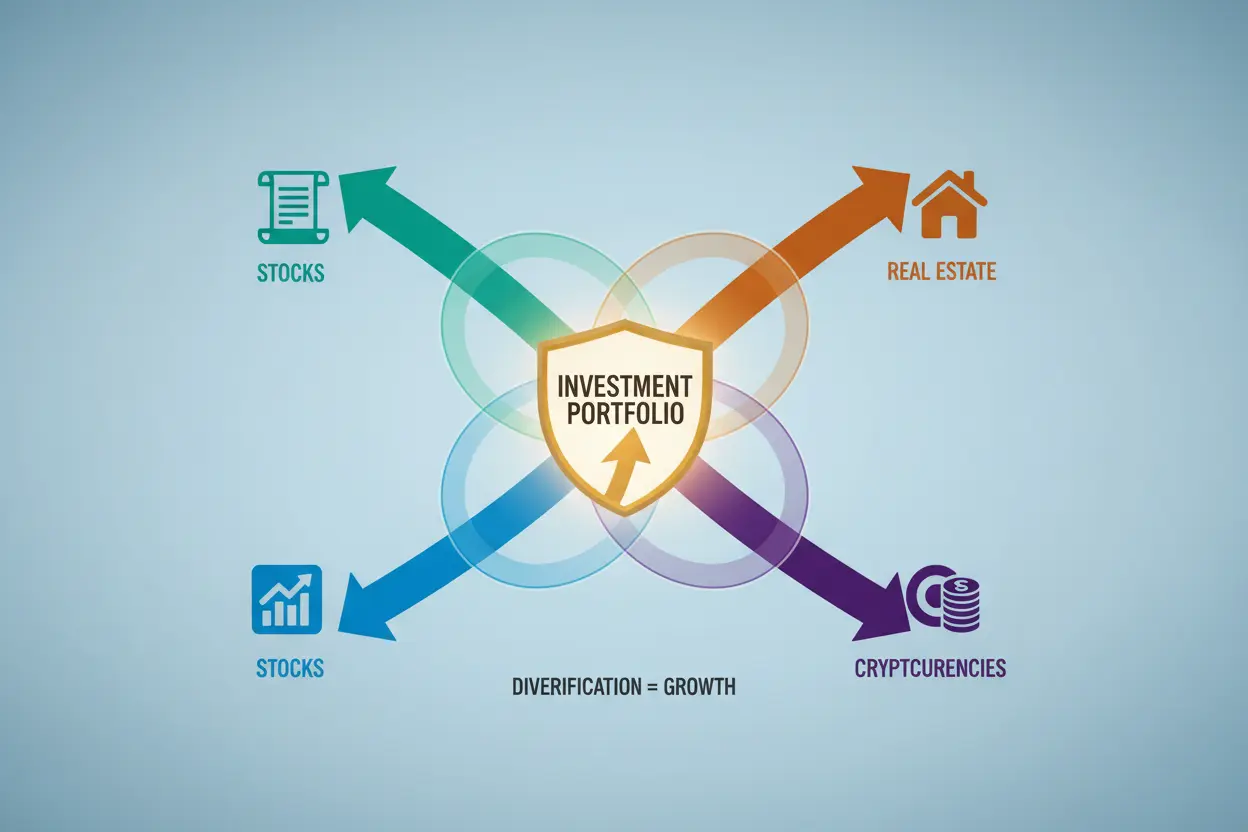
To build a strong portfolio, we need to know the asset classes.
Each class fulfills a specific role within its planning.
Below, we list the main types of assets we use to diversify:
- Fixed Income: It is the security basis of the portfolio.
- Direct Treasury Government loans are the safest in the country.
- CDBs: Bonds issued by banks with excellent rates of return.
- Equities: Focused on growth and generating passive income.
- Actions: You become a partner in big companies and profit from them.
- Real Estate Investment Funds (FIIs): Receive monthly “rents” without having to buy a physical property.
- Cryptocurrencies: Digital assets such as Bitcoin, focused on high appreciation potential.
- International investments: Dollar protection and access to the global market.
We can organize these assets in a table to make them easier to see:
| Type of Asset | Risk Level | Main objective |
|---|---|---|
| Fixed Income | Bass | Security and booking |
| Actions | High | Capital appreciation |
| FIIs | Medium | Monthly Income (Dividends) |
| Crypto | Very high | Speculation and Technology |
| International | Medium/High | Exchange Rate Protection (Dollar) |
Fixed Income works like our anchor in times of storm.
It ensures that you have liquidity and stability when the market falls.
Variable Income is our engine of growth.
It is through this that we have been able to significantly outstrip inflation.
Real estate funds are excellent for those looking for cash flow.
They deposit money into your account every month on a recurring basis.
The cryptocurrencies bring innovation and the potential for exponential gains.
Finally, investing abroad protects us against internal crises in Brazil.
By combining these elements, we create a financial ecosystem resilient.
Each asset compensates for the weakness of the other, creating a perfect balance.
How to Build and Rebalance Your Ideal Portfolio
The first step to building your portfolio is to know your risk profile.
We need to know whether you are conservative, moderate or bold.
This defines how much “scare” you can bear to see on your investment screen.
Then we looked at their financial objectives.
Do you want to retire, buy a house or just protect your purchasing power?
O time horizon is also fundamental to this account.
Money for a year from now should be in different places from money for 10 years.
A simple rule we use is percentage allocation.
For example: 50% in Fixed Income, 30% in Shares and 20% in FIIs.
But it's not enough just to buy the assets and forget that they exist.
The market moves and the proportions of your portfolio will change by themselves.
If stocks go up a lot, they could take up 40%s in your portfolio.
This is where periodic rebalancing.
Rebalancing is the act of adjusting your portfolio to return to the original target.
We recommend doing this every six months or once a year.
The rebalancing process is simple and very intelligent:
- Identify which assets have grown beyond their means.
- See which assets have fallen below the desired percentage.
- Put new money into assets that are “behind”.
- If necessary, sell some of what has risen and buy what has fallen.
This forces us to do what every successful investor does.
We ended up buying low e selling high automatically.
Rebalancing controls risk and boosts your profit in the long term.
Also, adjust your portfolio as your life changes.
If you're getting close to retirement, we've increased the Fixed Income.
If you are young and have a stable income, we can be more daring in the Equities.
The ideal wallet is one that respects your moment and your dreams.
Common Diversification Mistakes and How to Avoid Them

Many investors believe they are diversifying, but make serious mistakes.
The most common mistake is the so-called false diversification.
This happens when you buy five different shares, but all from the same sector.
If you only invest in banks, your portfolio is not protected against a banking crisis.
We must look for assets that have low correlation each other.
Another dangerous trap is over-diversification.
Investing in 50 different companies can dilute your returns too much.
If you have little money in each thing, no gain will be relevant.
We call this “pulverization”, and it gets in the way of tracking assets.
The ideal is to have a number of assets that you can study and monitor.
A lack of research also destroys a lot of heritage.
Never invest in something just because a friend or influencer recommended it.
We need to understand where we are putting our hard-earned money.
Study the basics about each company or fund before clicking “buy”.
Another classic mistake is forgetting to look at the costs and fees.
Many investment funds charge high fees that eat into your profit.
We always look for options with fair rates and good tax efficiency.
To avoid these mistakes, follow these practical tips:
- Vary the sectors: Banks, energy, technology and retail.
- Vary the coins: Always keep part of your capital in dollars.
- Keep it simple: Don't complicate your strategy unnecessarily.
- Review your assets: Check that the companies are still good periodically.
Intelligent diversification requires discipline and a little study.
Don't try shortcuts or magic formulas to get rich quick.
The secret lies in solid strategy and the patience to let time act.
We are here to help you build this path with clarity.
Avoiding these mistakes is half the battle towards a prosperous financial life.
Now that you know how to protect your investments, it's time to act!
Did you enjoy learning how to protect your money with a diversified portfolio? Don't stop here! Subscribe to our newsletter now and receive exclusive tips from Jeferson Santos to accelerate your journey to financial freedom!
Your Path to Financial Security Starts Now!
We saw that understanding what is a diversified portfolio and applying it is more than a strategy; it's an investment philosophy that protects and drives us forward. By spreading your investments intelligently, you build a solid foundation for your finances, paving the way for peace of mind and the realization of your goals.
Don't put it off! Share your doubts and experiences in the comments below. Your journey to a more secure and prosperous financial life is one step at a time, and we're here to accompany you!
FAQ - Common Questions About Diversified Portfolios
We've prepared this section to answer your main questions about how to protect your assets and maximize your profits in a smart way.
For us, a diversified portfolio is an allocation strategy where we distribute capital between different asset classes, such as fixed income, shares and real estate funds. The main objective is to reduce exposure to specific risks, ensuring that the fall in one investment does not jeopardize all your assets.
Absolutely not. We believe that diversification is accessible to everyone, because today it is possible to invest in fund shares or fractions of assets with very low values. The key is to start with what you have, focusing on learning what is a diversified portfolio and how to build your own little by little.
There is no magic number, but we suggest that you have enough assets to dilute risks without making monitoring difficult. Generally, keep between 8 to 15 assets from different sectors and classes already offers robust protection against market volatility.
By concentrating your resources in just one type of investment, you become vulnerable to crises specific to that sector or asset. We warn that a lack of diversification can lead to severe property losses, While a balanced portfolio smooths out oscillations and brings more consistent returns.
We recommend carrying out a technical review at least once or twice a year, or when an asset appreciates so much that it now represents a much larger share than planned. Rebalancing serves to sell what has gone up and buy what is cheap, maintaining your original strategy of diversified portfolio.