

Você está pronto para dar um passo decisivo rumo à sua independência financeira? O Treasury Direct é uma das opções de investimento mais seguras e acessíveis do Brasil, ideal para quem busca construir um patrimônio sólido. Seja para realizar sonhos de curto prazo ou garantir uma aposentadoria tranquila, entender como investir no Tesouro Direto é essencial.
This complete guide demystifies the process, showing you every step you need to take to start earning money safely and intelligently, comparing options and maximizing your profits.
What is Treasury Direct and Why Invest?
Many Brazilians still believe that investing is something restricted to those with large fortunes. O Treasury Direct was created precisely to break down this barrier, allowing contributions from around R$ 30.00. This is a National Treasury program created to sell federal government bonds directly to individuals.
Basically, when you buy a bond, you lend money to the federal government. In return, the government pays you back with interest at an agreed future date. This is the fixed income the safest in the country, because the government itself is the guarantor.
We see the Treasury as the safe haven for any portfolio. If the government can't pay its debts, no private bank can. That's why it's safer than any savings account or commercial bank CDB.
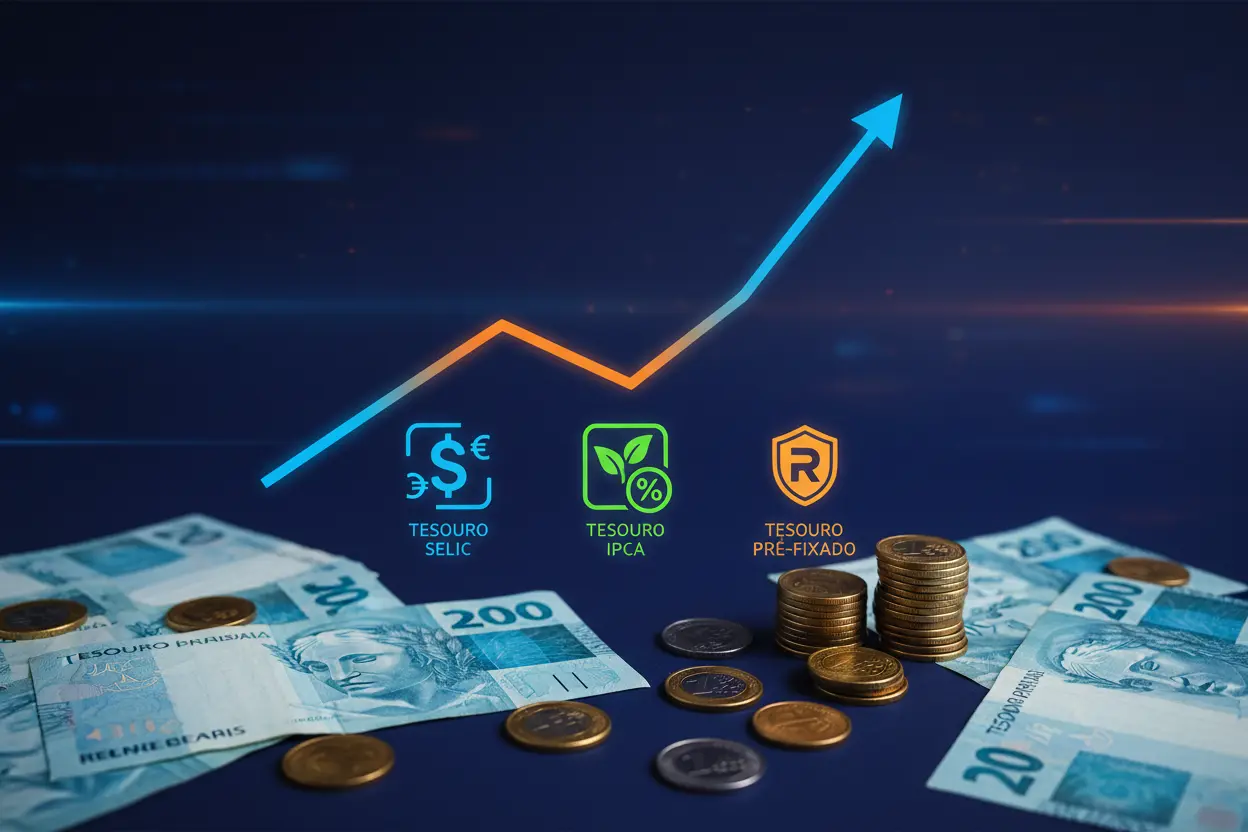
The diversity of bonds allows you to plan everything from buying a car to your retirement. There are bonds that track inflation, others with a fixed rate and the famous Selic Treasury. Each one meets a specific profile of needs and timeframe.
Personally, I consider Tesouro Direto to be the foundation of any solid asset. Starting here prevents you from falling into high-risk traps before you have an emergency reserve. It's the first step for anyone who wants to get out of financial inertia.
Recomendamos o Tesouro Direto para quem busca previsibilidade. Você sabe exatamente como a rentabilidade será calculada no momento da compra. Isso traz uma paz de espírito que ativos variáveis, como ações, dificilmente oferecem no curto prazo.
How to Open an Account and Invest in Treasury Direct
The process of getting started is much simpler than it sounds. First, you need to choose a investment broker that is authorized by the National Treasury. Institutions such as XP Investimentos and BTG Pactual are benchmarks in the market for the robustness of their platforms.
Once you've chosen an institution, the next step is to register digitally. Usually, all you need to do is send photos of your documents and fill in a quick registration form. Once your account has been approved, you must transfer the money from your bank via TED or Pix to the broker.
Learning how to invest in treasury direct step by step requires attention to detail on the platform. Within the broker's app, look for the Fixed Income tab and select Treasury Direct. There you will see a list of all the securities available for immediate purchase.
Look at the maturities and minimum values for each paper. When you click on “Invest”, you set the amount and confirm the transaction with your electronic signature. The security will appear in your custody within two working days of settlement.
We suggest you start with the Selic Treasury if you are building up your emergency reserve. It has daily liquidity and the lowest risk of loss in the event of early redemption. It is the ideal entry point for the novice investor.
| Step | Action Needed | Estimated time |
|---|---|---|
| 1 | Choose a broker (e.g. XP, BTG) | 5 minutes |
| 2 | Transfer Funds (Pix/TED) | Instant |
| 3 | Select the Title | 2 minutes |
| 4 | Confirm Investment | 1 minute |
Treasury Direct Rates and Real Profitability
Investing requires an understanding of the costs involved in order to avoid surprises at the time of redemption. The Treasury rates are mainly made up of B3's custody fee, which is 0.20% per year. Note that there is an exemption for investments of up to R$ 10,000.00 in the Selic Treasury.
In addition to B3, some brokers may charge an administration fee, although the majority now charge zero. Income tax (IR) follows the regressive table for fixed income. It starts at 22.5% for redemptions within 180 days and drops to 15% after two years.
A profitability real is what's left over after inflation and taxes have been deducted. If you invest in the IPCA+ Treasury, the bond already guarantees a gain above the increase in prices. This is essential for maintaining the purchasing power of your money over the decades.
Fixed-rate bonds, on the other hand, lock in a specific rate, such as 11% per year. If inflation rises too much, your real gain decreases. With Selic Treasuries, on the other hand, the return follows the economy's basic interest rate, making them excellent for short terms.
| Type of Title | Return Indicator | Best use |
|---|---|---|
| Selic Treasury | Selic rate | Emergency Reserve |
| IPCA+ Treasury | Inflation + Fixed Rate | Retirement / Long Term |
| Prefixed Treasury | Fixed Rate (ex: 12%) | Falling Interest Rates Scenario |
Our recommendation is to always focus on the net yield. Don't just look at the gross rate on the broker's screen. Consider how long the money will sit idle in order to take advantage of 15%'s lower IR rate.
Tesouro Direto vs. CDB: Which is Best for You?
Deciding between the Treasury and a CDB (Bank Deposit Certificate) raises many questions. A CDB is a loan you make to a bank, such as Nubank or Banco Inter. The security here comes from the FGC (Fundo Garantidor de Créditos) up to a limit of R$ 250 thousand.
To compare investments, In addition, we realized that smaller banks tend to offer higher rates than Tesouro Direto. A CDB from a digital bank can pay 110% of the CDI, while the Selic Treasury yields close to 100% of the CDI. The risk, however, is slightly higher at the bank.
Liquidity is another point for immediate attention. In Treasury Direct, the government guarantees the daily repurchase of securities. In CDBs, some have liquidity only at maturity, which can tie up your money for years if you're not careful.
We have observed that for very high amounts, the Treasury is more advantageous due to the absence of a guarantee ceiling. If you have R$ 1 million, the FGC won't cover everything in the event of a bank failure. With the National Treasury, there is no such financial protection limit.
For those looking for maximum returns with acceptable security, diversifying between the two is the way to go. Use the Selic Treasury for money you might need tomorrow. Use CDBs from solid banks to look for a few percentage points more in the medium term.

Choosing the Best Broker for Tesouro Direto
A escolha da plataforma impacta diretamente na sua experiência como investidor. Corretoras como a Rico e a Clear são muito populares por serem totalmente digitais e focadas em custo zero. A Clear, especificamente, é a queridinha de quem também deseja operar na Bolsa de Valores.
Ágora Investimentos, linked to Bradesco, offers more traditional support and in-depth analysis reports. If you value human service and integration with your traditional bank, it could be a viable option. However, always check for extra fees.
BTG Pactual stands out for its fluid interface and 24-hour support. For those who are leaving savings now, having an intuitive app makes all the difference. Avoid overly complex platforms if your goal is just to buy government bonds in a simple way.
We believe that the best broker is the one that doesn't bite into your profitability with unnecessary fees. Today, zero fees for Tesouro Direto are the market standard. If your broker charges self-custody, seriously consider switching institutions to optimize your gains.
XP Investimentos and BTG are our top recommendations for those looking for solidity. Both have complete ecosystems that allow you to move on to other products as your knowledge grows. Starting with the big boys brings an extra layer of institutional security to your capital.
Tips for Maximizing Your Treasury Direct Profits
Taking advantage of the power of compound interest requires discipline and constant contributions. Reinvesting the biannual coupons, if you opt for bonds that pay periodic interest, is essential for the cake to grow. Bonds without coupons are usually more efficient for accumulating wealth.
Understanding mark-to-market can generate significant gains above the contracted rate. When interest rates fall, the price of fixed-rate and IPCA+ bonds rises. If you sell the bond at this time of appreciation, you can profit much more than expected.
Diversifying maturities protects your portfolio from sudden swings. Have a portion in short bonds for liquidity and another in long bonds to capture higher premiums. The financial market changes fast and being positioned on different fronts is a smart strategy.
Follow the Focus bulletin every week to understand the inflation and Selic projections. If inflation is expected to rise, the IPCA+ Treasury becomes the protagonist. If interest rates are going to fall, fixed-rate securities can guarantee an excellent return before the drop.
This content is for information purposes only and does not constitute financial advice. Please consult an expert before making investment decisions.
Always focus on your personal long-term goals. Tesouro Direto is not a get-rich-quick tool, but one for building solid wealth. With patience and monthly contributions, you will see the transformative power of fixed income in your financial future.
FAQ - Common Doubts on how to invest in Tesouro Direto step by step
We've prepared this section to answer the most frequently asked questions and help you start your investment journey in complete safety.
We can start investing in Treasury Direct with very affordable amounts, starting at around R$ 30,00. This allows anyone to learn how to invest in Tesouro Direto step by step and gradually build up your assets.
Yes, government bonds are considered the assets of lower risk of the Brazilian economy, as they are guaranteed by the National Treasury. By investing in them, we have the maximum security that the Federal Government will honor the payment of the debt.
Yes, the National Treasury guarantees daily buyback of the bonds, which offers investors liquidity. However, we recommend paying attention to the mark-to-market, which can cause the value of the bond to fluctuate if it is redeemed before the deadline.
Investments in Tesouro Direto are subject to Income tax, The tax rate is based on a regressive table (the longer the money is invested, the less tax we pay). In addition, there is B3's custody fee, although the Selic Treasury is exempt for investments of up to R$ 10 thousand.