

- What is it: The 2026 income tax exemption is a reduction in the monthly tax, established by Law 15,270/2025, which eliminates the tax on taxable income of up to R$ 5,000.00 per month.
- Transition: Between R$ 5,000.01 and R$ 7,350.00, the reduction decreases according to a formula and reaches the upper limit.
- Annual tax return: There is a separate deduction of up to R$ 2,694.15 for 2026 income reported in 2027.
- Attention: The filing requirement is another rule, established each year by the Federal Revenue Service.
Income Tax Exemption in 2026 in a Few Lines
The 2026 income tax exemption is not a new tax bracket: it is a discount applied to the tax amount already calculated by the bracket. This discount reduces the tax liability to zero for those earning up to a certain amount. The law that established it took effect on January 1, 2026.
In practice, anyone with taxable income of up to R$ 5,000.00 per month is exempt from paying tax on that income. Above that amount, the tax break gradually decreases and disappears at R$ 7,350.00, so that no one is suddenly subject to the full tax rate.
This guide explains how the account works and provides a hypothetical example, calculated step by step. It also distinguishes between three topics that are often confused: withholding tax, the annual adjustment, and the filing requirement.

Income Tax Exemption in 2026: What the Law Has Changed
A Law No. 15,270 of 2025 amended Law No. 9,250 of 1995 and took effect on January 1, 2026 (Art. 8). The key provision is found in Art. 3-A: a monthly tax reduction, applied after the tax is calculated using the progressive tax scale.
Thus, the tax continues to be calculated as before. Then the reduction applies, which can be as high as R$ 312.89; at that level, the tax due is reduced to zero. This rule also applies to withholding on the 13th-month salary (Art. 3-A, § 3).
The reduction is capped: it cannot exceed the tax calculated according to the schedule (Art. 3-A, § 1). Therefore, the tax never becomes negative as a result of this reduction.
Since the reduction decreases between R$ 5,000.01 and R$ 7,350.00
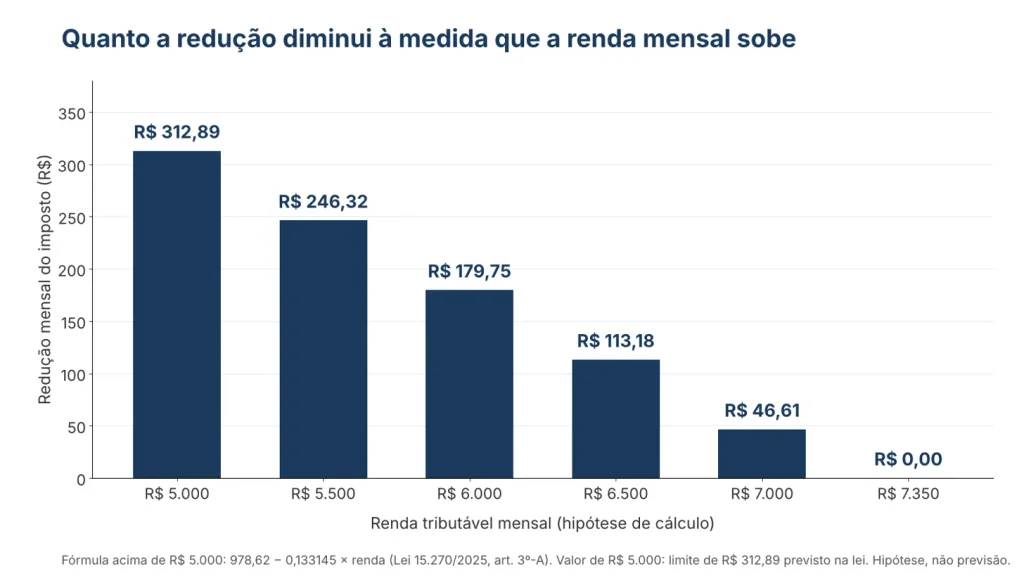
In the transition bracket, the income tax exemption is no longer total, and Article 3-A requires the use of the following formula: R$ 978.62 minus 0.133145 multiplied by the taxable income for the month. The higher the income, the smaller the reduction, until it reaches zero at the upper limit.
Above R$ 7,350.00, there is no reduction (Art. 3-A, § 2). Since the formula ends in zero exactly at that point, the transition from one bracket to another is gradual. The basis for the calculation is monthly taxable income, as typically shown on pay stubs and income statements.
Hypothetical example of income tax exemption in the transition bracket
The following table applies the formula in Article 3-A to rounded figures. The calculations were performed using a computer program, rounded to the nearest cent, and are intended solely to illustrate the pace of the reduction.
| Monthly taxable income | Calculation of the reduction | Discount (R$) |
|---|---|---|
| R$ 5,000.00 | exemption range limit | up to R$ 312.89 |
| R$ 5,500.00 | 978.62 − 0.133145 × 5,500 | R$ 246.32 |
| R$ 6,000.00 | 978.62 − 0.133145 × 6,000 | R$ 179.75 |
| R$ 6,500.00 | 978.62 − 0.133145 × 6,500 | R$ 113.18 |
| R$ 7,000.00 | 978.62 − 0.133145 × 7,000 | R$ 46.61 |
| R$ 7,350.00 | 978.62 − 0.133145 × 7,350 | R$ 0.00 (zero) |
Note that for every additional R$ 500.00 in income, the reduction decreases by about R$ 66.57. It is this steady pace that prevents a ‘step’ from forming between those who earn just below and just above a certain threshold.
Income Tax Exemption on the Annual Tax Return: What to Expect in 2027
The annual tax return has its own deduction, as provided for in Article 11-A. It applies to income earned during the 2026 calendar year, which will be reported in 2027 (tax year 2027).
For annual taxable income of up to R$ 60,000.00, the reduction amounts to R$ 2,694.15 and eliminates the tax owed. For income between R$ 60,000.01 and R$ 88,200.00, the formula is R$ 8,429.73 minus 0.095575 times the annual income. Above R$ 88,200.00, there is no reduction. A cap also applies here: the reduction cannot exceed the calculated annual tax (Art. 11-A, § 1).
The annual income tax exemption limits are calculated by multiplying the monthly amounts by 12 (5,000 × 12 = 60,000 and 7,350 × 12 = 88,200). Here are three sample calculations, which are not projections:
- Annual income of R$ 65,000.00: 8,429.73 − 0.095575 × 65,000 = R$ 2,217.36.
- Annual income of R$ 70,000.00: 8,429.73 − 0.095575 × 70,000 = R$ 1,739.48.
- Annual income of R$ 80,000.00: 8,429.73 − 0.095575 × 80,000 = R$ 783.73.
The tax return filed in 2026 covers income from 2025, the year prior to the law taking effect. Therefore, it does not apply this reduction (Art. 8).
Being exempt from income tax does not mean you are exempt from filing a tax return
Even those who do not pay taxes may still be required to file a tax return. The Federal Revenue Service establishes this requirement each year in a normative instruction, based on its own criteria. One of these criteria is the total taxable income received during the year.
For the 2026 tax return (calendar year 2025), the Brazilian Internal Revenue Service has stated that taxpayers who received more than R$ 35,584.00 in taxable income during the year must file a return, among other criteria (Statement from the Ministry of Finance). The rule for the 2027 tax year will be established by the Internal Revenue Service; be sure to check the current regulatory instruction before deciding not to file a tax return.
To find out who might be left out, see Who Does Not Need to File an Income Tax Return. Those who have filed their returns and have outstanding issues can find solutions at What to Do If You're Under Investigation.
What Is Not Exempt: Dividends and the Minimum Tax
The same law addresses high income, and this often causes confusion: dividends are not covered by the income tax exemption under Article 3-A. Dividends exceeding R$ 50,000.00 in a single month, paid by the same company to a resident individual, are subject to a 10% withholding tax on the total amount (Article 6-A). There are exceptions for profits calculated through 2025 and approved by December 31, 2025 (Article 6-A, paragraph 3). To understand the payment itself, read what dividends are.
There is also a minimum tax, provided for in Article 16-A, effective as of the 2027 fiscal year. It applies to those with annual income exceeding R$ 600,000.00, with a maximum tax rate of 10%. These rules are separate from the tax reduction discussed in this guide.
What Has Changed and What Hasn't
Status as of October 27, 2026, in accordance with the legal text.
- What has changed: Law No. 15,270 of 2025 established the reductions set forth in Articles 3-A and 11-A and the rules set forth in Articles 6-A and 16-A, effective as of January 1, 2026 (Article 8), as provided in the text on the Planalto.
- What hasn't changed: The progressive tax scale remains the basis for the calculation, and the income tax exemption continues to be a reduction on the calculated tax. The requirement to file a tax return depends on the annual tax regulations.
- Still under discussion: Article 6 requires the Executive Branch to submit to Congress, within one year, a bill on the policy for adjusting tax amounts. For now, this is only a proposed bill, not a rule in effect.
How to Check If the Income Tax Exemption Applies to You
- Calculate your taxable income for the month: Take your pay stub and identify the amount used as the tax base.
- Compare with the tracks: Check whether the amount falls within the income tax exemption range, the transitional range, or above it.
- Calculate the reduction: Use the formula for the corresponding tax bracket, and remember that the reduction cannot exceed the calculated tax.
- Review the income report: Verify that the tax withheld at source matches what the rule stipulates.
- If you have any questions, please ask: The Internal Revenue Service and your accountant will address your specific case, which is not discussed in this text.
See also: Your Income Tax Guide
Frequently Asked Questions
Who is exempt from income tax in 2026?
Those with monthly taxable income of up to R$ 5,000.00 pay no tax after the reduction provided for in Article 3-A. Between that amount and R$ 7,350.00, the reduction is partial, and above that amount, there is no reduction.
Does the reduction apply to the 13th-month salary?
Yes. Article 3-A, paragraph 3, extends the rule to the withholding of tax on the 13th-month salary.
Does an income tax exemption mean you don't have to file an annual tax return?
Not necessarily. The filing requirement is based on criteria set by the Internal Revenue Service each year, such as total taxable income. Check the current normative instruction.
Are dividends tax-exempt?
The law provides for a 10% withholding tax on dividends exceeding R$ 50,000.00 per month paid by the same company. There are exceptions for profits through 2025 (Art. 6-A).
Before finalizing your tax return, open your pay stub and identify your taxable income. Compare that number with the brackets in this guide, as they determine how the 2026 income tax exemption applies to you.
- Office of the President of the Republic, Law 15,270/2025 (text on the Planalto website) (accessed on October 27, 2026)
- Chamber of Deputies, Law No. 15,270 of 2025 (original publication) (accessed on October 27, 2026)
- Ministry of Finance, Rules for Filing the 2026 IRPF Return (accessed on October 27, 2026)
Notice: This content is for educational and informational purposes only. It does not constitute an investment recommendation, advisory service, or securities analysis, and does not take into account your situation, your objectives, or your risk tolerance. All investments involve risks, and past performance is no guarantee of future results. Rates, taxes, and regulations are subject to change: the data was sourced from the official sources indicated, as of the date stated at the beginning. Consult a licensed professional before making a decision. Illustrative images, when created by artificial intelligence, do not depict real institutions, products, or people.