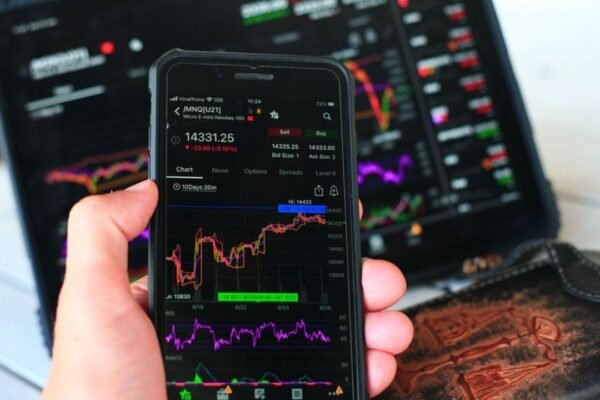

Do you know how much an option needs to rise to offset the premium paid? Understanding how to trade options in the market It helps you evaluate that account before placing an order, especially on B3, where small fluctuations can significantly affect the outcome.
Calls, puts, collateral, and expiration dates may seem complex at first, but they follow objective rules. With numerical examples, costs, and an exit strategy, it is possible to study the Derivatives Market without confusing protection, speculation, and stock investment.
What Are Options and How Do They Work?
Options are exchange-traded contracts that give the buyer the right, but not the obligation, to buy or sell an asset at a specified price by a specific date.
In practice, understanding how to trade options in the market begins by distinguishing between two types. A phone grants the right to purchase; the put It grants the right to sell. The buyer pays a premium for that right.
O strike The strike price is the price at which the option can be exercised, while the expiration date indicates the latest date by which the option can be exercised. The premium is the amount paid per contract, which is influenced by the underlying asset, the term, and volatility.
Imagine a call option linked to a B3 stock priced at R$ 30. The investor pays R$ 1 in premium per share for a strike price of R$ 32. With 100 shares, the total cost is R$ 100, excluding fees.
If the stock reaches R$ 36 at expiration, the intrinsic value will be R$ 4 per share. The gross result will be R$ 300: R$ 400 in option value minus R$ 100 in premium. If it closes at R$ 32 or lower, the loss could be the full R$ 100 paid.
How to Trade Options in the Market

To understand how to trade options in the market, the first step is to open an account with a licensed brokerage firm and transfer funds. Before doing so, check the fees, trading platform, guarantee policy, and your risk profile.
Next, look up the option code, the underlying asset, the strike price, the expiration date, the trading volume, and the bid-ask spread. Know how to buy options It also requires confirming whether the order is a buy or a sell order.
On the trading screen, check the quantity, limit price, order validity, and exercise date. In our order book analysis tests, options with few trades usually require more patience to enter or exit at the desired price.
This itinerary outlines how to trade options in the market Before, during, and after the surgery:
- Before: Set your objective, stop-loss, expiration date, strike price, liquidity, and maximum committed amount.
- During: Please verify the code, transaction type, quantity, price, and expiration date before submitting the order.
- Then: Record the brokerage fee, monitor the position, and execute the exit plan.
For a more in-depth look at these concepts, see the options guide and the official materials from the B3 and the CVM. Always make sure the content is up to date.
How to Evaluate Prices, Liquidity, and Risks
When studying how to trade options in the market, note that the premium tends to be affected by the time to expiration, expected volatility, and the distance between the stock price and the strike price. An option that is far out of the money may cost very little, but it may expire worthless.
For example, an R$ 0.20 option on 100 shares costs R$ 20. If the spread is R$ 0.05, buying at R$ 0.20 and immediately selling at R$ 0.15 results in a difference of R$ 5, before fees.
Liquidity is important for how to trade options in the market with less friction. Low volume can widen the spread and make it difficult to close out a position. The table compares the structures and their main exposures.
| Position | Example | Maximum loss | Guarantees and Risk |
|---|---|---|---|
| Call buyer | Pays a R$ premium of 100 per 100 options | R$ 100, plus costs | Limited risk; no margin is required as the writer, but the premium may drop to zero |
| Put buyer | Pay R$ 150 for a protection with a strike of R$ 28 | R$ 150, plus costs | Limited risk; depends on the asset's decline in value and the remaining term |
| Covered pitcher | He owns 100 shares and sells a R$ 1 call option | Stock prices fall; receives a R$ 100 bonus | It holds stocks as a hedge; this limits part of the rise |
| Uncovered Pitcher | Sell a call option without owning the shares | Potentially very high | It may require collateral; an increase in the asset's value increases exposure |
Initial Strategies with Practical Examples

Among the Options Strategies The basic strategies are buying a call, buying a put, and a covered write. Each one addresses a different scenario and should be analyzed with specific time frames, prices, and risk levels.
To understand how to trade options in the market With a call option, suppose the stock price is R$ 40, the strike price is R$ 42, and the premium is R$ 1.20. For 100 options, the initial cost is R$ 120, and the breakeven point at expiration is R$ 43.20.
If the stock closes at R$ 46, the gross value will be R$ 400, resulting in R$ 280 before costs. If it closes at R$ 41, the option may expire worthless, and the loss will be R$ 120.
When buying a put option, consider a stock price of R$ 50, a strike price of R$ 48, and a premium of R$ 0.80. The cost for 100 options is R$ 80. With the underlying asset at R$ 44, the value of the put will be R$ 400, resulting in a gross profit of R$ 320.
If the stock closes at R$ 49, the put could lose its entire premium of R$ 80. Therefore, how to trade options in the market This includes accepting that protection comes at a cost and must be consistent with the duration of the risk you wish to cover.
In a covered call strategy, imagine buying 100 shares at R$ 30 and selling a call for R$ 1, with a strike price of R$ 32. If the underlying asset closes at R$ 35, the exercise price limits the loss on the sale to R$ 32, but the premium raises the effective return to R$ 33 per share.
If the stock price falls to R$ 27, the premium reduces the loss to R$ 2 per share, before costs, but does not eliminate the loss. No strategy with limited risk means no risk at all.
Costs, Taxation, and Operational Control
Who conducts research how to trade options in the market You need to calculate brokerage fees, commissions, spreads, exercise or settlement costs, and income tax. A transaction that appears to be positive may end up being negative after these deductions.
Consider a purchase of R$ 1,000 and a sale of R$ 1,350. Assume R$ 30 in costs upon receipt and R$ 40 upon shipment. The net gain before tax will be R$ 280, not R$ 350.
Assuming a tax rate of 15%, the tax would be R$ 42, resulting in R$ 238 after tax. The tax rate is for illustrative purposes only: please verify the rules for standard transactions, Day trade, loss offsets and withholdings on the Internal Revenue Service and on B3.
Do not automatically apply the exemption for stock sales to options. Taxation depends on the nature of the transaction and the calculated result; therefore, keep records of notes, dates, prices, costs, and any losses organized.
Checklist Before the First Surgery
Before making a decision how to trade options in the market, determine your goal: to gain upside exposure, protect your investments, or generate a premium. Also, determine how much you can afford to lose without compromising your expenses, emergency fund, or debt payments.
Check liquidity, spread, collateral, maturity, underlying asset, and exit strategy. In our financial organization tests, recording each order in a spreadsheet helps prevent confusion between open, closed, and exercised positions.
To learn more about resource allocation, see also investments in U.S. dollars. If you still have high-interest debt, make planning a priority; this Guide to Paying Off Debts It is complementary and does not overlap with the topic of options.
Use this short list to avoid common mistakes when getting started:
- Inexpensive option: A low price does not automatically mean a low probability of winning.
- Due date ignored: A position can lose value quickly in the final days.
- Unknown asset: Without understanding the action or index, the decision remains incomplete.
- Warranty omitted: Placing options without knowing the margin can result in margin calls.
From Theory to Clearer Decision-Making
Learning how to trade options in the market This doesn't mean you should start trading right away. Use the examples to simulate costs, scenarios, and losses; then, consult official sources and start only once you understand how it works.
The next step might be to review the guide to options, develop an exit plan, and document each scenario. This content is for educational purposes only and does not constitute investment advice. Consult a certified financial advisor before making any decisions.
Frequently Asked Questions About Trading Options in the Market
How do I trade options on the market for the first time?
Open an account with a licensed brokerage firm, transfer funds, and review the costs, guarantees, and your risk profile. Then, look up the option symbol, underlying asset, strike price, expiration date, volume, and spread. Before placing the order, confirm the quantity, price, validity, and whether you are buying or selling.
What is the difference between a call and a put?
A call option grants the buyer the right to purchase the asset at the strike price, while a put option allows the buyer to sell it at a specified price. In both cases, the buyer pays a premium and is under no obligation to exercise the option. The choice depends on the buyer’s expectations regarding the asset or the objective of hedging.
What are the benefits of trading options?
Options can enable strategies for hedging, speculation, and market exposure with a lower initial investment than buying stocks directly. However, the premium may be lost in its entirety if the expected outcome does not occur. Therefore, it is essential to set a loss limit and an exit strategy.
Are options riskier than investing directly in stocks?
The risk depends on the strategy. When buying an option, the maximum loss is typically limited to the premium paid, but the contract loses value over time and may expire worthless. Short positions may require collateral and involve greater risks, necessitating careful evaluation before placing an order.
Is it true that all it takes for a call option to be profitable is for the stock price to rise?
Not necessarily. The price must exceed the strike price and offset the premium paid, in addition to the transaction costs. In the example from the article, a call option with a strike price of R$ 32 and a premium of R$ 1 requires the stock price to exceed R$ 33 at expiration to generate a positive gross return.