
- How it works: A CDB yielding 100% of the CDI yields, before taxes, the same as the DI rate.
- Tax: A regressive income tax ranging from 22.5% to 15%; IOF only within the first 30 days.
- Hypothetical example: With a CDI of 12% per year, R$ 10,000.00 yields a net return of R$ 947.92 in 360 days.
- Warranty: FGC up to R$ 250,000 per CPF and per institution.
The return on a CDB that pays 100% of the CDI depends on the CDI rate, the term, and income tax. This guide breaks it down using a hypothetical example of R$ 10,000.00.
No one knows what the CDI will be in the coming months. For this reason, the simulation uses three rounded rates (10%, 12%, and 14% per year) as assumptions, not as forecasts.

How Much Does a 100% CDI CDB Yield: The Logic Behind the Account
A Bank Deposit Certificate (CDB) is a security issued by financial institutions to raise funds, as described in the B3's "Bora Investir" Glossary. In exchange for the money, the bank pays interest to the lender. To learn more about this product, see the guide What is CBD?.
When a CDB is floating-rate and pays 100% of the CDI, the security’s daily rate is equal to the DI rate for that day. The DI rate is the weighted average of one-day, fixed-rate interbank deposits registered with B3, and serves as the market’s primary interest rate benchmark (B3, Interbank Depository page, accessed on October 31, 2026).
It is reported on an annual basis, with 252 business days per year, because the rate for a single day is very small (B3, DI Index Methodology). If you'd like to review the concept, read What is the CDI?.
In practice, the return on this type of CDB is the CDI for the period, multiplied by the agreed-upon interest rate, minus taxes. At 100%, the gross yield tracks the CDI. At 110%, the daily rate is multiplied by 1.10; at 90%, by 0.90.
How the Selic Rate Affects the Return on a CDB
The CDI usually hovers very close to the Selic rate target, but the daily rate comes from B3. Therefore, looking at the Selic rate gives you a general idea of the level, but it doesn't tell you exactly how much a CDB will yield over its term.
Simulation: How Much Does a R$10,000 CDB Yield at 100% of the CDI?
How the Calculation Was Done
To show how much a CDB yields for each term, the calculation first converts the number of calendar days to business days by multiplying by 252 and dividing by 365, then rounding to the nearest whole number. Then, the gross yield is calculated using the formula: amount × [(1 + CDI)^(business days ÷ 252) − 1].
Next, the regressive income tax rate is applied to the income, not to the total amount. The amounts were rounded to the nearest cent, and the calculation was performed by code, verifying that gross minus tax equals net.
Table: How Much Does a CDB Yield for Each Term?
| Hypothetical CDI | Deadline | Gross income | Income tax rate | Withheld income tax | Net income | Final amount |
|---|---|---|---|---|---|---|
| 10% per year | 180 days (124 business days) | R$ 480.16 | 22,50% | R$ 108.04 | R$ 372.12 | R$ 10,372.12 |
| 10% per year | 360 days (249 business days) | R$ 987.53 | 20,00% | R$ 197.51 | R$ 790.02 | R$ 10,790.02 |
| 10% per year | 720 days (497 business days) | R$ 2,068.01 | 17,50% | R$ 361.90 | R$ 1,706.11 | R$ 11,706.11 |
| 10% per year | 1,080 days (746 business days) | R$ 3,259.75 | 15,00% | R$ 488.96 | R$ 2,770.79 | R$ 12,770.79 |
| 12% per year | 180 days (124 business days) | R$ 573.49 | 22,50% | R$ 129.04 | R$ 444.45 | R$ 10,444.45 |
| 12% per year | 360 days (249 business days) | R$ 1,184.90 | 20,00% | R$ 236.98 | R$ 947.92 | R$ 10,947.92 |
| 12% per year | 720 days (497 business days) | R$ 2,504.57 | 17,50% | R$ 438.30 | R$ 2,066.27 | R$ 12,066.27 |
| 12% per year | 1,080 days (746 business days) | R$ 3,986.24 | 15,00% | R$ 597.94 | R$ 3,388.30 | R$ 13,388.30 |
| 14% per year | 180 days (124 business days) | R$ 665.98 | 22,50% | R$ 149.85 | R$ 516.13 | R$ 10,516.13 |
| 14% per year | 360 days (249 business days) | R$ 1,382.23 | 20,00% | R$ 276.45 | R$ 1,105.78 | R$ 11,105.78 |
| 14% per year | 720 days (497 business days) | R$ 2,948.78 | 17,50% | R$ 516.04 | R$ 2,432.74 | R$ 12,432.74 |
| 14% per year | 1,080 days (746 business days) | R$ 4,738.61 | 15,00% | R$ 710.79 | R$ 4,027.82 | R$ 14,027.82 |
How Much Does a CDB Yield in Each Scenario?
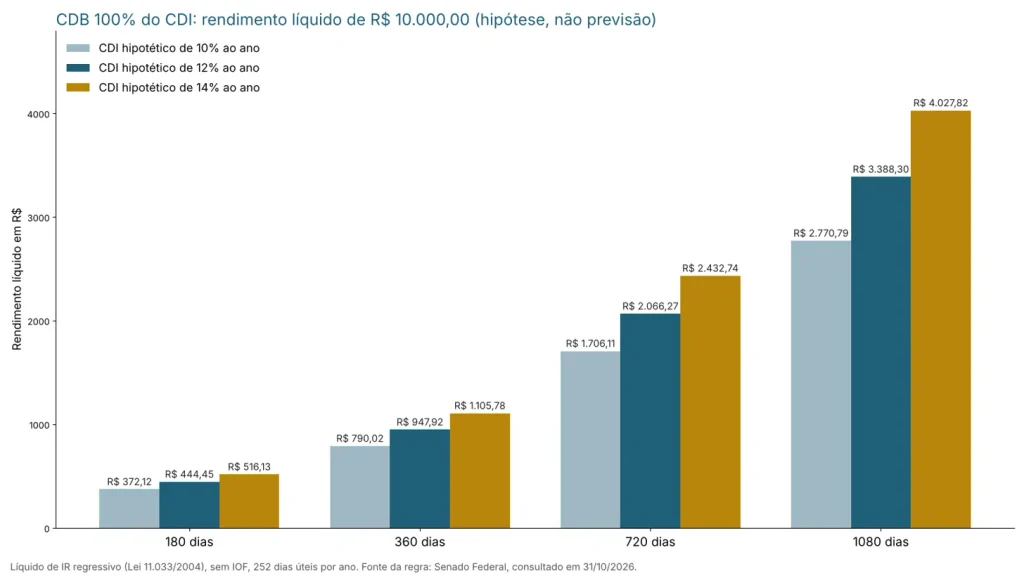
Notice the effect of the term. With a CDI of 12% per year, 180 days yield a net total of R$ 444.45, while 1,080 days yield R$ 3,388.30. Part of the difference comes from compound interest, and part from the tax rate, which drops from 22.5% to 15%.
The effect of the interest rate, however, becomes apparent when comparing accounts with the same term. Over 360 days, the net return ranges from R$ 790.02 (10% CDI) to R$ 1,105.78 (14% CDI). That is why the return on a CDB tied to 100% of the CDI fluctuates so much with the interest rate cycle. For other accounts tied to the CDI, see how to calculate profitability with CDI.
How Much Does a CDB Yield After Income Tax (IR) and Financial Transactions Tax (IOF)?
Income tax on fixed income follows a regressive tax schedule, as provided for in the Law No. 11,033 of 2004, Article 1. It applies only to the return and is withheld at source by the institution, as provided by law (accessed on October 31, 2026). Anyone who wants to know how much a CDB actually yields needs to look at the net amount, after taxes.
| Application Deadline | Income tax rate on income |
|---|---|
| Up to 180 days | 22,5% |
| From 181 to 360 days | 20% |
| From 361 to 720 days | 17,5% |
| Over 720 days | 15% |
In addition to income tax (IR), there is a Financial Transactions Tax (IOF) on redemptions made within the first 30 days. It is regressive: it starts at 96% of the income on the first day and drops to zero starting on the thirtieth day, applying only to the income, while income tax is calculated on the remaining amount (Decree No. 6,306/2007, Article 32, accessed on October 31, 2026). To learn more, read What is income tax?.
On the annual tax return, the CDB is taxed exclusively at source. The income is reported under “Income Subject to Exclusive/Final Taxation,” with code 06, and the balance under “Assets and Rights” (B3, Let's Invest: How to Report CDBs, accessed on October 31, 2026).
What Factors Affect a CDB's Yield Besides the Interest Rate?
Fees and taxes aren't the whole story. There are also other factors that affect a CDB's yield, and it's worth reviewing them before making any decisions:
- Percentage of the CDI: 100% is not the same as 95% or 110%; check the percentage in the security contract.
- Deadline and due date: Income tax decreases over time, but the money may remain tied up until the final date.
- Liquidity: Some CDBs can be redeemed daily, while others can only be redeemed at maturity; the rules are outlined in the terms and conditions of the security. See Liquidity in investments refers to how easily and quickly an asset can be converted into cash without significantly affecting its price.Here's a breakdown:* **High Liquidity:** Assets that are highly liquid can be sold quickly at or near their market value. Examples include cash, money market accounts, and actively traded stocks. * **Low Liquidity:** Assets that are illiquid can be difficult to sell quickly without accepting a lower price. Examples include real estate, private equity, and collectibles.**Why is liquidity important?*** **Meeting Financial Obligations:** If you need cash unexpectedly for emergencies or other expenses, you'll want to be able to access your funds easily. * **Investment Flexibility:** Liquidity allows you to take advantage of new investment opportunities as they arise. * **Risk Management:** In volatile markets, having liquid assets can help you avoid being forced to sell less liquid assets at a loss.When considering an investment, it's important to understand its liquidity and how it fits into your overall financial plan..
- Issuer risk: The bank may not pay; the FGC guarantee has a limit, as the next section shows.
FGC Guarantee: How Far Does the Protection Extend?
The return on a CDB matters, but so does the issuer’s risk. CDBs are among the products covered by the FGC’s standard guarantee. The limit is up to R$250,000 per CPF or CNPJ at each member institution or financial conglomerate, and R$1 million per four-year period, across different redemptions (FGC, supporting materials, December 2025 version).
The balance considered includes the principal and interest accrued through the settlement date, and tax is deducted. Any amount exceeding the limit becomes a credit against the settled amount. Thus, the amount covered by the FGC may be less than or greater than the final balance calculated in the simulation. In a joint account, the limit is divided equally among the account holders, and investment funds are not included in this coverage.
What Has Changed and What Hasn't
Status as of October 31, 2026, in accordance with the legal text.
- What has changed: Provisional Measure No. 1,303/2025 proposed a single tax rate for a portion of investments and expired on October 8, 2025, after the Chamber of Deputies removed it from the agenda. Its effects have ended, according to an official statement from the Planalto.
- What hasn't changed: The sliding scale from 22.5% to 15% is still provided for in the Law No. 11,033 of 2004, Article 1.
- Still under discussion: Any new rule must be based on an enacted law; a bill or proposal does not constitute a rule in force.
In summary, the return on a CDB indexed to 100% of the CDI varies depending on the interest rate, the term, and the tax rate. The chart below summarizes the net results from the table.
{{IMAGEM_03}}
See also: What Is a CDB: A Complete Guide for Beginners
Frequently Asked Questions
How much does a CDB paying 100% of the CDI yield in the first year?
How much a CDB yields in the first year depends on the CDI. Assuming a rate of 12% per year, R$ 10,000.00 would yield a net return of R$ 947.92 in 360 days; at 10%, it would yield R$ 790.02. This is a hypothetical calculation, not a forecast.
Is the 100% CDI CDB guaranteed?
It is covered by the FGC’s standard guarantee, up to R$250,000 per CPF and per institution, as of the date of issuance. Above that amount, the issuer’s risk comes into play again, even if the return on a CDB seems attractive.
How do I find out the tax on my withdrawal?
To find out how much a CDB yields after taxes, keep in mind that the financial institution withholds income tax based on the number of calendar days of the investment, using a sliding scale ranging from 22.5% to 15%. In your case, consult the Federal Revenue Service or an accountant.
How much will I earn on a CDB if I redeem it before maturity?
It depends on the terms of each security, and the yield on a CDB varies accordingly. For redemptions made within 30 days, the IOF tax is also charged, but only on the interest earned.
- Federal Senate, Law No. 11,033 of 2004 (accessed on October 31, 2026)
- Office of the President of the Republic, Decree No. 6,306/2007 (accessed on October 31, 2026)
- FGC, supporting materials, December 2025 version (accessed on October 31, 2026)
- B3, Interbank Depository (accessed on October 31, 2026)
- B3, DI Index Methodology (accessed on October 31, 2026)
- B3, Let's Invest, Glossary: CDB (accessed on October 31, 2026)
- B3, Let's Invest: How to Report CDBs (accessed on October 31, 2026)
- Central Bank of Brazil, COPOM Statement, 281st Meeting (September 16, 2026)
Notice: This content is for educational and informational purposes only. It does not constitute an investment recommendation, advisory service, or securities analysis, and does not take into account your situation, your objectives, or your risk tolerance. All investments involve risks, and past performance is no guarantee of future results. Rates, taxes, and regulations are subject to change: the data was sourced from the official sources indicated, as of the date stated at the beginning. Consult a licensed professional before making a decision. Illustrative images, when created by artificial intelligence, do not depict real institutions, products, or people.