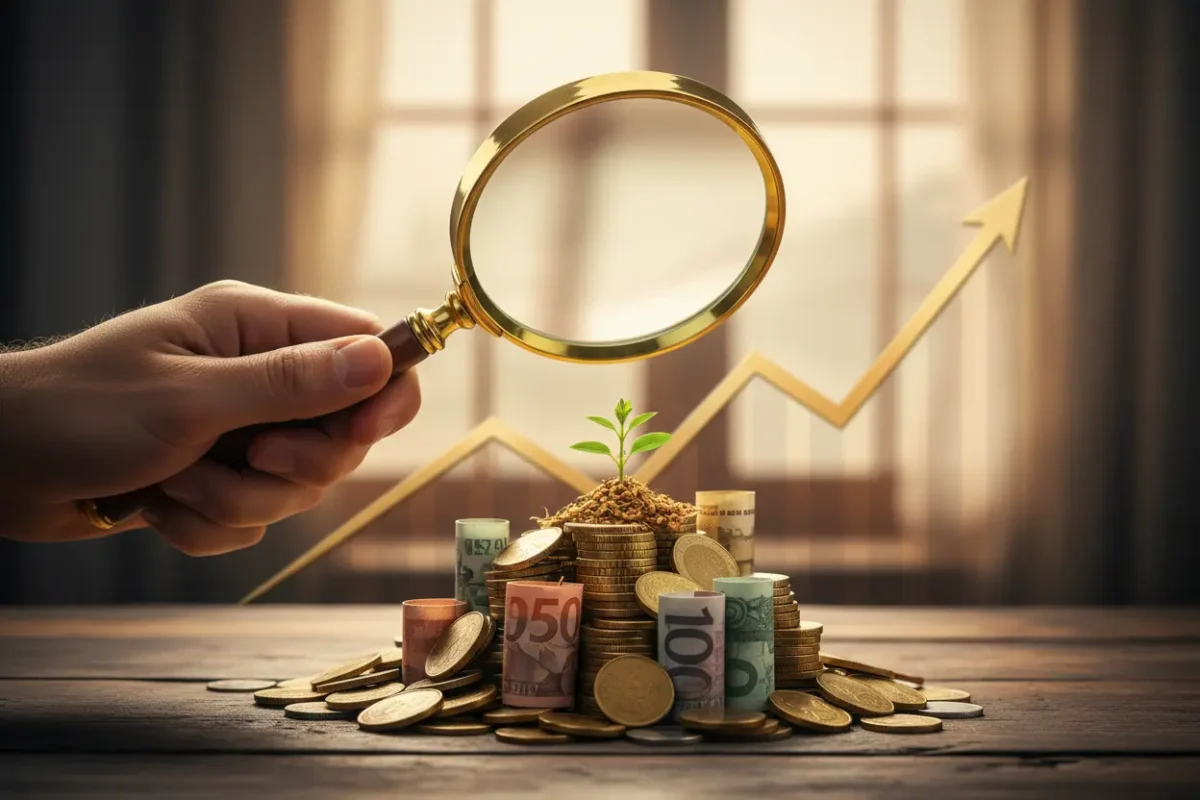
Have you ever imagined watching your money grow exponentially, almost as if by magic? Many people dream of this, but few understand the power behind one of the greatest secrets to getting rich: the compound interest.
In this article, we'll explore how the How Compound Interest Works in Practice, providing clear examples and tips to help you apply this powerful concept to your finances and build a solid financial future.
What Is Compound Interest, and Why Does It Matter?
To understand how to build wealth, we must first understand the driving force behind great fortunes.
We often hear about profitability, but we rarely stop to analyze the math that makes money work on its own.
The compound interest are, in essence, the concept of interest on interest, creating a snowball effect.
Unlike simple interest, where the return is calculated only on the initial amount, here the profit is continuously reinvested.
Imagine that we make a contribution, and the following month, the return is calculated based on the cumulative total, not just the contribution itself.
This small difference, when repeated over months and years, results in a growth curve exponential impressive.
We believe that understanding this logic is the first step toward escaping the rat race and achieving financial freedom.
The importance of compound interest to our financial health lies in its ability to grow our capital without any additional effort.
In the long run, the amount generated by the returns ends up being much greater than the amount we take out of our own pockets.
That is why major investors, such as Warren Buffett, consider patience and compound interest to be their greatest allies.
Without this concept, building wealth would be a purely linear process—and a much slower one—for all of us.
Once we master this system, we stop working just for the money and let the system work for us.
Below, we've put together a quick comparison to help you see this fundamental difference:
| Features | Simple Interest | Compound Interest |
|---|---|---|
| Calculation Basis | Only the initial capital | Initial capital + earnings |
| Growth | Linear and constant | Exponential and rapid |
| Impact of Time | Low impact | Extremely high impact |
| Common use | Consumption and Short-Term Loans | Investments and Wealth Building |
Understanding this distinction is what sets apart those who merely save money from those who truly build a solid fortune.
How Compound Interest Works in Practice!

The mechanics of compound interest may seem complex at first glance, but we can simplify them using the basic formula.
The mathematical formula that governs this growth is: M = P (1 + i)^n.
In this equation, the M represents the final amount we will have after the specified period.
O P It is the principal—that is, the initial amount we decided to invest today.
The lyrics i represents the interest rate, which must be expressed as a decimal (for example: 10% becomes 0.10).
Finally, the n Time is the most powerful factor in this equation, since it acts as an exponent.
Note that, since time is an exponent, any increase in the time period results in a gain disproportionately higher in the final result.
Let's look at this with a simple numerical example to make it easy for all of us to understand.
Imagine that we invest R$ 1,000.00 at an annual rate of 10% for 3 years.
In the first year, we will have R$ 1,100.00 (the original 1,000 plus 100 in profit).
In the second year, the 10% is no longer calculated based on the initial 1,000, but rather on the accumulated R$ of 1,100.00.
This brings us to R$ 1,210.00 at the end of the second period, earning R$ 110.00 in interest.
In the third year, the tax is levied on R$ 1,210.00, resulting in R$ 1,331.00—a profit of R$ 121.00 for that year alone.
Notice how the annual return gradually increases, even though we haven't added a single cent more.
The interest rate determines the speed of growth, but time determines the final size of our “mountain” of money.
The higher the rate, the steeper our equity growth curve is.
However, it is time that allows the magic to happen in a sustainable and safe way.
We should focus on keeping the money invested for as long as possible to maximize that potential.

After writing several papers and giving numerous lectures on restrictions on the capitalization of interest, the author realized that most readers and listeners still did not understand the historical and practical foundations of this issue, which, unfortunately, remains controversial.
A professor of financial mathematics since the 1970s, author of books on the subject, a scholar in the field, and mindful of his responsibility toward teaching and financial education, Dutra presents a work that helps shed light on this issue, given its importance for the financial market and for the fields of economics, finance, and law.”
Real-Life Examples of Compound Interest in Action
In our day-to-day financial lives, we encounter compound interest in a variety of financial products, sometimes to our advantage and sometimes to our disadvantage.
The most classic example of a positive application is the Treasury Direct, specifically fixed-rate securities or the IPCA+ Treasury bonds.
When we invest in Treasury securities, the government pays us interest, which is automatically reinvested if there are no semiannual coupons.
Another excellent example is the CDBs (Bank Deposit Certificates) that yield a percentage of the CDI.
In these titles from fixed income, the return for each business day is added to the principal to calculate the return for the following day.
This ensures that, even with small fluctuations, our money grows steadily and safely.
We also see this power in the Private Pension, where the focus is on the very long term—usually decades.
We use these investment vehicles to build up capital for retirement, taking advantage of the power of time.
In the stock market, compound interest works through the dividend reinvestment.
When we receive dividends from a company and use that money to buy more shares, we increase our base for future earnings.
However, we need to be transparent: compound interest also has a dark and dangerous side.
The credit card debt and overdraft accounts use this same mathematical logic to the detriment of our wallets.
If we do not pay the full amount of the bill, next month's interest will be calculated based on the interest that has already accrued.
That's why a small debt can snowball into an unpayable amount in just a few months.
Below, we've listed some examples of how compound interest typically plays a role in our daily lives:
- Fixed-Income Investments: CDB, LCI, LCA, and Tesouro Direto.
- Equities: Real Estate Stocks and Funds (through reinvestment of proceeds).
- Retirement Plans: VGBL or PGBL-type private pension plans.
- Bank Debts: Credit cards, overdraft protection, and loans.
The golden rule is: we should always stand by those who receives interest, never from the person who pays it.
By understanding where they are, we can make smarter decisions to protect our assets.
Tips for Maximizing the Power of Compound Interest

If we are to truly grow our money, it’s not enough to just know the theory; we need a strategy.
The first and most important tip is: Get started as soon as possible, even if it's on a tight budget.
Time is the exponential factor in the formula, and waiting a year today could cost hundreds of thousands of reais in the future.
If we start investing at age 20, we’ll end up with much better results than those who start at age 40, even if we invest less.
Another crucial point is consistency in contributions, that is, investing every month without interruption.
Regular contributions form the base of our pyramid, allowing interest to accrue on increasingly larger amounts.
We should also make it a habit to reinvest all earnings that our investments will generate.
If you receive dividends or interest from a CDB and spend that money, you’ll be stunting the growth of your snowball.
Keeping your profits within your investment is what ensures that the multiplier effect continues to work in your favor.
In addition, we need to seek favorable interest rates, always balancing risk and return.
A difference of just 1% or 2% per year may seem insignificant now, but in 30 years, it will double your final net worth.
That is why researching the best brokerage firms and financial products is an essential part of our work as investors.
Avoid, as much as possible, the exorbitant management fees charged by large traditional banks that erode your profitability.
Below, we've put together an action plan for you to implement right away:
- Pay off high-interest debt: Don't try to invest if you're paying 12% interest per month on your credit card.
- Create an emergency reserve: This prevents you from having to cash out your investments during tough times.
- Automate your investments: Set up a monthly transfer to your brokerage firm as soon as you receive your paycheck.
- Increase your contributions: Whenever you get a raise or some extra income, set aside a portion for your investments.
- Please be patient: The greatest growth in compound interest occurs toward the end of the investment period.
We know that the path to wealth requires discipline, but compound interest makes that journey much easier.
By following these steps, we ensure that every real we save becomes a “soldier” working tirelessly for us.
Your Financial Future Starts Now!
Understanding how the How Compound Interest Works in Practice It is a crucial step for anyone seeking financial independence. We have seen that, with discipline and knowledge, it is possible to turn small amounts into large fortunes over time.
Now that you've mastered this concept, how about putting it into practice? Share Share this article with friends and leave your comment Read on to find out how you plan to use compound interest to your advantage!
FAQ – Common Questions About How Compound Interest Works in Practice
We've created this section to answer your most frequently asked questions and help you safely grow your wealth.
With simple interest, the return is calculated only on the initial amount invested. With compound interest, however, the earnings from each period are added to the principal, causing subsequent interest to accrue on an ever-increasing amount, creating the well-known “snowball” effect.
Time allows compound interest to work over more cycles, causing the principal to grow exponentially. The sooner we start investing, the greater the long-term impact of interest will be, requiring less financial effort on our part.
We see this mechanism at work in various fixed-income investments, such as Tesouro Direto, CDBs, and interest-bearing accounts, as well as investment funds. With these assets, accumulated returns generate new gains on a daily or monthly basis, thereby multiplying the invested capital.
No, we can start with very affordable amounts, such as about 30 reais in the Tesouro Selic. The secret to seeing How Compound Interest Works in Practice It's not the initial amount, but rather the consistency of the contributions and the patience to let time do its work.
If we withdraw our profits instead of reinvesting them, we interrupt the cycle of exponential growth driven by compound interest. Without reinvestment, our capital grows at a linear rate, and we miss the opportunity to turn small gains into a fortune in the future.