
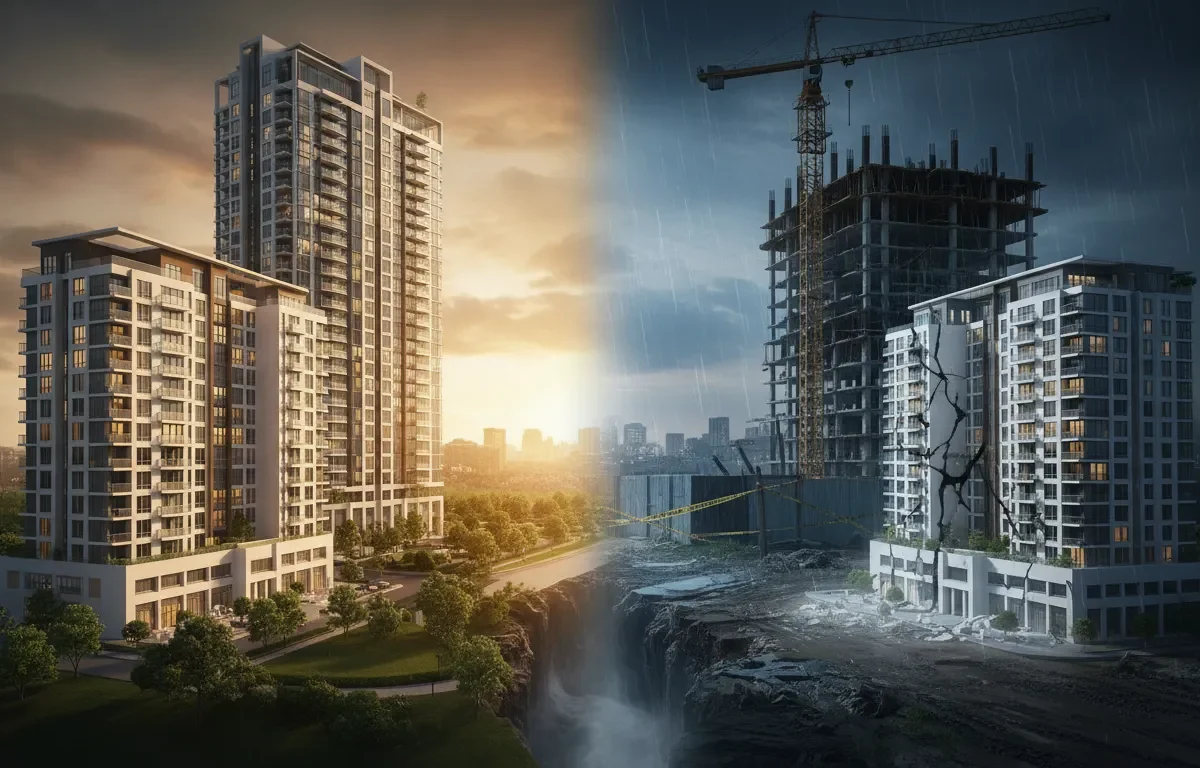
The decision to buy a home involves many financial factors. One of the most popular options on the market is to buy a property on the drawing board, attracting many with its low starting price.
However, this type of investment hides pitfalls that could jeopardize your budget. It is essential to understand whether the potential for appreciation outweighs the risks of delays and inflation adjustments.
In this article, we’ll explore every detail of this type of real estate investment. Get ready to find out whether signing this contract is a step toward your dream or a financial nightmare.
Key Findings 🌟
Before we dive into the details, take a look at the key features that define this type of product. Understanding these aspects will help you filter out the offers that are truly worthwhile.
- Attractive Price: It generally costs between 20% and 30% less than a finished property.
- Monetary Adjustment: The outstanding balance is adjusted monthly based on the INCC.
- Customization: Finishes can be changed during construction.
- Delivery Risk: Delays in construction are common and should be anticipated.
- Valuation: Potential for capital gains after the keys are handed over.
The Big Draw: Why Buy Off-Plan? 📌
The main draw for those looking for properties under construction is the cash flow. Unlike a completed property, the down payment is usually made in installments during the construction period.
This allows people without significant financial reserves to begin making purchases. Construction companies offer flexible terms to secure sales even before the building is constructed.
In addition, there is an expectation that capital appreciation significant. A property purchased at the initial offering tends to be worth much more once the occupancy permit is issued and the condominium is handed over.
For investors, this is the logic of “buy low, sell high.” If the region is developing, the profit on resale can easily exceed returns on fixed income.

Expert Tip 💡
“Never look only at the price of the initial payment. The INCC is a volatile index and applies to the total outstanding balance, not just the payment. In times of high inflation, your debt can grow faster than your ability to pay.”
The Hidden Villain: Understanding the INCC 📖
The National Construction Cost Index (INCC) is the official index used to calculate installment payments. It measures changes in the costs of materials and labor in the construction industry.
Many people overlook this detail and end up surprised by their rising bills. Unlike a bank loan with fixed or decreasing payments, here the payment goes up every month.
If the prices of cement and steel go up, your outstanding balance will increase as well. This means that, by the time construction is complete, the property may have cost more than originally planned.
Comparison: Off-Plan Property vs. Completed Property 📊
To help you make your decision, we've put together a side-by-side comparison. Weigh the pros and cons of each option before signing any paperwork.
| Features | Property on the drawing board | Ready property |
|---|---|---|
| Starting Price | More affordable (20-30% is cheaper) | Full market value |
| Entry | Paid in installments during construction | Immediate (min. 20%) |
| Adjustment | INCC (may be high) | Bank interest rates (TR or IPCA) |
| Change | It takes 2 to 4 years | Immediately after registration |
Risks Nobody Tells You About 🎯
In addition to the financial issue, there are serious operational risks. Delayed delivery is the most common problem faced by Brazilian buyers.
- Construction Company Bankruptcy: There is a risk that construction will come to a halt and not resume, although the law on Earmarked Assets has provided greater certainty.
- Bottom Finish: The furnished apartment is beautiful, but the actual delivery may include materials of questionable quality if they aren't specified.
- Construction Defects: Structural problems or leaks can arise as early as the first few months of use, causing headaches.
- Termination with Compensation: Canceling a purchase partway through results in heavy fines, which can withhold up to 50% of the amount already paid.
Safety Checklist Before Buying ✅
Don't be swayed just by the attractive model at the sales booth. Follow this rigorous checklist to protect your assets and avoid scams.
- [ ] Check the Incorporation Record (RI) at the notary's office.
- [ ] Check the construction company's reputation on Reclame Aqui.
- [ ] Visit previous projects completed by the same company.
- [ ] Simulate the INCC trend for future installments.
- [ ] Confirm whether the project has designated assets.
- [ ] Read the Project Description carefully, paying close attention to the finishes.
Overall Consumer Opinion 🗣️
In discussion forums and groups focused on the real estate market, sentiment is mixed. Many celebrate the achievement and the increase in value realized after receiving the keys.
On the other hand, there are frequent reports of frustration with the actual size of the rooms. The perception of space in a model home often does not match the reality of the bare walls.
The issue of the “balloon payment” at the end of the loan term (the large final installment) is also a cause for concern. Many buyers fail to prepare for bank financing of the final balance and face difficulties at closing.
Notable Quotes 💬
“The real estate market is cyclical. Buying off-plan requires a long-term perspective and the patience to weather economic fluctuations during construction.” — Ricardo Amorim, Economist.
Final Verdict 🏆
Buying a property off-plan This isn't for amateurs or for those in a hurry. It's an excellent option for anyone looking to plan their finances and who has the discipline to make the adjusted payments.
If you're paying high rent, waiting three years may not be worth it financially. In that case, a ready-to-move-in property—even if it's smaller or older—may be the more financially advantageous option.
However, if your goal is to invest or if you can manage living with your parents, the potential for profit is real. The key is to choose reputable developers and have a solid emergency fund.

Related Topics 🧠
To expand your financial knowledge, understand how the macroeconomic landscape affects your investments. The real estate market doesn't operate in a vacuum; it responds to interest rates and inflation.
- Real Estate Investment Funds (FIIs): A liquid alternative for investing in real estate.
- Loan Amortization: How to Pay Off Your Debt Faster.
- Selic rate: The Impact of Interest Rates on Mortgage Loans.
Conclusion: Buying Off-Plan Real Estate: A Sure Profit or a Headache?
Buying a property off-plan is a strategy that combines risk and opportunity. The decision should be based on careful calculations, not just on the excitement of seeing a furnished apartment.
Assess your financial stability and your tolerance for unexpected construction costs. If you do your homework, this could be the best purchase of your life; otherwise, what seems cheap will end up costing you dearly.
Frequently Asked Questions
Yes, that’s called an assignment of rights. However, the developer usually charges a consent fee, and the new buyer must have their credit approved.
If there is a trust fund, the construction project is separated from the developer's debts. A committee of buyers may take over the project and continue construction.
Yes. Once the occupancy permit is issued, the outstanding balance is no longer adjusted based on the INCC, and interest is calculated based on the bank loan rate (IGPM or IPCA plus interest).
Generally, FGTS funds can only be used to pay off the outstanding balance at the time the keys are handed over or to make payments on a subsequent bank loan.