
Have you ever stopped to think about how a single interest rate can influence everything from the price of a roll to your investments? The Selic—our economy’s benchmark interest rate—has that power and directly affects your day-to-day finances.
We’re going to demystify the Selic rate and, more importantly, show you how it affects your wallet, your savings, and your debts. Get ready to gain a clear and practical understanding of one of the pillars of your financial health.
What is the Selic Rate, and what is its purpose?
We need to understand that the Selic rate It is the heart of our economy.
It is Brazil's benchmark interest rate, serving as a reference for everything.
Its name comes from Special Settlement and Custody System.
The one who sets this value is the Copom, the Monetary Policy Committee.
They meet every 45 days to decide whether to raise or lower the rate.
This decision is no coincidence, as they are concerned about the country's health.
The main role of the Selic is to inflation control.
When prices rise too much, the Central Bank usually raises interest rates.
This makes money more expensive and curbs excessive consumption.
On the other hand, if the economy is stagnant, they can lower the rate.
Low interest rates stimulate credit and encourage companies to invest more.
It's a constant balancing act that we, as investors, must monitor closely.
We view the Selic as a tool for incentive or disincentive.
It sets the standard for how much it costs to borrow money from a bank.
It also sets the amount the government pays to those who lend it money.
Understanding this dynamic is the first step toward your financial freedom.
After all, the Selic rate affects everything from the bread at the bakery to your income.
It is the compass that guides our key investment decisions today.
How does the Selic rate affect your investments?

The relationship between the Selic rate and your money is direct and very powerful.
When the rate goes up, the Fixed Income It becomes the market’s “darling.”.
This is because the yields on these securities track interest rates.
Investments such as the Selic Treasury They yield immediate results.
The same applies to the CDB, LCI e LCA which are floating-rate.
We've realized that, with high interest rates, it's easier to make money safely.
Here's how the Selic rate affects major assets:
- Tesouro Selic It yields exactly the change in the base rate.
- Floating-Rate CDBs: They pay a percentage of the CDI, which has been tracking closely with the Selic rate.
- Savings If the Selic rate is above 8.5%, the yield is 0.5% per month + TR.
- Equities: It generally suffers when interest rates rise too quickly.
In Equities, the impact is usually the opposite of that of fixed-income securities.
When interest rates are high, companies pay more for their loans and debts.
This reduces net income and, consequently, the value of the actions on the stock market.
In addition, many investors are pulling out of the stock market to seek “easy” returns from fixed-income investments.
We call this movement of capital “risk-driven migration.”.
The Real Estate Funds (FIIs) They may also feel this pressure on prices.
However, when the Selic rate falls, the situation is completely reversed.
Credit becomes cheaper, companies make more profits, and the stock market tends to rise.
That is why we always emphasize the importance of intelligent diversification.
The Selic Rate and Its Purchasing Power: Learn More!
Many people think that the Selic rate only matters to those who invest in the stock market.
But the truth is that it really hits home for her purchasing power daily.
There is a close relationship between interest rates and the price index.
When the Selic rate is high, the goal is to curb the inflation (IPCA).
With high interest rates, financing purchases becomes much more expensive.
People are buying fewer cars and appliances and avoiding installment plans.
This drop in demand causes prices to stop rising so quickly.
It's a way to protect the value of our currency in the long term.
We feel this when the prices of food and services stabilize.
On the other hand, a lower Selic rate increases the amount of money circulating in the market.
It makes it easier to pay for that home renovation in installments or upgrade from your old cell phone.
If everyone decides to buy at the same time, prices tend to rise.
| Selic Outlook | Impact on Consumption | Impact on Inflation |
|---|---|---|
| Selic Rate on the Rise | Consumption Declines | Inflation is expected to fall |
| Selic Rate on the Decline | Consumption Rises | Inflation is likely to rise |
We need to understand that interest rates that are too low can lead to high inflation.
And high inflation silently and cruelly erodes your salary.
That is why the Selic rate acts as a necessary “remedy” for the economy.
Maintaining purchasing power is essential for our financial security.
Keeping an eye on the Selic rate helps you plan for large purchases.
Sometimes, waiting for the rate to drop can mean savings of thousands of reais.
Loans and Financing: The Impact of the Selic Rate
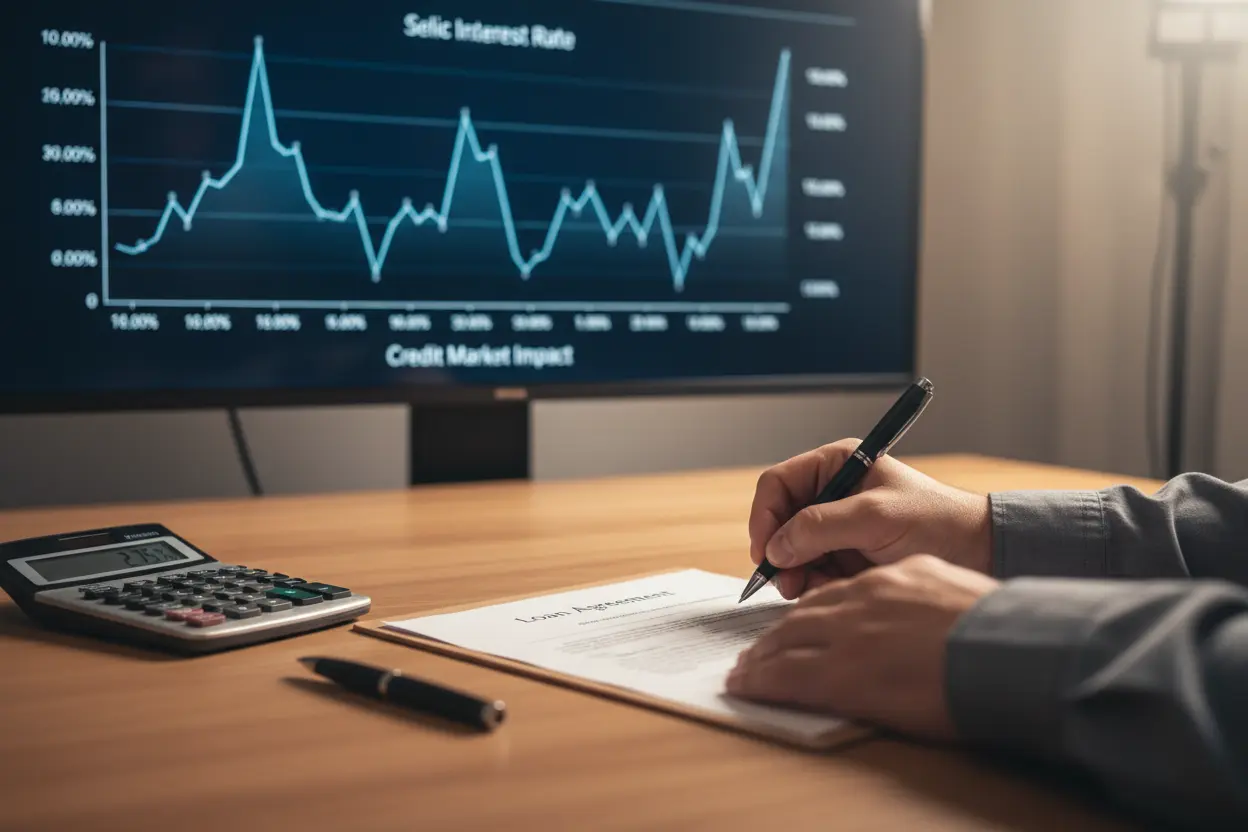
If you plan to borrow money, the Selic rate is either your greatest ally or your worst enemy.
It serves as the benchmark rate for banks to raise funds in the market.
If the Selic rate rises, the bank passes that extra cost on to the end consumer.
O real estate financing It is one of the sectors most affected by this fluctuation.
A small increase in the Selic rate could increase the total amount of your debt.
This happens because long-term contracts accrue interest on interest.
The same logic applies to auto loans.
The installments become more burdensome, and the total effective cost ends up skyrocketing.
We always recommend reading the fine print in contracts during these periods.
In the case of the credit card And with overdraft protection, the impact is even worse.
These types of loans already have naturally very high interest rates in Brazil.
With the Selic rate high, these fees can really snowball.
- Personal Loan: Rates rise to offset the bank's risk and costs.
- SAC Financing: The amount of the initial payments may be much higher.
- Payroll Loan: It's usually more stable, but it's also subject to adjustments.
We recommend that, when the Selic rate is high, you avoid taking on new debt.
Now is the perfect time to renegotiate any outstanding issues with the bank.
Try to swap a high-interest debt for a lower-interest one whenever possible.
On the other hand, when the Selic rate falls, there is an opportunity to portability.
You can transfer your debt to another bank that offers lower interest rates.
Keeping an eye on these trends ensures that you don't waste money.

In this ebook, you'll learn—in a simple and intuitive way—the main features and differences between savings accounts and investments in SELIC Treasury bonds.
As a result, you’ll see that the SELIC Treasury offers far more advantages in terms of returns and security compared to a savings account, making it the best option for investing the money you want to set aside for unexpected expenses or short-term goals.
Selic: What Is It, and How Does It Affect Your Wallet in Practice?
Let's apply this theory to the real world using examples from our daily lives.
Imagine that you have 10,000.00 R$ in your checking account today.
If the Selic rate goes up, leaving that money sitting around means missing out on a great opportunity.
In practice, a high Selic rate benefits those who are able to save and invest.
A simple investment in Selic Treasury It would yield much more than before.
It's money working for us while we focus on other activities.
On the other hand, imagine that you want to buy a house with a mortgage.
With the Selic rate at 13.75%, the total cost of the property could double in 30 years.
With the Selic rate at 2%, the monthly payments on that same property would be much lower.
Another practical consideration is the profitability of our beloved Savings.
Many Brazilians still use the passbook simply out of habit and tradition.
But we know that it yields less when the Selic rate is very low.
There's a golden rule for saving that you should memorize:
If the Selic rate is less than or equal to 8.5%, it yields only 70% of the Selic rate.
That means you're losing out to other safe investments.
To protect yourself from fluctuations, we suggest creating a emergency reserve.
This money should be held in an account that offers daily liquidity and tracks the Selic rate.
That way, you can take advantage of high interest rates without taking on unnecessary risks.
Take advantage of periods of high interest rates to “grow” your net worth.
And when interest rates are low, focus on growing your business or career.
The key is to adapt your behavior to the current economic cycle.
Strategies for Dealing with Changes in the Selic Rate
We have no control over Copom's decisions, but we do have control over our own actions.
The best strategy for dealing with the Selic rate is to Asset diversification.
Never put all your eggs in one investment basket.
Hold some floating-rate securities to take advantage of rising interest rates.
But also consider fixed-rate securities if you believe the Selic rate will fall.
Fixed-rate borrowers “lock in” a high rate and ensure a profit even when interest rates are low.
Another valuable tip is to stay focused on your financial planning.
Don't make hasty decisions based solely on the previous day's news.
The financial market usually anticipates changes in the Selic rate months in advance.
Follow the official reports, such as the Focus Report of the Central Bank.
It reflects the expectations of hundreds of economists for the coming years.
This gives us a clear picture of which way the wind is blowing.
- Trending: Prioritize floating-rate fixed-income securities and avoid taking out new loans.
- On the decline: Consider increasing your exposure to stocks and real estate funds.
- Stability: Focus on maintaining balance and reinvesting your dividends.
Remember that learning about finances is an ongoing and continuous process.
We're here to simplify these technical terms for your everyday life.
The Selic rate is just one piece of the puzzle when it comes to your wealth and prosperity.
Stay calm during market fluctuations and stick strictly to your original plan.
Discipline is worth much more than trying to “guess” the peak of the Selic rate.
With knowledge and patience, you'll see your net worth grow steadily.
Did you enjoy learning how the Selic rate affects your money? Don’t stop here! Sign up for our newsletter right now and get exclusive tips on investing and financial education sent straight to your inbox. Let’s build your Formula for Wealth together!
Your Financial Future Is in Your Hands!
Understanding the Selic is a giant step toward taking control of your financial life. We've seen how this rate affects every aspect of your finances, from investments to credit.
Now that you’ve mastered the topic, why not share your questions or experiences in the comments? Your input helps us build a community with a wealth of knowledge!
FAQ – Common Questions About What the Selic Is and How It Affects Your Wallet
We've created this section to quickly address the main questions about how the base interest rate affects your financial life and the choices you make.
The Selic is the Brazilian economy’s benchmark interest rate, used by the Central Bank as its primary tool for controlling inflation. We consider it essential because it serves as a benchmark for all other market interest rates, influencing everything from investment returns to the cost of loans.
The return on savings accounts is directly linked to the Selic rate: if the rate is above 8.5% per year, the savings account yields 0.5% per month plus the TR; if it is equal to or below 8.5%, they yield only 70% of the Selic rate. Understanding this rule is essential to knowing How the Selic Rate Affects Your Wallet and when looking for more profitable investments.
Since the Selic rate is the base cost for banks to raise funds, when it rises, these institutions’ operating costs also increase. Consequently, we see this increase passed on to the end consumer through higher interest rates on financing, credit cards, and personal loans.
A high Selic rate is generally positive for fixed-income investors, as it increases the returns on securities such as Selic Treasury bonds, CDBs, and LCIs. We recommend taking advantage of these periods to build up your emergency fund with assets that offer higher returns and low risk.
The Selic rate affects your purchasing power by helping to control inflation; when it rises, consumption tends to fall, which helps keep product prices in check. On the other hand, high interest rates make installment payments more expensive, requiring us to plan our finances more carefully to avoid going into debt.