

Have you ever wondered how the initial public offering (IPO) works in Brazil and how it can be a gateway to the investment world? Going public is an important milestone, and for investors it represents a unique chance to participate in the growth of promising businesses. In this comprehensive guide, we'll unravel the IPO process, its risks and rewards, and how you can position yourself to take advantage of these opportunities on the stock market.
What is the ipo brasil initial public offering and how does it work?
Understanding how the ipo brasil initial public offering works requires looking into the heart of companies seeking the next level of financial maturity. This process marks the transition from a limited company to a publicly traded corporation, allowing anyone to buy a slice of the business.
Raising funds for expansion
Many companies reach a stage where their internal cash flow is no longer sufficient to finance large-scale projects.
When accessing Capital Markets, The company raises billions of reais without incurring onerous bank debts, which will accelerate growth in 2026.
Debt repayment and deleveraging
We have observed that some listings take place in order to restructure the financial balance sheet, replacing high interest rates with shareholders' equity.
This strategy improves solvency indicators and allows management to focus on operations rather than just managing heavy liabilities.
Benefits for the financial ecosystem
The entry of new players into the stock market increases liquidity and offers more diversification options for Brazilian investors' portfolios.
💡 Smart Strategy: Assess whether the company intends to use the money to buy competitors or just to plug financial holes before investing.
After understanding the business motives, we need to look at who dictates the rules of the game and guarantees the integrity of operations.
IPO Regulatory Bodies in Brazil: CVM, B3 and Receita Federal
Investor security in 2026 depends on a solid institutional structure that oversees each stage of the public offering. Three main institutions ensure that information is transparent and that the market operates fairly for all participants.
CVM supervision
A CVM (Securities and Exchange Commission) acts as the market's sheriff, thoroughly analyzing the prospectus before releasing the sale of shares.
It requires the company to disclose all the risks involved, preventing crucial data from being withheld from the investing public.
B3's role in listing
A B3 is the infrastructure where the magic happens, being responsible for listing actions and ensuring that negotiations take place without technical glitches.
It defines the listing segments, such as the Novo Mercado, which demands much stricter governance standards from first-time companies.
The IRS and monetary policy
Although it does not interfere in the direct operation, the Internal Revenue Service monitors the flow of capital and taxation on the profits generated.
Indirectly, the Central Bank's decisions on the Selic in 2026 influence investors' appetite for new IPOs to the detriment of the fixed income.

Financial analysts in a meeting, analyzing IPO data.
With clear regulation, the practical process unfolds in rigorous stages that transform a private company into a public one.
Step by step: how the ipo brasil initial public offering works in practice
The road to the bell ringing on the stock exchange is long and involves technical preparation that can last more than a year. We have divided this process into critical phases that determine whether the offer will be a success or a failure of demand.
Hiring coordinators and registration
The company hires investment banks, such as Itaú BBA or BTG Pactual, to structure the offer and define the sales strategy.
After this phase, the application for registration is sent to the regulators for the preliminary prospectus to be analyzed by market analysts.
Roadshow and Bookbuilding
The executives hold the Roadshow, a series of meetings with large funds to present the business's growth potential.
At the same time, the Bookbuilding, This is a process in which the price of shares is tested on the basis of the buying intentions of institutional investors.
Pricing and start of negotiations
On the day of pricing, the company sets the final value per share based on the demand collected during the reservation period.
A few days later, the shares debuted on the B3 trading floor, allowing free trading between buyers and sellers on the secondary market.
📊 Quick Simulation: > If a company seeks R$ 1 billion and receives offers of R$ 3 billion, the price tends to come out at the top of the estimated range. > This usually indicates strong upside potential on the first day of trading.
This entire bureaucratic and structural process generates expenses that directly impact the company's final valuation.
IPO Costs and Fees: What You Need to Know
Launching shares on the market is not cheap and requires a considerable financial commitment from the company wishing to go public. These costs are divided between fixed fees from regulatory bodies and variable commissions paid to financial intermediaries.
CVM and B3 fees
Supervision fees and listing fees vary according to the company's net worth and the volume of the offer.
For an average offer in 2026, these costs could represent a significant slice of the capital raised right from the start.
Commissions from coordinating banks
Investment banks charge commissions that are usually between 2% and 5% of the total value of the public offering.
This amount pays for the work of structuring, guaranteeing the placement and the sales effort to major global investors.
Audit and legal consultancy costs
Companies like PwC or Ernst & Young are hired to audit previous years' balance sheets with absolute rigor.
Specialized law firms also charge high fees to ensure that all contracts comply with the law.
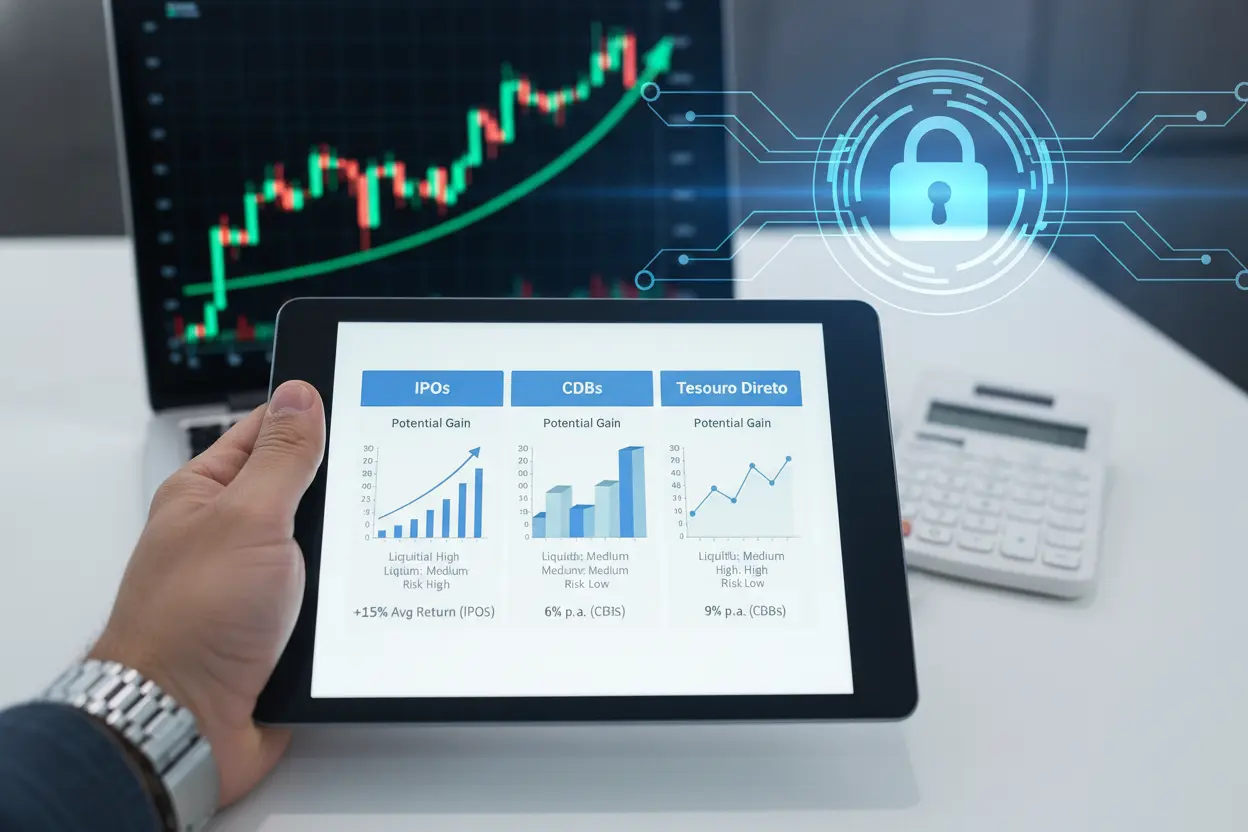
Tablet showing comparison of IPOs with other investments.
In addition to the operating fees, the investor must consider the government's share of the profits made.
Taxation of Capital Gains on IPOs
Financial success in an IPO is only complete when you understand how much of the profit will actually go into your pocket. The Internal Revenue Service has clear rules for Capital Gains obtained through the sale of shares on the Brazilian market.
The standard rate of 15%
For ordinary transactions (buying on one day and selling on another), the income tax rate is 15% on net profit.
It is the investor's responsibility to calculate the tax and issue the DARF by the last working day of the month following the sale.
The exemption rule for low sales
Individuals are exempt from tax if their total share sales for the month are less than R$ 20,000.00.
⚠️ Common mistake: Many people think that the exemption is on profit, but the rule applies to the total value of gross sales.
Difference to Day Trade
If you sell the IPO shares on the same day as the debut (the famous “flip”), the tax rate rises to 20%.
In this modality, there is no exemption for sales below R$ 20,000, and the lion taxes every cent of profit made.
📊 Real Economy Simulation: > - Scenario A: Sale of R$ 19,900 with a profit of R$ 5,000 -> Tax payable: R$ 0.00. > - Scenario B: Sale of R$ 20,100 with a profit of R$ 5,000 -> Tax payable: R$ 750.00. > Note that a small difference in the amount sold generates an immediate tax cost.
Knowing the costs and taxes, it remains to be seen whether the risk of a stock market debut is worth it compared to more traditional assets.
IPO vs. Other Investments: What's the Best Choice for You?
Comparing an IPO with fixed income or already consolidated shares is essential for maintaining balanced risk management. While newcomers promise explosive growth, traditional assets offer the predictability needed to preserve wealth.
Fixed Income and the security of the Selic
Em 2026, com a Selic estabilizada em patamares ainda atrativos, o Tesouro Direto continua sendo um forte concorrente.
A CDB with daily liquidity offers a guaranteed return, while an IPO can be highly volatile in the first few months of trading.
Consolidated stocks vs. newcomers
Companies that are already listed have a history of dividends and audited balance sheets for several years, which reduces uncertainty.
An IPO, on the other hand, is a bet on the future, where the investor agrees to take on more risk in exchange for accelerated appreciation potential.
The role of investment brokers
Use Investment Brokers robust, such as XP or BTG, facilitates access to exclusive analysis reports on the IPO.
These institutions help filter out which offers have solid fundamentals and which are just passing market euphoria.
| Type of Investment | Estimated risk | Return Potential | Liquidity |
|---|---|---|---|
| Selic Treasury | Very low | Average (Selic) | Daily |
| Blue Chips shares | Medium | Variable + Dividends | High |
| IPO (New Listing) | High | High (Growth) | Variable |
Best choice: For those looking for security, fixed income wins; for those looking to multiply capital in the long term, IPO is the superior option.
The choice between assets also depends on how the market behaves globally and the new listing modalities.
Trends and Innovations in the Global IPO Market
The international financial market is dictating trends that are likely to arrive in Brazil in full force in 2026. We have seen a change in the way companies present themselves to investors, prioritizing sustainability and technology.
The focus on ESG criteria
Companies that do not demonstrate a commitment to the environment, social and governance (ESG) face greater difficulty in going public.
Global institutional investors now require impact reports as a prerequisite for participating in any initial public offering.
The evolution of SPACs
Blank check companies (SPACs) have matured and offer an alternative route to traditional listings.
Although less common in Brazil than in the US, they represent a faster way for technology startups to access the capital market.
Digitalization and democratic access
Today, anyone with a digital account in a modern bank can book shares in an IPO by cell phone.
This digitalization has removed barriers to entry, allowing small investors to participate in offers that were previously restricted to millionaires.
For those who decide that an IPO is the way to go, the entry process requires attention to technical details on your platform of choice.
How to Participate in an IPO: Tips for Beginner Investors
Participating in a public offering requires more than just having money available; it requires strategy and technical reading. We've prepared a simple roadmap so you don't make any basic mistakes during your first share subscription.
Prospectus Analysis and Valuation
The prospectus is the official document in which the company details its financial health and plans for the future.
Check that the suggested price makes sense compared to companies in the same sector that are already listed on the stock exchange.
The booking period and price limit
During booking, you define how much you want to invest and the maximum price you are willing to pay for each share.
If the final price of Bookbuilding is greater than your limit, your order will be canceled automatically for your protection.
Choosing a broker and digital account
Have an account with a broker that offers zero fees for variable income in 2026 is a differentiator for its profitability.
Banks such as Nubank and Inter facilitate this process by integrating the investment platform directly with the banking application.
💡 Smart Strategy: Never put all your available capital into a single IPO. > Reserve only a small percentage (e.g. 2% to 5%) of your assets for this type of high-risk asset.
This content is for information purposes only and does not constitute financial advice. Please consult a 2026 expert before investing.
The universe of IPOs offers exciting opportunities to diversify your portfolio and seek significant returns. Understanding ‘how the ipo brasil initial public offering works’ is the first step towards making more assertive financial decisions. Don't miss the chance to invest in promising companies. Open your account with a partner ‘investment broker’ or ‘digital bank’ today and start building your financial future with intelligence and strategy. Remember: knowledge is your best ‘investment’!
FAQ - Common Questions About How the IPO Brazil Works
We have prepared this section to clarify the most frequently asked questions about new companies going public and how you can safely take advantage of these opportunities.
Although there is no universal minimum value set by B3, most offers establish a minimum reserve that usually varies between R$ 1,000.00 and R$ 3,000.00 for retail investors. We always recommend consulting the offer prospectus at your broker to check the specific limit for each operation.
Taxation follows the general rule for shares: tax rate of 15% on profit obtained from the sale of securities. We remind you that individual investors are exempt from income tax on total sales of up to R$ 20,000.00 within the same month, provided they are not Day Trade operations.
Investing in an initial public offering can be an excellent diversification strategy, but the return depends directly on the company's financial health and the economic cycle. We believe that, with the stabilization of interest rates, new windows of opportunity will emerge, requiring investors to focus on companies with a strong financial position. good fundamentals and governance.
The IPO is the first time the company goes public and is traded on the stock exchange, while the Follow-on is a subsequent offering of shares in a company that is already listed. Understanding how the IPO Brazil works is the first step for anyone wishing to capture the growth of a company from its “birth” on the capital markets.
Yes, there is a withdrawal period provided for in the schedule, but it has strict rules and short deadlines. If the final price defined in the Bookbuilding is out of your range of interest or there are significant changes to the prospectus, we advise you to contact your broker immediately to cancel the order within the legal deadline.