

Have you ever stopped to think that keeping all your money in Brazil is, statistically speaking, an unnecessary risk? Invest Globally It is no longer a luxury for millionaires but has become a necessity for financial survival. If you're looking for How to Invest in Global Index Funds, you've come to the definitive guide.
In this article, I not only explain the ‘how,’ but also reveal the strategies that top managers use to protect capital against local volatility.
The Current Situation: Why Step Outside Your Comfort Zone?
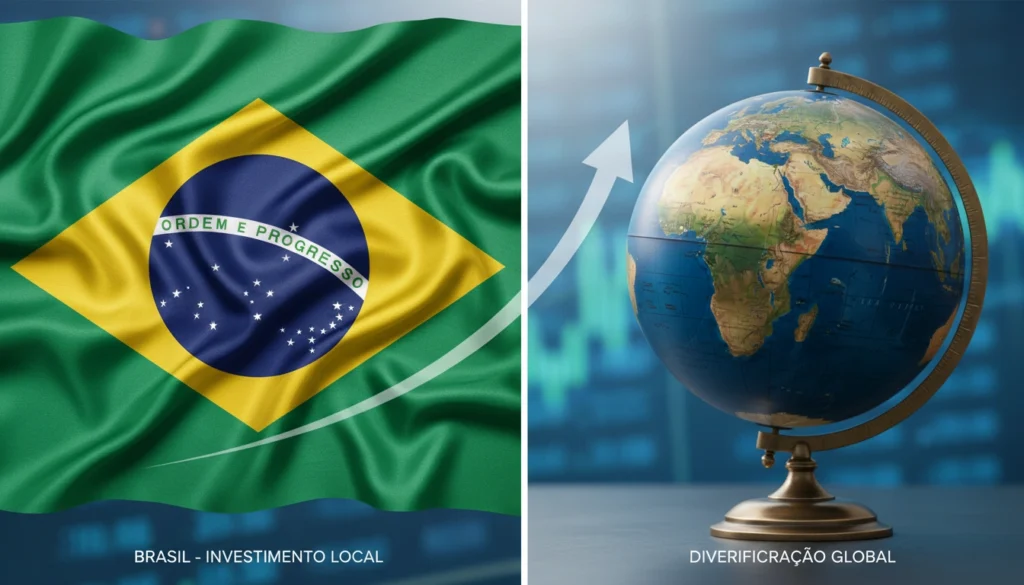
First, it is crucial to understand the big picture. Brazil accounts for less than 2% of the global financial market. Consequently, by ignoring international investment, you are turning your back on 98% of the planet’s profit opportunities.
In addition, geographic diversification serves as a safeguard against domestic crises and runaway inflation.
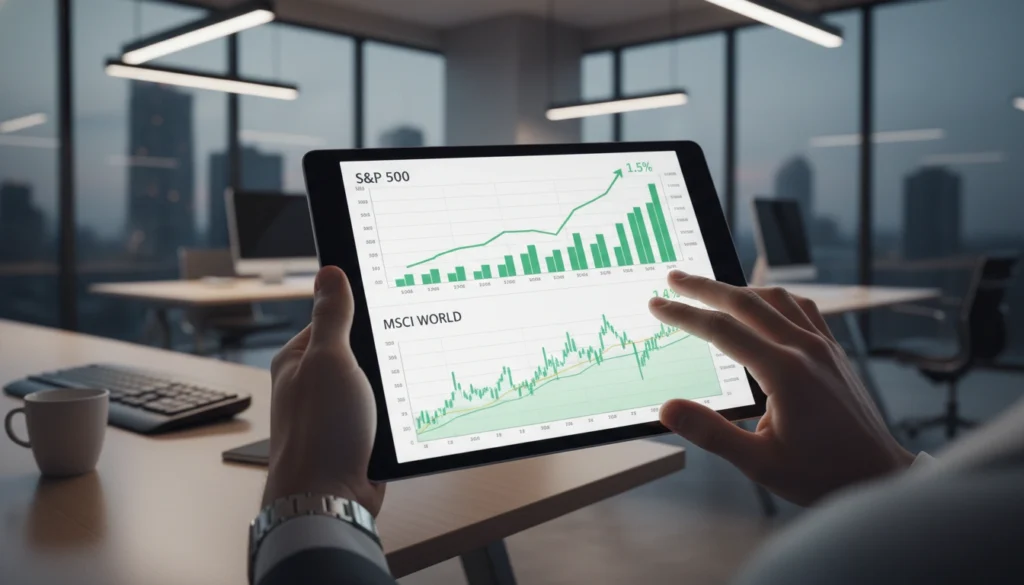
However, many novice investors hesitate to take action because they find the process too bureaucratic. The good news? It's never been easier to access the S&P 500 or MSCI World. Today, with just a few clicks, you can become a partner in the world's largest companies.
What Are Global Index Funds?
Before we open the home broker, we need to choose the investment vehicle. Index funds, which are generally structured as ETFs (Exchange Traded Funds), are baskets of assets that track a market index. Instead of trying to predict which company will rise (stock picking), you buy the entire market.
For example, when investing in a fund that tracks the index MSCI ACWI, you are, indirectly, investing in thousands of companies in developed and emerging countries. Thus, the specific risk of a single company going bankrupt is reduced to almost zero.
“The most logical way to invest is to buy a share of the entire market and hold onto that investment forever.” — John Bogle, founder of Vanguard.
Ways to Invest: BDRs vs. Global Account
There are, essentially, two main options for Brazilian investors:
- Via B3 (Brazil): Through local ETFs or ETF BDRs.
- Via International Account: Investing directly in dollars abroad.
On the other hand, each option has different tax and operational implications. Let's take a look at the technical details below.
Technical Table: Comparison of Investment Vehicles
| Features | ETFs on B3 (e.g., WRLD11) | ETF BDRs (e.g., BIVW39) | Direct Investment (e.g., mutual funds in the U.S.) |
|---|---|---|---|
| Trading Currency | Real (BRL) | Real (BRL) | Dollar (USD) |
| Foreign Exchange Exposure | Yes (Dollarized) | Yes (Dollarized) | Yes (Assets in Dollars) |
| Dividends | Automatically Reinvested | Paid (after taxes) | Paid (Taxed under 30% in the U.S.) |
| Ease of use | Registration (Local Brokerage Firm) | Registration (Local Brokerage Firm) | Average (Global Brokerage Firm) |
| Foreign Exchange Spread | Implicit in the quota | Implicit | Pay on delivery (1% to 2%) |
| Taxation (Sales) | 15% on profit | 15% on profit | 15% on Profits (Law 14,754) |
What is the best global index fund for beginners?
For those who are just beginning to understand How to Invest in Global Index Funds, simplicity is the key. The WRLD11 (on B3) is often cited by experts as the ideal gateway.
It tracks the Vanguard Total World Stock ETF, covering more than 9,000 companies around the globe. In addition,, since it is traded in reais, you don't need to worry about exchange rates at the time of purchase, although the asset's value fluctuates based on the dollar.
If you choose to open an account with a foreign broker (such as Nomad, Avenue, or Inter Global), the ticker VT (Vanguard Total World Stock ETF) is the “parent fund” of WRLD11, with negligible management fees (about 0.07% per year).
Step by Step: How to Invest in Practice
Now that the theory is clear, let's move on to the practical side. Follow this step-by-step guide to avoid mistakes:
- Choose Your Structure: Decide whether you want the convenience of B3 or the legal protection of an offshore account.
- Open an Account: If you're trading on B3, any brokerage firm will do (XP, Rico, BTG). If you're trading overseas, have your documents verified by a global brokerage firm.
- Analyze the Ticker: Search for the fund code. Examples: IVVB11 (S&P 500), WRLD11 (World), EURP11 (Europe).
- Set the Contribution: Start with amounts you won't need in the short term. Remember: it's variable income.
- Execute the Order: Enter the code and the quantity, and purchase at market price.
In short, the process is identical to buying a Petrobras stock, but with a much more robust underlying asset.
Is it safe to invest in global index funds?
Yes, it is one of the safest ways to invest in equities. However, security does not mean the absence of volatility. The global market fluctuates.
Here, "safety" refers to diversification: it is highly unlikely that the world's 9,000 largest companies would all go bankrupt at the same time. If that were to happen, we would face problems far greater than the stock exchange to solve.
Expert Tips for Maximizing Returns
- Recurring Contribution: Don't try to time the market. Buy a little bit every month. This lets the average price work in your favor.
- Reinvestment: If you choose assets that pay dividends, reinvest them immediately. The effect of compound interest in U.S. dollars is powerful.
- Note regarding the IOF: If you invest abroad, take into account the IOF tax of 1.1% (which will gradually decrease to zero by 2028) and the foreign exchange spread on remittances.
“The risk comes from not knowing what you’re doing. Diversification is the protection against ignorance.” — Warren Buffett.
Quick Action Checklist
- Set the percentage of the portfolio allocated to foreign investments (e.g., 20%).
- Choose between B3 (BDR/ETF) or a Global Account.
- Check brokerage fees (prefer Zero Fee).
- Make the first payment this week.
- Set up automatic monthly contributions.
Verdict: Is it worth it?
Without a doubt. Learning How to Invest in Global Index Funds It is a turning point in the life of a Brazilian investor. Therefore, the question isn't “whether” you should invest, but “when.” And the answer is: now.
Currency hedging, combined with the growth of the world’s largest economies, offers a risk-return profile that the CDI will never be able to match in the long term.
Expert's note: 4.9/5 ⭐ (It loses only a few tenths of a point due to the initial difficulty in understanding the latest developments in international taxation).
FAQ: Frequently Asked Questions
No. With as little as R$ 100.00, you can already buy shares of ETFs such as IVVB11 or WRLD11 on the Brazilian stock exchange.
On the B3, ETFs tracking global indices are subject to a 15% capital gains tax on proceeds from sales. Overseas, the new 15% rule applies to profits, in accordance with the Offshore Law.
O IVVB11 focuses solely on the 500 largest U.S. companies (S&P 500). The WRLD11 covers the entire world, including the U.S., Europe, Asia, and emerging markets.
Yes. If the dollar falls against the real, the value of your investment in reais may decrease, even if the foreign stocks rise. It’s a double-edged sword, but it serves as a hedge.
For smaller investments and convenience, BDRs/ETFs on B3 are the better choice. For larger portfolios and protection against country risk (confiscation, local laws), an overseas account is superior.