The world of investments may seem complex, but understanding how the futures market works for beginners is a crucial step for anyone looking to diversify and maximize profits. In this complete guide, Jeferson Santos, from the blog Fórmula da Riqueza, demystifies this segment of the market. variable income, by offering the financial education essential to building a solid foundation of security and success.
We'll cover everything from basic concepts to practical strategies, helping you to make smart financial decisions and choose the best platforms to start your investments.
What is the Futures Market and Why Invest?
Understanding how the futures market works for beginners requires looking at tomorrow's price today. We trade contracts that establish the purchase or sale of an asset on a specific date. This model of investment allows you to profit from both the rise and fall of commodities, currencies and indices.
Unlike buying a stock and waiting for years, the focus here is usually on the short term. We trade on market expectations about the value of the dollar or the Bovespa index. If we believe that coffee will rise due to the weather, we buy a futures contract now.
Many investors use this environment to protect their real assets. A corn producer, for example, locks in the selling price to avoid losses from sudden drops. We, as individual investors, seek volatility in order to make a quick return on our capital.
Liquidity is another key point that attracts new participants on a daily basis. It is very easy to enter and exit positions in seconds due to the high volume of trades. Thousands of mini-index and mini-dollar contracts change hands every minute at B3.
We believe that diversification is the greatest advantage of this market. You're not just tied to the performance of specific companies on the stock exchange. You can operate the global macroeconomic scenario through a single standardized contract.
The transparency of operations ensures that everyone sees the same prices in real time. This provides security for those taking their first steps now. Understanding how the futures market works for beginners opens doors to strategies that fixed income doesn't allow it.
Costs and Fees: How Much Do You Pay to Trade Futures Contracts?
Trading on the financial market involves costs that can eat into your profits if you don't plan ahead. In addition to brokerage fee, Then there are the emoluments and registration fees charged by B3. Each broker has a different pricing policy to attract new clients.
We observed that XP Investimentos and Rico dominate much of this scenario. XP usually offers zero brokerage packages for those who use the active RLP system. Rico, on the other hand, maintains an aggressive approach, focusing on low costs for the small investor.
| Institution | Brokerage (Mini Contracts) | Custody Fee | RLP Assets |
|---|---|---|---|
| XP Investments | R$ 0,00 (with RLP) | Zero | Yes |
| Rico Corretora | R$ 0,00 | Zero | Yes |
| B3 (Fees) | Variable by volume | N/A | N/A |
Os emolumentos são taxas fixas da bolsa de valores e incidem sobre cada contrato negociado. Eles funcionam como uma pequena comissão pelo uso da infraestrutura da B3. Mesmo com corretagem zero, você ainda verá esses pequenos débitos na sua nota de corretagem.
There is also Income tax, The tax rate is 20% on profits from Day Trade operations. For trades lasting more than one day, the rate drops to 15%. We always recommend setting aside a reserve to pay the DARF monthly and avoid fines.
Keeping a close eye on these costs separates the amateurs from the real professionals. High operating costs can turn a winning strategy into an accumulated loss. Always compare the benefits of each platform before making your first ticket.
Our recommendation is to choose brokers that offer zero brokerage, such as Rico. This allows you to test your strategies without the burden of fixed fees per order.
Credit cards and coins next to a laptop, representing the diversity of financial products and the importance of capital management.
Futures vs. Stocks: Which Investment is Best for You?
Choosing between futures contracts and shares depends directly on your risk appetite. In the variable income Traditionally, you buy a fraction of a real company. You become a partner, receive dividends and participate in the long-term growth of the business.
In the futures market, the logic is based on financial settlement and daily adjustments. You don't own the asset, but rather a contract that reflects its value. If the index rises by 100 points, the money goes into your account at the end of the day.
Understanding how the futures market works for beginners reveals that the agility here is superior. While a stock can take days to react to news, the future reacts instantly. This requires extra attention and a psychology that is much more prepared for fluctuations.
We realized that the futures market requires less initial capital to move large amounts. In stocks, if you want to buy R$ 10,000 worth of Petrobras shares, you need to have that amount. In futures, you only use a margin to trade the same amount.
Shares are ideal for those looking to build wealth and live off passive income. Futures, on the other hand, are for those who want to speculate or protect existing positions. Both can coexist in your portfolio in a harmonious and strategic way.
Our view is that shares form the base, while the futures market is the accelerator. Don't try to trade futures without having a solid emergency reserve in fixed income. Security must come before the pursuit of exponential short-term profits.
We recommend starting with shares if you are conservative and want to understand the dynamics of the stock market. If you already have experience and are looking for volatility, the futures market is the next logical step.
Step by Step: How to Start Investing in the Futures Market Safely
The first practical step is to open an account with a broker of trustworthy securities. We recommend names like Clear or Toro because of the ease of use of their platforms. The process is completely digital and usually only takes a few minutes to complete.
After registering, you will need to transfer funds from your digital account to the broker. This balance will serve as your margin for future trades. Margin is an amount that the stock exchange “locks up” to ensure that you pay any losses.
Learning how the futures market works for beginners involves choosing the right asset to start with. The mini-index (WIN) and the mini-dollar (WDO) are preferred by those who are just starting out. They have smaller minimum lots, which reduces the financial risk per trade.
Install a professional trading platform, such as ProfitPro or MetaTrader 5. These tools offer advanced graphics and technical analysis tools that are essential for success. Many brokers offer these platforms free of charge if you trade at least one contract per month.
Study the concept of daily adjustments to avoid surprises in your current account. Every day, the stock exchange calculates who has won and who has lost, making debits and credits. If you sleep positioned, this adjustment will happen automatically according to the price variation.
We suggest that you use the simulator for at least two weeks before using real money. Practicing in a risk-free environment helps you understand the speed of orders and how the book works. Operational security is what keeps investors alive in the long term.
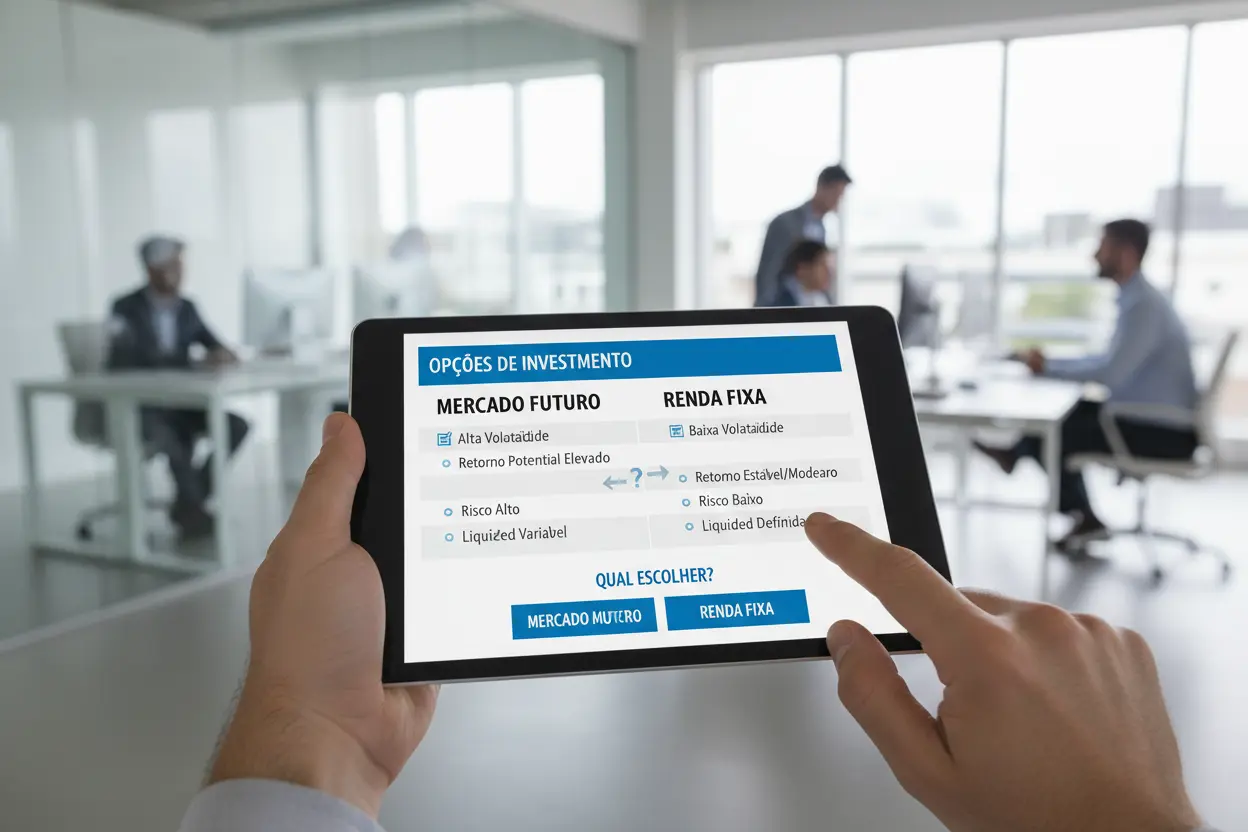
Hands holding a tablet with a comparative investment chart, highlighting the analysis for financial decisions.
Leverage and Risk Management: Maximizing Profits and Protecting Your Capital
A leverage is the most powerful and dangerous tool on the futures market for beginners. It allows you to move R$ 50,000 with only R$ 100 deposited as collateral with the broker. This disparity can generate incredible gains, but also losses that exceed your total capital.
I've seen many investors lose everything in an afternoon by ignoring risk management. They go in too “heavy”, trying to recoup previous losses with even bigger trades. The secret of success is not how much you win, but how much you accept losing.
Always set a “Stop Loss” before you even click the buy or sell button. A Stop Loss is an automatic order that closes your position if the price reaches a negative limit. We never trade without this protection, as the market can move unpredictably in seconds.
Calculate the size of your position based on your total available balance with the broker. A common rule of thumb is to never risk more than 1% of your capital on a single trade. If you have R$ 10,000, your maximum acceptable loss should be R$ 100 per trade.
Emotional discipline is what separates the winners from the losers in this highly competitive environment. The market has no feelings and doesn't care about your immediate financial needs. Respect its strategy and get out of front of the screen when you hit your daily loss target.
Understanding how the futures market works for beginners it is essential to master these risk calculations. Profit is the consequence of survival well executed over several weeks. Protect your capital as if it were your most precious asset, because in trading, it really is.
Brokers for the Futures Market: Choose the Best Platform for You
Choosing the ideal platform depends on your profile, whether it's more technical or focused on low costs. BTG Pactual, for example, offers robust advisory support and highly stable platforms. It is ideal for those who are looking for a premium service and are willing to pay for it.
Itaú Corretora has integrated the futures market directly into the bank's app for account holders. Although this is practical, the fees are often higher than at independent brokers focused on trading. We see Itaú as an option for those who prioritize extreme convenience.
Modalmais stands out for offering specific plans for traders who trade large volumes on a monthly basis. They have proprietary analysis tools that help you understand the order flow of the big banks. It's a solid choice for those who want to pursue the futures market as a profession.
| Broker | Ideal Profile | Main advantage |
|---|---|---|
| BTG Pactual | Professional Investor | Stability and advice |
| Modalmais | Active Trader | Flow Tools (Tape Reading) |
| Clear | Beginner / Low Cost | Zero Brokerage and Simplicity |
Analyze the platform's latency, which is the response time between your click and the execution. In the futures market, milliseconds can mean the difference between an unexpected profit or loss. Test customer service to ensure that you have help if a technical problem occurs.
We recommend Clear for those who are starting out and want to avoid fixed maintenance costs. For those who already have more capital and are looking for elite tools, BTG Pactual is unbeatable. The best broker is the one that doesn't crash at times of greater market volatility.
Know how the futures market works for beginners is only half the road to financial success. The other half is having the right tools and the support of a solid financial institution. Choose wisely and start small to gain confidence before increasing your lots.
This content is for information purposes only and does not constitute financial advice.
Consult an expert before making investment decisions.
To conclude, the futures market is one of the most dynamic ways to monetize capital today. With education, patience and the right tools, you can turn this environment into a source of income. Always remember that knowledge is your best shield against market risks.
FAQ - Common Questions About How the Futures Market Works for Beginners
We have prepared this section to clarify the most frequently asked questions and help you navigate this segment of variable income more safely.
The futures market is an environment where we trade contracts to buy or sell assets for a future date, based on price expectations. To understand how the futures market works for beginners, If you're a trader, imagine that you're trading the price fluctuations of assets (such as the dollar or an index) without needing to own the physical asset immediately.
No, because we use the guarantee margin, This allows you to move larger amounts than the capital you have in your account. However, it is essential to have a financial reserve to cover daily fluctuations, ensuring that operations are not closed prematurely due to lack of balance.
Mini-contracts (WIN and WDO) are reduced versions of full contracts, created specifically so that small investors can access the market with less capital. They have high liquidity and are the ideal entry point for those who want to learn in practice how the futures market works for beginners.
The main risk is leverage, This is why we always emphasize the importance of using stop-loss orders, which, while boosting our profits, can also accelerate losses if the market goes against our position. That's why we always emphasize the importance of using stop orders. stop loss and never commit your entire capital to a single operation.
Taxation follows the rule for variable income: we pay 15% Income Tax on the profit on position operations (more than one day) and 20% for Day Trade operations. It is our responsibility to calculate the tax monthly via DARF, deducting operating costs and brokerage.