
- What is it: Ibovespa futures contract on B3, at R$ 0.20 per point.
- How it works: Gains and losses are adjusted every day.
- Key risks: leverage; the loss may exceed the margin.
- Taxation: 20% for day trading and 15% for all other trades.
The mini index is a futures contract linked to the Ibovespa, traded on B3, and appears on the brokerage screen under the ticker symbol WIN. This guide explains how it works, how much each point is worth, why the margin can be misleading, and how taxes are calculated.
The text does not describe the operation or provide a table of contents. It compiles the information contained in the official documents and indicates where to find it.
What is the mini index?
The mini index is B3’s Ibovespa mini futures contract. Instead of buying the stocks in the index, traders take a long or short position in its future price change, measured in points. That is why the product is a derivative, not an equity interest in companies.
Each point on the mini index is worth R$ 0.20, and the smallest price change is 5 points, or R$ 1.00, according to the contract page on B3, accessed on October 31, 2026. The minimum lot size is one contract. To understand the index behind it, see What is the Ibovespa, and why is it important?.
How the mini index works: points, adjustment, and expiration
Those who buy a contract profit when the index rises and lose when it falls. Those who sell do the opposite. Thus, the mini index allows investors to take a position on either a rise or a fall, and there is risk on both sides.
The result is not determined until the end of the trade. B3 calculates a daily adjustment, which is the difference between the day’s settlement price and the trade price, multiplied by R$ 0.20 and the number of contracts. If the adjustment is negative, the money is deducted from the trader’s account.
Mini Index Code and Expiration Date
The code consists of "WIN," the letter of the month, and the two digits of the year. For example, WINZ26 matures in December 2026. Contracts expire in even-numbered months corresponding to the letters G, J, M, Q, V, and Z, and the contract expires on the Wednesday closest to the 15th.
The contract expires upon maturity. Therefore, maintaining exposure requires opening a position in the next contract, which is a decision made by the trader.
Trading Hours
According to B3 schedule page, WIN trading hours are from 9:00 a.m. to 6:25 p.m., and on the expiration date, the contract closes at 6:00 p.m. B3 may change trading hours via a circular, so it’s a good idea to check the website before trading.
Margin and Leverage in the Mini Index
To open a position, the brokerage firm requires a margin deposit—a deposit that covers potential losses. B3 publishes the minimum required margin: For day trading, the minimum price was set at R$ 155.00 per contract as of October 31, 2026, and each brokerage firm may charge more. For positions held overnight, the price set by B3 applies.
This deposit is small relative to the position. With the index at 170,000 points (hypothetical value), one contract is worth R$ 34,000. With a margin of R$ 155.00, the trader controls a position more than 200 times larger, and that is what is called leverage.
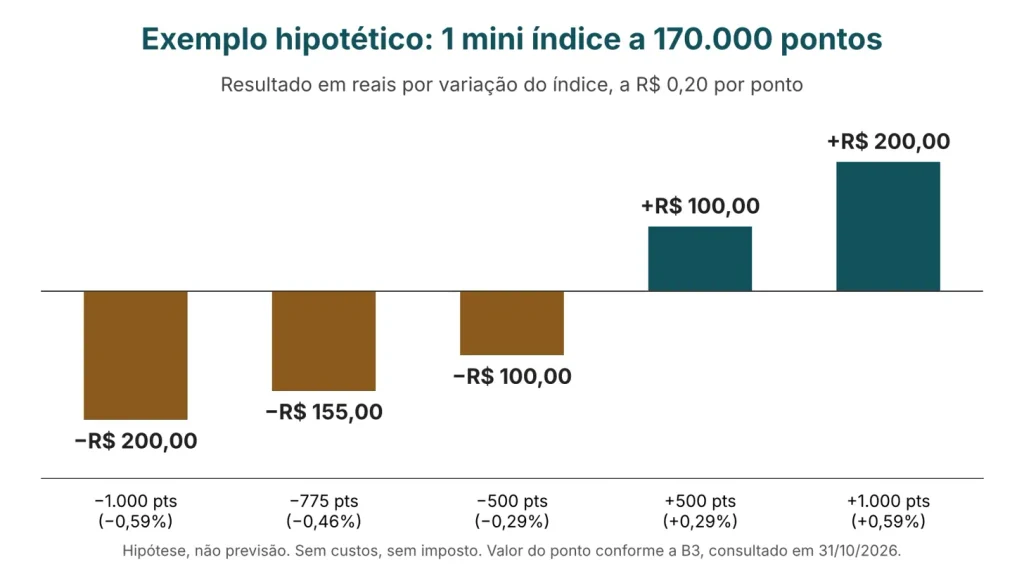
Leverage multiplies both gains and losses equally. If the loss exceeds the margin, the brokerage firm charges the difference, and the trader ends up in debt. In the example, a drop of 775 points—about 0.46% of the index—wipes out the entire deposit of R$ 155.00.
Tax on the mini-index: what the law says
Gains on the mini index are taxed as capital gains. The Law No. 11,033 of 2004, in Article 2, sets the rate at 20% of the net profit from day trading and 15% on other transactions. A transaction opened and closed on the same day is considered day trading, while one that carries over into the next day follows the standard rule.
The law also provides for a 1% withholding tax on day-trading gains, which serves as an advance payment of the tax and can be deducted from the amount due. The exemption for stock sales of up to R$ 20,000 per month does not apply to day trading or futures contracts.
The calculation is done monthly. The net profit for the month—taking into account both positive and negative adjustments—determines whether tax is due, which must be paid via DARF using code 6015 by the last business day of the following month, according to the Investments Portal. A loss from a day trade can only be offset by a gain from a day trade, and the same applies to regular trades.
What Has Changed and What Hasn't
Status as of October 31, 2026, in accordance with the legal text.
- What has changed: No tax rate changes took effect. Provisional Measure 1,303/2025 proposed a flat tax rate of 17.5% on gains from variable-income securities, but it was withdrawn from the agenda on October 8, 2025, and expired, according to the COAD.
- What hasn't changed: The 20% rate for day trading and the 15% rate for other transactions under Law 11.033/2004 remain in effect, as set forth in the text of the Chamber of Deputies.
Risks and What Studies Show
The first risk is market risk: the index can move against your position in a matter of minutes. The second is leverage, where the loss exceeds the margin. There is also operational risk, such as a loss of connection or an order executed at a price different from the expected one, and cost risk, because brokerage fees, commissions, and taxes reduce the profit.
The available figures paint a grim picture. The study by Fernando Chague and Bruno Giovannetti of FGV, using data from the CVM, tracked 19,696 people who started trading on the mini index between 2013 and 2015. Of these, 92.1% dropped out, and among the 1,558 who traded for more than 300 trading sessions, about 91% suffered losses, according to the Your Money.
Another survey, conducted by FGV EESP, found that 968,512 people engaged in day trading during the pandemic, and together they lost R$ 9.9 billion, according to the Monitor Mercantil. These are specific examples, and past performance is no guarantee of future results. They are intended to help assess risk, not to predict the outcome.
Hypothetical example: How much does the mini index fluctuate in reais?
| Change in the index | Points | About 170,000 points | 1 contract found |
|---|---|---|---|
| A drop of 1,000 points | −1,000 | −0.59% | −R$ 200.00 |
| A drop of 775 points | −775 | −0.46% | −R$ 155.00 |
| A drop of 500 points | −500 | −0.29% | −R$ 100.00 |
| Up 500 points | +500 | +0,29% | +R$ 100.00 |
| A 1,000-point rise | +1.000 | +0,59% | +R$ 200.00 |
If the index were at 120,000 points, the position would be worth R$ 24,000, but 1,000 points would still be worth R$ 200.00. In other words, the value in reais per point does not depend on the index level; what changes is the relative weight of the fluctuation, which would go from 0.59% to 0.83%.
How to Evaluate Before Making a Decision
This text doesn't say whether it's worth trading, because that depends on your goals, time horizon, capital, and risk tolerance. What you can do is apply certain criteria. If you want to learn more, you can read about Day Trading and Its Risks and about Futures Market for Beginners.
- Position size: Look at the total value of the contract, not just the margin.
- Loss in reais: Calculate how much each point costs and how many points it takes to empty the account.
- Total cost: excluding brokerage fees, charges, taxes, and the margin required by the brokerage firm.
- Contract Terms: Check the trading hours, expiration date, and code on B3.
- Routine: Day trading requires monitoring during trading hours.
See also: How to Report Investments on Your Income Tax Return
Frequently Asked Questions
How much is each point of the mini index worth?
Each point is worth R$ 0.20, and the minimum fluctuation is 5 points, or R$ 1.00, according to B3. Thus, 1,000 points are equivalent to R$ 200.00 per contract.
Is it possible to lose more than the margin on the mini index?
Yes. The margin is a guarantee, not a loss limit. If the daily settlement exceeds the deposited amount, the brokerage firm charges the difference.
How do I report the gain on my income tax return?
Using the "Variable Income" tab, under the "Common Transactions/Day Trade" option, with monthly results broken down by type and DARF 6015 forms posted under "Tax Paid/Withheld." Verify this in the Federal Revenue Service program.
Is the mini index suitable for beginners?
This product is a leveraged derivative, and the studies cited show high dropout rates and a high loss rate. This does not predict your results, but it does call for caution and consultation with a qualified professional.
The mini index converts each point of the Ibovespa into a gain or loss of R$ 0.20, with a small margin and no fixed upper limit on losses. Before making any decision, check the rules on B3 and the tax provisions in the law.
- B3, the Future of Ibovespa (accessed on October 31, 2026)
- B3, minimum margin requirement (accessed on October 31, 2026)
- B3, index trading hours (accessed on October 31, 2026)
- Chamber of Deputies, Law No. 11,033 of 2004 (accessed on October 31, 2026)
- Investments: How to Report Futures Trading (accessed on October 31, 2026)
- COAD, MP on the Taxation of Investments (accessed on October 31, 2026)
- Your Money, a study on day trading (accessed on October 31, 2026)
- Monitor Mercantil, a study on day trading during the pandemic (accessed on October 31, 2026)
Notice: This content is for educational and informational purposes only. It does not constitute an investment recommendation, advisory service, or securities analysis, and does not take into account your situation, your objectives, or your risk tolerance. All investments involve risks, and past performance is no guarantee of future results. Rates, taxes, and regulations are subject to change: the data was sourced from the official sources indicated, as of the date stated at the beginning. Consult a licensed professional before making a decision. Illustrative images, when created by artificial intelligence, do not depict real institutions, products, or people.