


What is Gross Domestic Product?: O Gross Domestic Product (GDP) is an important economic indicator. It helps measure the performance of the economy of a country, state or city. But do you know what the GDP and why is it so important?
O GDP adds up all the final goods and services produced in a year. This includes cars, computers, education, health and transportation. Thus, it measures final production, without counting intermediate products.

GDP also takes into account the value of products and services in the final price. This includes taxes. So GDP shows the flow of new goods and services produced, not the total wealth of a country.
Definition of Gross Domestic Product
O Gross Domestic Product (GDP) shows the value of everything produced in an area. This includes final goods and services. O Brazilian Institute of Geography and Statistics (IBGE) calculates the GDP in Brazil every three months.
What is GDP?
GDP adds up the value of everything that is produced and reaches the consumer. It does not include products that are used to make other goods. This avoids double counting.
Final products taken into account when calculating GDP
- Consumer goods (food, clothing, household appliances, etc.)
- Services (education, health, transportation, entertainment, etc.)
- Investments (machinery, equipment, buildings, etc.)
- Government spending (health, education, security, etc.)
- Exports (minus imports)
Thus, the GDP measures the economic activity of an area. It is a key indicator for understanding the economic growth and a country's development.
Importance of Gross Domestic Product
O Gross Domestic Product (GDP) is essential for understanding economic growth. It shows how a country's economy changes over time. It also helps to compare different regions and countries.
Analysis of economic growth
GDP is calculated by the IBGE in Brazil. They use data from various places, such as the Bank and the Federal Revenue Service. This way, we can see whether the economy is growing or shrinking.
Comparing regions
GDP figures show that São Paulo has the highest GDP in Brazil. This is followed by Rio de Janeiro, Minas Gerais, Rio Grande do Sul and Paraná. This helps to see where the economy needs to improve.
Although GDP is important, it doesn't show everything. It doesn't show income distribution or quality of life. That's why it's best to look at GDP in conjunction with other social data.
"GDP helps us understand a country, but it doesn't express important factors such as income distribution, quality of lifeeducation and health."
Calculating Gross Domestic Product
O Gross Domestic Product (GDP) is calculated using data from various sources. The Brazilian Institute of Geography and Statistics (IBGE) is one of them. This data includes industrial production and trade sales.
Other important data are services provided and investments. Exports and imports are also taken into account. All these economic indicators help to understand GDP.
The formula for calculating GDP is: GDP = CF + IP + GG + BC. Here, FC is Household Consumption, PI is Private Investment, GG is Government Spending and BC is Trade Balance. This equation shows the variables that affect the calculation of Gross Domestic Product.
O GDP per capita is calculated by dividing the GDP by the population. This measure helps to see how income is distributed among the people of a place.
"O GDP per capita is obtained by dividing the Gross Domestic Product by the total population of a country or region, providing a view of the generation of income proportional to the inhabitants."
However, GDP has limitations. It doesn't show how income is distributed. That's why it's necessary to use other measures to better understand a country's economy and society.
What is Gross Domestic Product?
O Gross Domestic Product (GDP) helps us understand a country's economy. It adds up all the goods and services produced in a year. It shows how the economy is growing.
O meaning of Gross Domestic Product shows the wealth of an area. It's often used by policymakers and analysts. They use it to decide on strategies.
In 2020, the Brazil's GDP grew by 4.1%. In 2021, was 4.6%. São Paulo has the highest GDP, with R$ 1.248 trillion. This represents 33.10% of the country's total.
O Rio de Janeiro has a GDP of R$ 407 billion. That's 10.80% of the national total. Minas Gerais contributes R$ 351 billion, 9.30% of the total.
Thus, the Gross Domestic Product is crucial to understanding the economy. It helps to compare and make better policies.
"GDP is a fundamental indicator for understanding a region's economic performance."
Nominal GDP vs Real GDP
When we talk about the Gross Domestic Product (GDP), it is crucial to know the difference between the Nominal GDP and Real GDP. O Nominal GDP is the current value, i.e. the year in which it was produced. The Real GDP is adjusted to old prices, without inflation.
Use the Real GDP helps to better understand economic growth. This is because it only shows changes in the quantity produced. Thus, we see the performance of the economy without the influence of prices.
Difference between nominal and real GDP
The big difference between Nominal GDP and Real GDP is how they consider prices. O Nominal GDP takes current prices into account. The Real GDP ignores inflation, showing only changes in the quantity produced.
- O Nominal GDP can show higher growth, as it doesn't take inflation into account.
- O Real GDP is a more accurate measure of economic growth, taking inflation out of the equation.
- To see how the economy has grown over the years, the Real GDP is more reliable.
"For a more consistent and accurate analysis of economic growth, it is recommended to use the Real GDPwhich only takes into account variations in the quantities produced."
Compare the Nominal GDP and Real GDP gives us a clearer view of the economy. So we can see whether growth comes from higher prices or more production.
GDP deflator
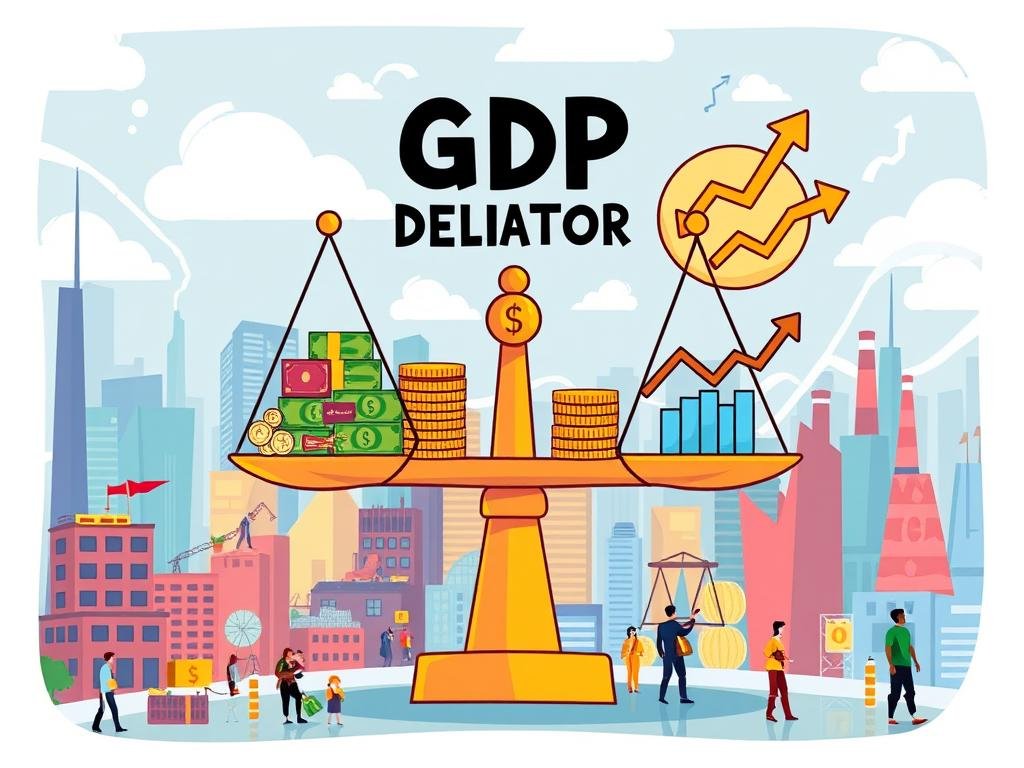
O GDP deflator helps to understand economic growth. It transforms Nominal GDP in Real GDPapart from inflation. This shows better how the economy is doing and how people are feeling.
To calculate, divide the Nominal GDP by Real GDP and multiply by 100. This number shows how the prices of everything have changed compared to a year earlier.
For example, a deflator of 105 means that prices have risen by 5% compared to the previous year. Thus, the GDP deflator shows the inflation of everything that is produced, not just a few items.
O GDP deflator is widely used to make economic policies. It helps adjust government spending and other economic things due to real inflation.
"The GDP deflator is probably the price index more comprehensive, as it takes into account information unavailable in other inflation indices."
In conclusion, the GDP deflator is very important for understanding economic growth. It helps to see how prices change and how people are feeling.
GDP and PIL
Gross Domestic Product (GDP) and Net Domestic Product (PIL) are very important in the economy. But GDP doesn't take depreciation into account. The PIL yes, better showing the value that the economy gains.
Depreciation is when capital goods lose value. O PIL is the GDP minus this loss. In this way, it shows the real wealth the country has.
| Indicator | Definition | Calculation |
|---|---|---|
| Gross Domestic Product (GDP) | Sum of all goods and services produced within a territory in a given period. | Sum of government spending, investments, final consumption and net exports. |
| Net Domestic Product (NDP) | Total value added to the economy after discounting capital depreciation. | GDP - Depreciation |
Thus, the PIL better shows what the economy gains. This is because it takes into account the loss in value of assets. Understanding the difference between GDP e PIL helps a lot in economic analysis.
How GDP is calculated
O calculation of Gross Domestic Product (GDP) can be done in three ways. They are: expenditure perspective, supply side e income perspective. Each one shows a different part of a country's economy.
Expenditure
In expenditure perspective, o calculation of Gross Domestic Product comes from spending on goods and services. This includes what households and the government spend, investments and the difference between exports and imports. The formula is: GDP = C + I + G + (X - M).
Supply Side
In supply side, o GDP calculation comes from gross value added (GVA) of companies. GVA is the difference between what companies produce and what they spend. Adding taxes gives calculation of Gross Domestic Product.
Income Optics
In income perspective, o calculation of Gross Domestic Product comes from factor incomes. This includes salaries, profits, interest and rents, all together in the account Gross Operating Surplus (GOS). Adding together the income from labor and capital gives the GDP.
These three ways of calculating Gross Domestic Product give a complete picture of a country's economy. They help to better understand the economy and to make more effective economic policies.
GDP and GNP
O Gross Domestic Product (GDP) and Gross National Product (GNP) are important economic measures. They show a country's economic activity. But there is a big difference between them.
O GDP Just look at the production within the country. It doesn't matter who made it. The GNP looks at the population's income. This includes production done outside the country by people from the country.
The big difference is Net Income Sent Abroad (NER). GDP doesn't count on it. But GNP yes. That's why GNP is lower than GDP in countries like Brazil.
| Indicator | Definition |
|---|---|
| GDP | Total value of the production of goods and services within the borders of a country, regardless of the nationality of the agents. |
| GNP | Total value of the production of goods and services generated by the population of a country, including production carried out abroad. |
O GDP is widely used by the Brazilian government. But the GNP is more commonly used in developed countries. This is because the income sent abroad is lower in these countries.
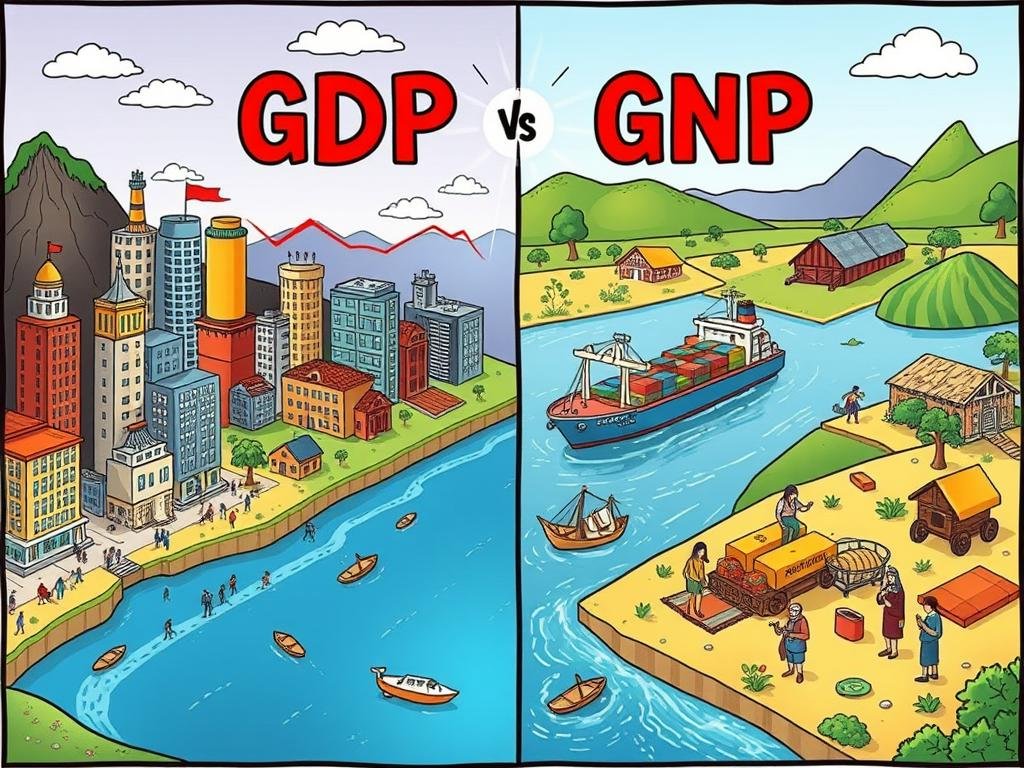
It is very important to understand the difference between GDP and GNP. It helps to see how a country is doing economically. And also how rich the country's population is.
GDP per capita
O GDP per capita shows the average value of Gross Domestic Product (GDP) per person. It divides the total GDP by the population. This gives an idea of the standard of living and the quality of life of people.
However GDP per capita does not show how wealth is distributed. Countries with high GDP per capita can have unequal wealth among its citizens.
| Year | Brazil | Northern Region | Northeast Region | Southeast Region | Southern Region | Central-West Region |
|---|---|---|---|---|---|---|
| 1995 | R$4,528.49 | R$2,669.79 | R$1,889.29 | R$6,294.24 | R$4,942.22 | R$5,776.49 |
| 2000 | R$6,946.35 | R$4,008.00 | R$3,075.47 | R$9,498.05 | R$7,737.01 | R$8,500.24 |
| 2005 | R$11,658.10 | R$7,241.44 | R$5,498.82 | R$15,468.75 | R$13,205.96 | R$14,605.74 |
| 2008 | R$15,989.77 | R$10,216.48 | R$7,487.55 | R$21,182.67 | R$18,257.78 | R$20,372.09 |
This table shows how GDP per capita changed in Brazil and its regions from 1995 to 2008. The Southeast has the highest values. The Northeast has the lowest. This shows the country's economic and social differences.
In 2023, the GDP per capita of Brazil was R$ 10.9 trillion. O GDP of the last quarter (2nd quarter of 2024) was R$ 2,887.7 billion.
O GDP per capita helps to compare economic growth between countries and regions. It also shows the quality of life of people. But it's good to look at other things, such as income distribution and the Human Development Index (HDI)to better understand social welfare.
Limitations and criticisms of GDP
Gross Domestic Product (GDP) is an important economic indicator. But it has limitations large. For example, GDP doesn't look at income distribution or to quality of life. Nor does it look at environmental sustainability and social development.
Some say that GDP is not a good measure of a population's well-being. They suggest using other development indices. Like the Human Development Index (HDI), which looks at education, health and income.
According to UNESCO (2022), culture and creativity make up 3.1% of the world's GDP. They employ 6.2% of workers. Countries like Portugal and France have created Culture Satellite Accounts (CSC) to measure these sectors.
In Brazil, measuring the GDP of culture and creativity is difficult. This is because many activities are informal. And also because unpaid work is common. This means that the GDP figures for these areas are either underestimated or overestimated.
"Traditional methods of calculating GDP, which use the product and expenditure perspectives, can capture noise and overestimate the figures, since the level of disaggregation present in the national accounts does not make it possible to distinguish cultural activities and the creative industries from other activities."
That's why it's good to use other metrics in addition to GDP. This helps to better understand the development and well-being of a society.
Conclusion: What is Gross Domestic Product?
Gross Domestic Product (GDP) helps us to understand the economy of a place. It shows how a region is growing compared to others. But GDP doesn't show everything about a society's development.
GDP gives a general idea of the wealth of a period. But it doesn't take income distribution into account. Nor does it take into account quality of life, unpaid work or the impact on the environment.
Understanding GDP and its limitations helps a lot. You can use GDP together with other indicators. This way, you can better see the economic and social development of a place. This helps you make better decisions for the growth of your region.
FAQ
Q: What is Gross Domestic Product?
A: Gross Domestic Product (GDP) is an economic indicator. It adds up all the final goods and services produced in a country, state or city. This usually happens in one year.
GDP helps measure economic activity and growth. It makes it possible to compare different locations.
Q: Which final products are taken into account when calculating GDP?
A: When calculating GDP, only final goods and services that reach the consumer are counted. Intermediate products are not included. For example, if a country produces wheat, flour and bread, its GDP is the value of the bread.
Q: How important is the Gross Domestic Product?
A: GDP is an important economic indicator. It helps to analyze economic growth and make comparisons. It allows us to identify the most productive sectors.
Com o PIB, é possível ver como a economia evoluiu ao longo do tempo. Também ajuda a encontrar fragilidades e oportunidades de investimento.
Q: How is the Gross Domestic Product calculated?
A: GDP can be calculated in three ways: expenditure, supply and income. On the expenditure side, GDP is calculated by spending on final goods and services. On the supply side, it is calculated by the gross value added by companies. On the income side, it is calculated by the return on productive factors.
Q: What is the difference between nominal GDP and real GDP?
A: Nominal GDP is calculated at current prices. Real GDP, at constant prices, so as not to take inflation into account. Real GDP is more recommended for consistent analysis.
Q: What is the GDP deflator?
A: The GDP deflator measures the change in prices from one year to the next. This index adjusts prices to obtain the Real GDP. Thus, all prices are standardized for more accurate analysis.
Q: What is the difference between GDP and PIL?
A: GDP doesn't take capital depreciation into account. PIL, on the other hand, takes this depreciation into account. Therefore, PIL better reflects the value added to the economy.
Q: What is the difference between GDP and GNP?
A: GDP doesn't take into account income sent abroad. GNP does. GNP therefore better reflects the income generated by a country's population.
Q: What is GDP per capita?
A: O GDP per capita is the average GDP per inhabitant. It is calculated by dividing the total GDP by the population. It is used to measure the standard of living and quality of life.
Q: What are the limitations of the Gross Domestic Product?
A: GDP is important, but it has limitations. It doesn't take into account income distribution, quality of life and environmental sustainability. Some suggest using the Human Development Index (HDI) to assess well-being.
Source links
- Personal Finances How to Organize
- Gross Domestic Product - GDP
- Gross domestic product
- Gross Domestic Product (GDP) | Glossary | CFP
- What is the difference between Nominal GDP and Real GDP? | Igor Barenboim
- GDP: how it is calculated and what it indicates for the economy
- What is Gross Domestic Product (GDP) and how is it calculated?
- Deflator: how does this monetary correction indicator work?
- GDP Deflator | Glossary | CFP